
China’s New Drone Export Controls: Impact on Russia’s War in Ukraine

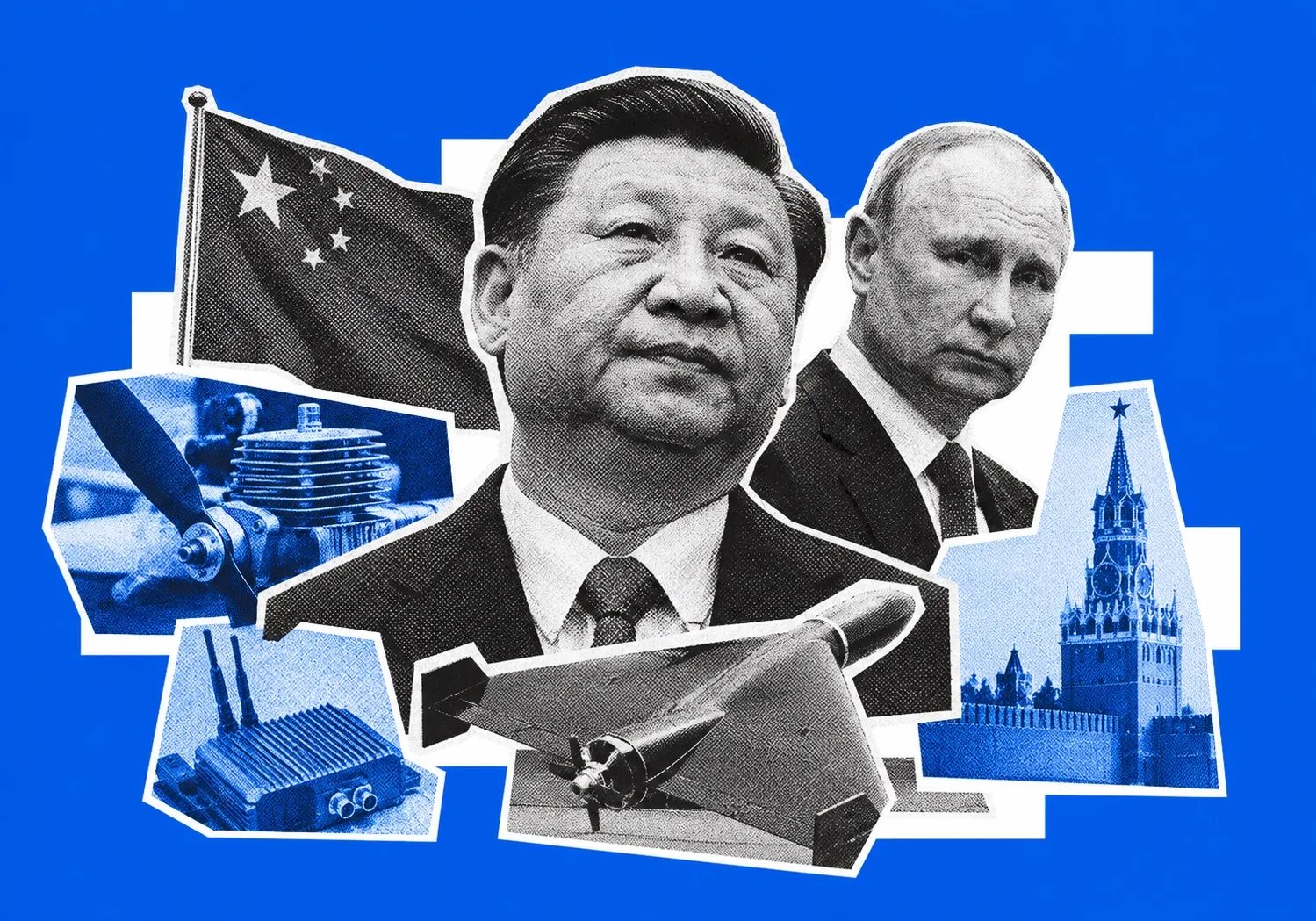
China’s new export controls on dual-use drone engines and radio equipment took effect on November 18, coinciding with Vladimir Putin’s visit to Shenzhen. While the licensing rules could complicate Russian military supply chains and aid European sanctions enforcement, they stop short of cutting off Chinese components used in Russian strikes against Ukraine.
Announced a month earlier, the measures were issued jointly by China's Ministry of Commerce, General Administration of Customs, and the Equipment Development Department of the Central Military Commission. Although Moscow has repeatedly bypassed Western sanctions through intermediaries and shipments disguised as civilian goods, the new rules add another layer of scrutiny. Their real impact on Russian drone production will depend on how Chinese authorities assess end-use and enforce the restrictions.
What China has restricted
Under Announcement No. 49, exporters must obtain authorisation before shipping certain categories of unmanned aircraft equipment.
The list includes aviation engines with maximum continuous power exceeding 16 kilowatts and turbojet engines producing at least 400 newtons of thrust. Certain specialised engines designed for high-altitude flight are also covered.
Radio communications equipment faces controls when it meets specified technical criteria. These include airborne systems with an equivalent isotropically radiated power of at least 30 dBm or systems capable of controlling more than ten aircraft from a single station.
The regulations also cover particular brushless motors, electronic speed controllers, carbon-fibre propeller blades, autopilots and technologies associated with flight control and navigation.
These are not blanket restrictions on every drone component manufactured in China. Each category is defined by technical specifications, and exporters must determine whether their products fall within the controlled range.
Chinese customs authorities can also question shipments whose declared specifications appear inconsistent with the regulations. Goods may be held while their classification is examined.

Crucially, the rules establish a licensing system rather than an absolute prohibition. Chinese authorities retain the power to approve exports that satisfy their requirements, while certain exporters can qualify for simplified procedures or general licences.
Why Russian drone manufacturers depend on Chinese equipment
The importance of Chinese components to Russia's military industry has been documented in investigations published over the past two years.
In July 2025, Reuters reported that Chinese-made engines were being shipped to Russian drone manufacturer IEMZ Kupol through intermediary companies, with some consignments described as industrial refrigeration equipment.
According to documents and European security officials cited by the agency, these shipments helped sustain production of the Garpiya-A1 attack drone despite sanctions targeting its supply chain.
The investigation identified L550E engines manufactured by Xiamen Limbach Aviation Engine, a Chinese company previously linked to the Russian drone programme.
Reuters also examined an internal company document indicating that Kupol had contracted to manufacture more than 6,000 Garpiya drones in 2025, compared with 2,000 in 2024.
Those figures illustrate how rapidly Russian production was expanding and why maintaining access to imported components became strategically important.
However, the newly controlled engine categories cannot automatically be equated with every Chinese engine previously identified in Russian weapons. Whether a particular model is affected depends on its technical characteristics and classification under the new rules.
That distinction matters when assessing the potential military consequences.
Communications equipment presents another vulnerability
Engines are only part of the supply chain.
In October 2026, investigative outlet The Insider reported that Chinese manufacturer Shenzhen Xingkai Technology had supplied, or offered to supply, mesh communications equipment associated with Russian Geran and Gerbera drones.
Mesh networks allow multiple devices to relay communications between one another. In military applications, this can extend the reach of remote-control systems and support communications between aircraft operating at different distances.
The Insider's investigation involved examining a modem recovered from a Russian drone in Ukraine and contacting the manufacturer while posing as a potential Russian military supplier.

The journalists reported receiving a quotation for 500 modems worth approximately $2.87 million. They also estimated that Xingkai accounted for roughly half the market for powerful mesh modems used in Geran and Gerbera systems.
The findings highlighted how commercially available Chinese communications technology could become part of Russia's military infrastructure.
China's new regulations cover certain high-powered radio systems, potentially creating additional licensing requirements for equipment used in drone communications.
Yet the restrictions do not establish that every mesh modem used by Russia is now controlled. Individual products must meet the relevant technical criteria.
The components that remain outside the restrictions
The limitations of China's measures are as important as their scope.
The November announcement does not impose a general prohibition on satellite navigation receivers, CRPA anti-jamming antennas, cameras, LTE modems, ordinary microchips or relays.
Such components have appeared in investigations of Russian drones and missiles, including Geran-series aircraft and longer-range weapons.
Some specialised navigation and flight-control technologies are covered by the regulations, but this does not mean that every finished navigation module or electronic component requires a licence under the new announcement.
Russia could therefore retain access to substantial parts of the electronics supply chain, provided the products are not covered by other applicable restrictions.
Another uncertainty is the extent of Russian import substitution. Moscow has invested in domestic production of selected drone components, including engines, as it attempts to reduce dependence on foreign suppliers.
Where Russian alternatives are already available, Chinese export controls may increase costs or complicate procurement without stopping production.
For components that remain difficult to replace, licensing delays or denied applications could have more significant consequences.
Why the timing of Putin's visit matters
The restrictions took effect on November 18, the date of Putin's reported arrival in Shenzhen for high-level talks.
The coincidence has political significance, particularly given the scrutiny surrounding China's commercial relationship with Russia during the war in Ukraine.
But the chronology limits what can reasonably be concluded.
Beijing published the measures on October 19, four weeks before they entered into force. The Chinese government also said that countries and regions participating in its export-control dialogue mechanisms had been notified in advance.
There is no evidence in the published announcement that the regulations were designed specifically as a response to Putin's visit or as a punitive measure against Moscow.
China presents the changes as an adjustment to its wider system for regulating dual-use technologies.
Its Ministry of Commerce has stated that the controls are intended to protect national security, meet non-proliferation obligations and maintain stable international supply chains.
Beijing has also emphasised that compliant civilian trade should continue.
The distinction between the official explanation and the possible geopolitical implications is essential. A regulation that creates obstacles for Russian procurement does not necessarily indicate a broader diplomatic break between China and Russia.
Ukraine wants Beijing to go further
Ukrainian authorities have repeatedly raised concerns about foreign-manufactured components recovered from Russian weapons.
Kyiv has shared information about such equipment with international partners, seeking tighter export controls and greater scrutiny of companies involved in military supply chains.
According to the statement attributed to Ukrainian presidential sanctions commissioner Vladyslav Vlasiuk in the reporting accompanying the new Chinese measures, Ukraine has also provided Beijing with information about components identified in Russian weapons.
He described the restrictions as covering only part of the equipment required by Russia's military industry, while welcoming the move as an initial step.
That position reflects a wider Ukrainian concern: restrictions on a limited number of products may leave manufacturers able to obtain other critical components through established commercial channels.
The effectiveness of China's approach will therefore depend not only on the technical scope of its regulations but also on enforcement, end-user verification and the treatment of intermediary companies.
What the restrictions mean for Europe
For European governments, the Chinese decision raises a practical question about sanctions enforcement.
The EU has imposed restrictions on Russian defence manufacturers and companies involved in supplying technology for Moscow's war effort. Yet investigations have repeatedly demonstrated the difficulty of preventing dual-use products from reaching military end users through international trade networks.
China's new licensing requirements could provide another mechanism for scrutinising sensitive exports.
If enforced against shipments intended for Russian military production, they may complement European efforts to disrupt procurement networks.
But the two systems are not equivalent. China's rules are based on its own export-control legislation and apply to defined categories of products. They do not automatically incorporate EU sanctions designations or prohibit transactions simply because a European authority considers them sensitive.
European policymakers will need to examine how the regulations operate in practice, particularly whether Chinese authorities reject applications involving military end users or companies linked to Russia's weapons industry.
Trade data, licensing decisions and future investigations into recovered Russian equipment will offer more meaningful evidence than the announcement alone.
Could the measures reduce Russian drone attacks?
An immediate reduction in Russian drone strikes cannot be inferred from the introduction of export controls.
Military manufacturers may hold inventories of imported components, maintain alternative suppliers or redesign systems around equipment that remains available.
The impact will also vary between drone models. A restriction affecting a specialised turbojet engine could matter greatly for one production line while having little relevance to another aircraft using a different propulsion system.
Communications equipment presents similar uncertainties. Restricting a particular class of radio modules may force manufacturers to seek alternatives, but it does not necessarily eliminate the capability those modules provide.
The larger issue is whether Russia can continue importing the same volume and quality of equipment at comparable cost.
For Ukraine, even limited disruptions could become relevant if they delay production or increase the resources required to manufacture attack drones. For Europe, the effectiveness of the measures will help indicate whether Chinese export controls can contribute to restricting Russia's access to military-relevant technology.
The November 18 changes establish new legal barriers. Whether those barriers alter the supply chains supporting Russia's war remains an open question.
Sources: China Ministry of Commerce, China Ministry of Commerce, Reuters, The Insider, Vladyslav Vlasiuk – Statement on Chinese export restrictions