
Kremlin Official Stages €200,000 Opera in Serbia Amid Backlash

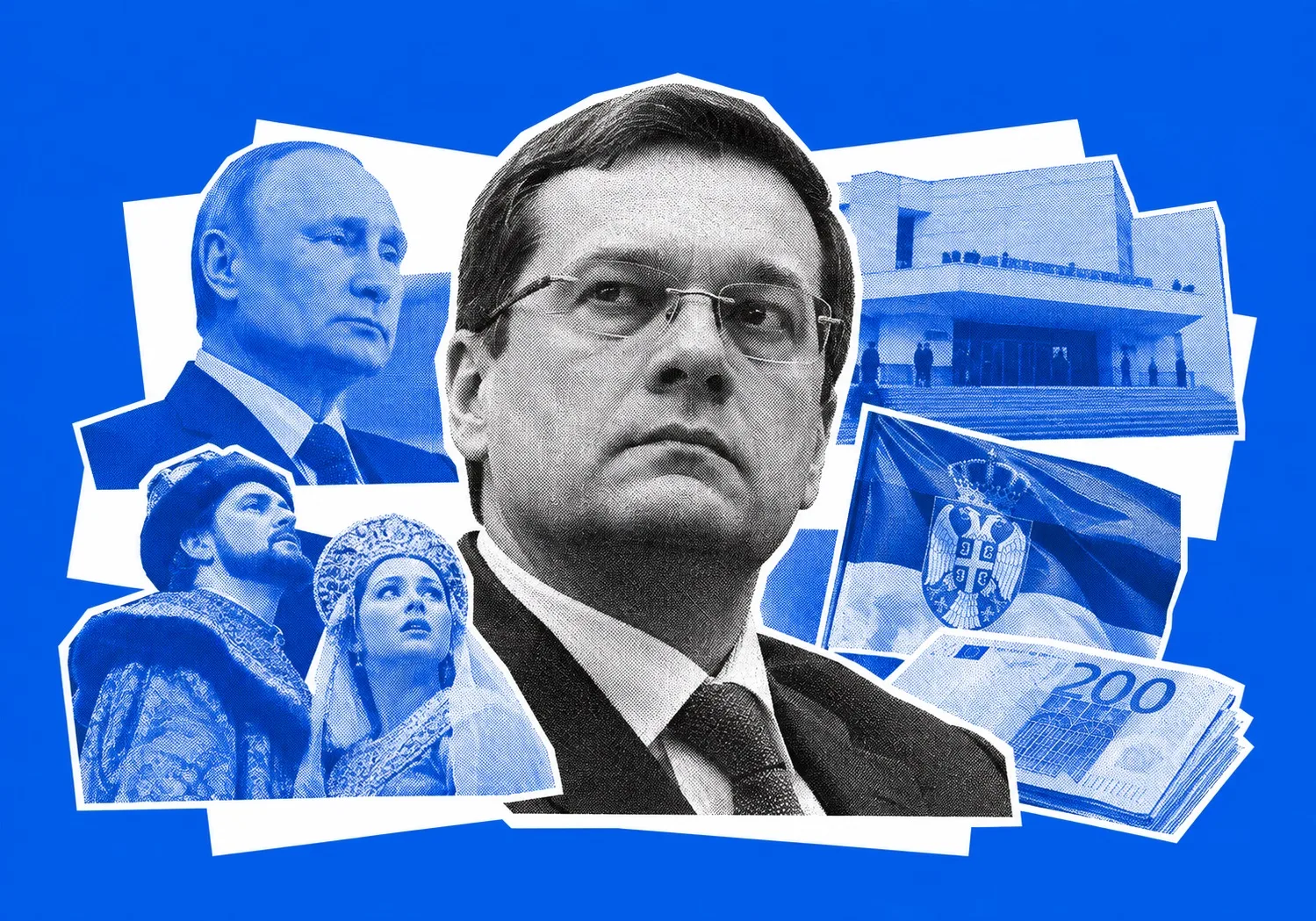
Sergei Novikov, a senior Russian presidential administration figure linked to wartime censorship, directed The Tsar’s Bride in Novi Sad—sparking outrage over its inflated €200,000 public budget and Moscow’s soft power in an EU candidate country.
The staging of Nikolai Rimsky-Korsakov’s classic opera at the Serbian National Theatre - the country’s oldest professional theatre - premiered on November 14. Soon after, the production became the focus of a local dispute, given Novikov’s influential role in shaping Moscow’s domestic cultural policies, a subject previously investigated by independent journalists.
The controversy emerged after the Novi Sad civic movement Bravo questioned why the Serbian National Theatre had allocated substantially more money to this production than to other major operas.
Why does the opera cost €200,000?
Bravo raised the issue in a statement published on November 14, shortly before the premiere. According to the movement, the theatre planned to spend €200,000 on The Tsar’s Bride, compared with approximately €45,000 each for previous productions of Faust and Carmen.
Even Aida, staged at the Petrovaradin Fortress with a large chorus and guest soloists, reportedly cost around €84,000.
On those figures, the new production’s planned budget is more than four times that of Faust or Carmen, and approximately 2.4 times the reported cost of Aida.
The comparison does not establish that money was misused. Opera production costs can vary depending on scenery, costumes, technical equipment, rehearsal schedules and visiting artists. However, the difference has led activists to demand an explanation of how the budget was calculated and who authorised it.
Bravo has also questioned the theatre’s wider financial management, including procurement decisions and changes in senior personnel. Its statement raises concerns about political connections within the institution and calls for greater transparency over public expenditure.
The available information does not establish how much of the €200,000 has actually been spent, whether the full amount was approved or what fee, if any, Novikov received for directing the production.
The Kremlin official behind the production
Novikov is not simply a Russian theatre director working abroad.
Since 2017, he has headed the Russian presidential administration’s Directorate for Public Projects, a department involved in domestic political and ideological initiatives.
In July 2024, independent Russian outlets Meduza and Important Stories published an investigation into his influence over the country’s cultural institutions.

Drawing on interviews with people familiar with the industry, the journalists described Novikov as a central figure in decisions about which artists could perform, which projects received official support and how cultural productions were expected to align with the Kremlin’s political priorities.
The investigation linked his department to informal restrictions on performers who had criticised Russia’s invasion of Ukraine. It also described the influence of presidential officials over cultural programming, extending beyond formal government institutions.
These findings were based on the outlets’ reporting and sources, rather than a publicly available official account of Novikov’s responsibilities.
His artistic work has continued alongside his government position.
In 2025, Novikov directed Sergei Prokofiev’s Semyon Kotko at Moscow’s Bolshoi Theatre. The production attracted attention for its contemporary political associations, including a finale interpreted as drawing parallels with Russia’s war against Ukraine. Novikov subsequently received a national Onegin theatre award for his directing.
His appearance in Novi Sad therefore brings together two roles that are difficult to separate: a working opera director and a senior official in the administration responsible for Russia’s political and ideological agenda.
A theatre appointment adds another political dimension
The production has also attracted scrutiny because of changes in the Serbian National Theatre’s leadership.
Željko Andrić, previously the head of its opera division, was appointed acting general manager following the resignation of Dragana Milošević. He also performs one of the principal roles in The Tsar’s Bride, portraying the oprichnik Grigory Gryaznoy.
Bravo has questioned Andrić’s political associations, pointing to connections with President Aleksandar Vučić’s Serbian Progressive Party.
The movement argues that the theatre’s management appointments and spending decisions deserve closer public scrutiny. Its wider statement also raises concerns about procurement and the treatment of employees.
The overlap between Andrić’s managerial position and his participation in the production is relevant to the debate over institutional accountability. It does not, by itself, demonstrate a conflict of interest or wrongdoing.
No independently verified evidence presented in the available reporting establishes that the opera’s budget was determined for political reasons.
An opera about the dangers of state power
There is an unusual contrast between Novikov’s government position and the interpretation he offered of The Tsar’s Bride before its premiere.
Set in 16th-century Russia during the reign of Ivan the Terrible, the opera tells the story of Marfa Sobakina, a young woman whose future is determined by powerful men.
Marfa hopes to marry Ivan Lykov, but the tsar chooses her as his bride without seeking her consent. Meanwhile, Gryaznoy, an oprichnik who desires her, attempts to interfere with her personal life.
The resulting tragedy centres on coercion, jealousy and the destruction of individual freedom.
Speaking to the Serbian newspaper Dnevnik on November 14, Novikov argued that the story remains relevant because it explores the consequences of imposing happiness on another person.
 He said that happiness cannot be forced upon someone, particularly by the state.
Novikov also discussed the oprichniki, the repressive force associated with Ivan the Terrible, and the division between those close to the ruler and everyone else.
His remarks are striking in light of the findings published by Meduza and Important Stories about his involvement in contemporary Russian cultural policy.
However, the director did not explicitly connect his interpretation of the opera to Vladimir Putin’s government or the war in Ukraine. Reading it as a criticism of the present-day Kremlin would go beyond what he publicly stated.
Applause on stage, questions outside the theatre
The premiere itself received favourable coverage in Russian and Serbian media.
Reports described prolonged applause, while Andrić praised the production. His comments carried particular weight in local coverage because he was both the theatre’s acting manager and a principal performer.
A more detailed review appeared in the Russian theatre magazine Teatral on November 18.
Critic Elizaveta Chevtaeva praised the orchestra under conductor Mikica Jevtić, the visual design and the performances. She also identified some practical difficulties for Russian-speaking audiences, including the pronunciation of Russian by Serbian singers and the use of Serbian subtitles.
The Serbian National Theatre originally scheduled four performances, on November 14, 17, 19 and 21.
The November 19 performance was cancelled following warnings of a severe storm. The theatre offered refunds or ticket exchanges, and the final scheduled November performance remains set for November 21.
The cancellation was unrelated to the dispute over the production’s budget.
Why the controversy matters beyond Serbia
Serbia occupies a distinctive position in Europe’s relationship with Russia.
It is an EU candidate country with longstanding historical, religious and cultural ties to Moscow. At the same time, its government has maintained relations with Russia despite the political tensions created by the invasion of Ukraine.
That balancing act is visible in several areas of Serbian public life, including energy, diplomacy and cultural cooperation.
The Novi Sad production illustrates a less frequently discussed aspect of those relations: the continued access of Russian state-connected cultural figures to prominent European institutions.
There is an important distinction between presenting Russian classical music and hosting a senior official of the Russian presidential administration.
Rimsky-Korsakov’s work belongs to the international operatic repertoire and has been performed around the world for generations. Its presence on a Serbian stage is not inherently a political statement.
Novikov’s participation raises a different question. He is an active government official whose work has been linked by independent investigations to the political management of Russian culture.
For European observers, the issue is not whether Serbian audiences should hear Russian opera. It is how cultural institutions assess the political roles of visiting directors, how publicly supported productions are financed, and whether those decisions are subject to adequate scrutiny.
The Novi Sad case does not prove that Moscow directed the production as an influence operation. Nor is there publicly verified evidence that its reported budget concealed political payments.
What it does show is how cultural cooperation can become politically contentious when the visiting artist is also a senior representative of a government engaged in war against another European country.
For Bravo, the immediate demand remains financial transparency. The movement wants to know who approved the €200,000 budget, what calculations justified it, and how the money was allocated.
Those questions remain central regardless of the production’s artistic reception.
Sources: Bravo, Dnevnik, Meduza and Important Stories, Teatral, Kurir, Radio Television of Vojvodina, Serbian National Theatre