
Russian Strikes Hit Kyiv Bridges and Lviv Railway Station, Killing Eight

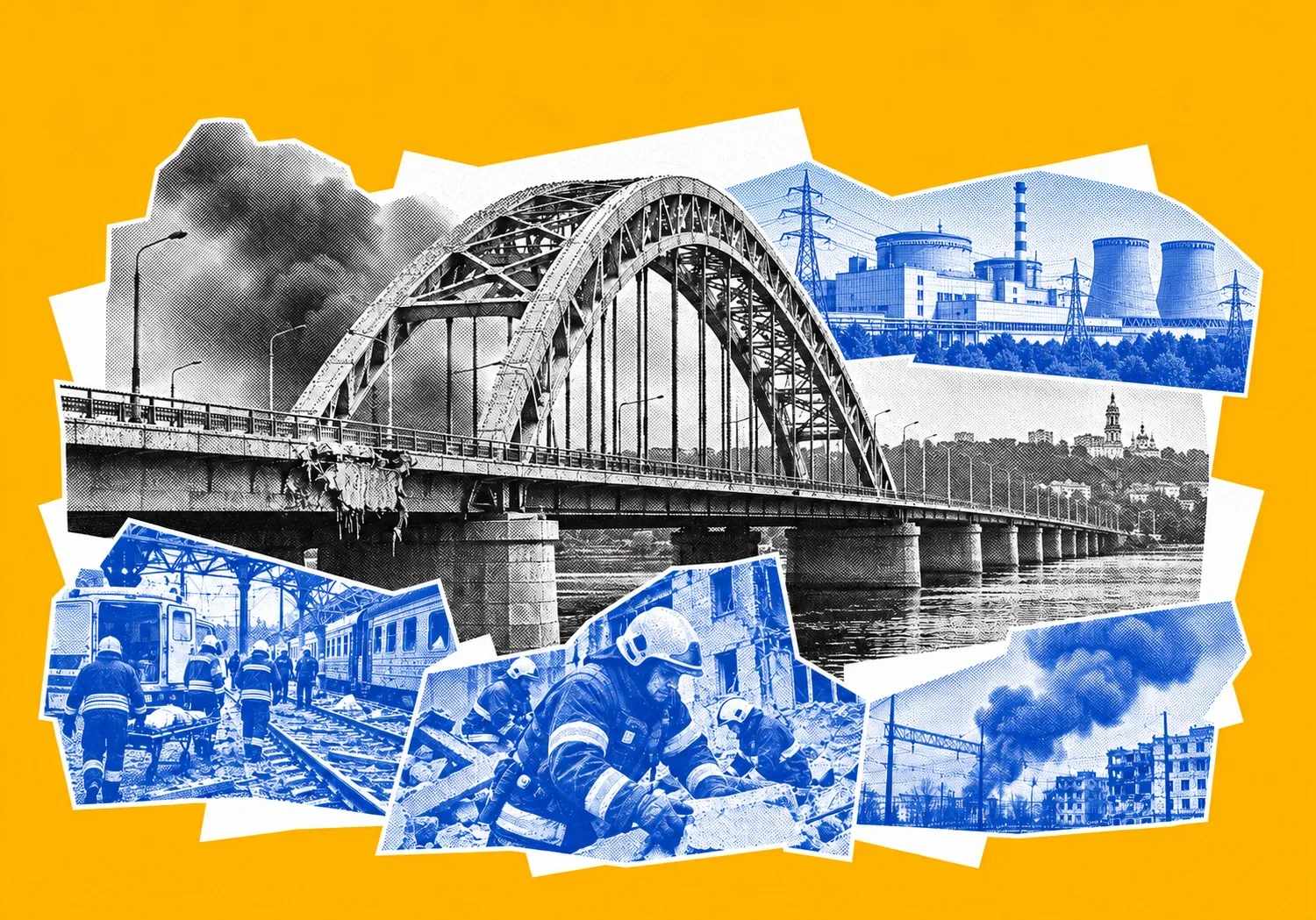
Russian missile and drone attacks killed eight people and injured 28 across Ukraine overnight and into Friday morning. Six of the deaths were in Kyiv, according to updated Ukrainian figures. The strikes damaged three bridges in the capital. A railway ticket terminal in Lviv and energy facilities were also hit.
Russia launched about 100 missiles and 400 drones overnight and into the morning, Ukrainian air force spokesman Yurii Ihnat said. His preliminary assessment included roughly 80 cruise missiles and 20 ballistic missiles. Kh-101 and Kalibr cruise missiles mainly headed towards western Ukraine, while ballistic missiles targeted Kyiv and the surrounding region.
The capital’s bridges were among the targets.

Ihnat identified energy facilities as the main targets. He reported a high interception rate but gave no final breakdown of missiles destroyed.
Russia’s defence ministry said it had struck defence industry sites and energy and transport infrastructure. It claimed Kyiv’s bridges were used to move weapons and military equipment to the front. Moscow also reported attacks on Odesa’s port infrastructure and vessels allegedly used for military purposes. The ministry claimed one cargo ship was carrying military equipment to Odesa.
Explosions in Kyiv began at about 1.20am.
Further waves followed through the night, with another ballistic missile warning shortly after 6.20am. Mayor Vitali Klitschko said three bridges across the Dnipro had been damaged: the Podilsko-Voskresenskyi, Darnytskyi and Pivdennyi crossings.
Prime Minister Serhii Koretskyi put the Kyiv toll at six dead and 15 injured. The capital and nine regions came under attack. He reported damage to a wastewater facility, office premises and commercial buildings in Kyiv.
Earlier city reports had identified three of those killed as employees of Kyivvodokanal, the municipal water utility. Fires broke out in the Obolonskyi and Podilskyi districts, while an infrastructure site was hit in Holosiivskyi.
Bridge restrictions disrupted travel between the city’s banks. Klitschko urged residents to avoid unnecessary car journeys and asked employers to allow remote working. Public transport routes changed, and parts of the capital lost electricity, water and heating. The extent of the damage to individual crossings remained under assessment.
In Lviv, two people were killed and others injured when the attack hit the ticket terminal at Sknyliv railway station, according to regional governor Maksym Kozytskyi.

A downed drone wounded a 48-year-old man in the Zolochiv district and damaged three houses and a car.
An energy installation in the Stryi district was damaged. A house and garage caught fire elsewhere in the region. In Lviv and its outskirts, authorities also reported broken dormitory windows, damaged vehicles and a damaged private home.
Ukraine’s nuclear power stations were forced to reduce output after the attacks damaged electricity networks, the energy ministry said. Power stations and transmission and distribution substations were targeted. Nuclear generation would return to normal gradually as the damaged networks were repaired.
Emergency power cuts were imposed in Kyiv and six regions, including Lviv, Ivano-Frankivsk and Zakarpattia. The energy ministry also reported that energy workers had been wounded in the Kharkiv region and taken to hospital. Repair crews were restoring damaged facilities where conditions allowed, but further attacks and air raid alerts were delaying their work.
Electricity problems also disrupted public transport in Ivano-Frankivsk after a combined missile and drone attack. In Kryvyi Rih, strikes damaged infrastructure and a petrol station. Hospitals switched to generators as boiler houses, water pumping stations and electric transport substations lost power. People were also injured in Zhovti Vody, where drones damaged blocks of flats, cars, a bank and a shop.
A drone hit a hospital in Kharkiv, causing injuries and shattering more than 50 windows. Another strike damaged vehicles beside a residential complex. Attacks resumed after 9am, damaging a business centre and garages. No additional casualties were reported in the initial updates.
In Zaporizhzhia, a drone struck a tram in the Zavodskyi district, leaving a woman with shrapnel wounds.

Poland on Alert, Embassies Damaged
Polish prosecutors confirmed that one unidentified airborne object had fallen in Nowy Lipowiec, in Biłgoraj county in Lublin province. It landed in a field near woodland and caught fire. No injuries or damage to buildings were reported. Early military statements had referred to nearby Chmielek.
Military prosecutors in Lublin were investigating with the Military Gendarmerie and military counterintelligence service. Prosecutor Marcin Kozak confirmed the discovery of one object. Its type and origin remained unknown, and reports of others were still being checked. Ihnat separately suggested that a Russian missile might have crossed the border.
Poland’s operational command initially reported two possible airspace violations. This did not establish two crash sites. In Rudnik nad Sanem, in Podkarpackie province, a railway traffic controller heard a loud bang near the tracks. An initial inspection found no visible damage. Trains were halted on the Nisko–Rudnik nad Sanem–Łętownia section while railway crews checked the line.
Emergency services were also reported to have found scorched metal fragments near a crater outside Mołodycz, in Jarosław county. Whether the fragments came from an airborne object or were linked to the morning’s airspace incident had not been established.
Residents in parts of Lublin and Podkarpackie provinces received air threat warnings, and Polish and allied aircraft were deployed. Operations at Lublin and Rzeszów airports were temporarily suspended. Prime Minister Donald Tusk said shortly before 8am that there was no current airborne threat. A further warning was issued around 9am as Russian attacks on Ukraine continued.
The incident followed a Russian daytime drone attack on Kyiv on Thursday that damaged the Dutch and Austrian embassies. The Dutch mission sustained minor damage after a projectile landed nearby. Austria’s embassy suffered broken windows and damage to vehicles. Neither country reported injuries among its staff.
Around ten people were working at the Austrian embassy when an explosion occurred at about 4.30pm, according to chargé d’affaires Daniel Roetlin.
The Netherlands summoned Russia’s ambassador for an explanation. Sweden also announced a summons after an explosion near its embassy. EU foreign policy chief Kaja Kallas said the bloc would summon Russia’s representative over the strikes and damage to diplomatic premises.
Kallas contrasted the attack with Putin’s reception in Shenzhen and pledged further support for Ukraine and increased pressure on Moscow.
Peace Talks and Putin’s Threats
The attacks came hours after Donald Trump, Xi Jinping and Vladimir Putin met in Shenzhen on Thursday. They met on the sidelines of the Asia-Pacific Economic Cooperation summit. US envoy Steve Witkoff confirmed that Trump had discussed a peaceful end to the Ukraine war.
The three governments issued a symbolic peace declaration. They reiterated that nuclear war should never be fought, but the document made no reference to Ukraine. No agreement to halt Russia’s bombardment emerged. The leaders also announced no plans for the arms control negotiations Trump had sought.
In Berlin, Trump’s envoy and son-in-law Jared Kushner reported progress on Ukraine’s future security. He said Washington had made Russia comfortable with guarantees modelled on NATO’s Article 5 collective defence principle. Trump was open to such an arrangement, Kushner added, but it would have to serve American interests. It would also need to form part of a broader security package.
No final guarantee had been agreed. Its obligations and enforcement arrangements remained unresolved. President Volodymyr Zelenskyy questioned whether the parties shared the same understanding of how an Article 5-style commitment would work.
Putin threatened a harsh response to Ukraine’s repeated strikes on the Kerch Bridge, which links Russia with occupied Crimea. He ruled out agreements halting attacks on energy infrastructure or in the Black Sea. Russia’s retaliation would be more painful than the damage to the bridge, he warned.
Ihnat rejected Moscow’s description of the bombardment as retaliation. Energy installations and bridges had long been Russian targets, he said.
German Chancellor Friedrich Merz outlined plans for talks involving Ukraine, Russia, the United States and Europe. The United Arab Emirates was a possible venue, although no final location or date had been announced. Merz proposed neutral ground after Putin invited European representatives to Moscow.
The Berlin coalition’s joint statement called for a winter ceasefire on energy infrastructure and an agreement protecting food exports through the Black Sea. It also demanded robust, legally binding security guarantees once a ceasefire took effect.
Merz insisted that a settlement must preserve Ukraine’s territorial integrity and integrate it into the European security system. European partners were ready for talks but still needed to establish whether Russia would join the proposed format.
Sources : LB.ua, Reuters, Suspilne , ZAXID.NET, Radio Zachód, Rzeczpospolita, Onet