
Russia Rejects EU Role in Ukraine Peace Talks, Contradicting Kushner

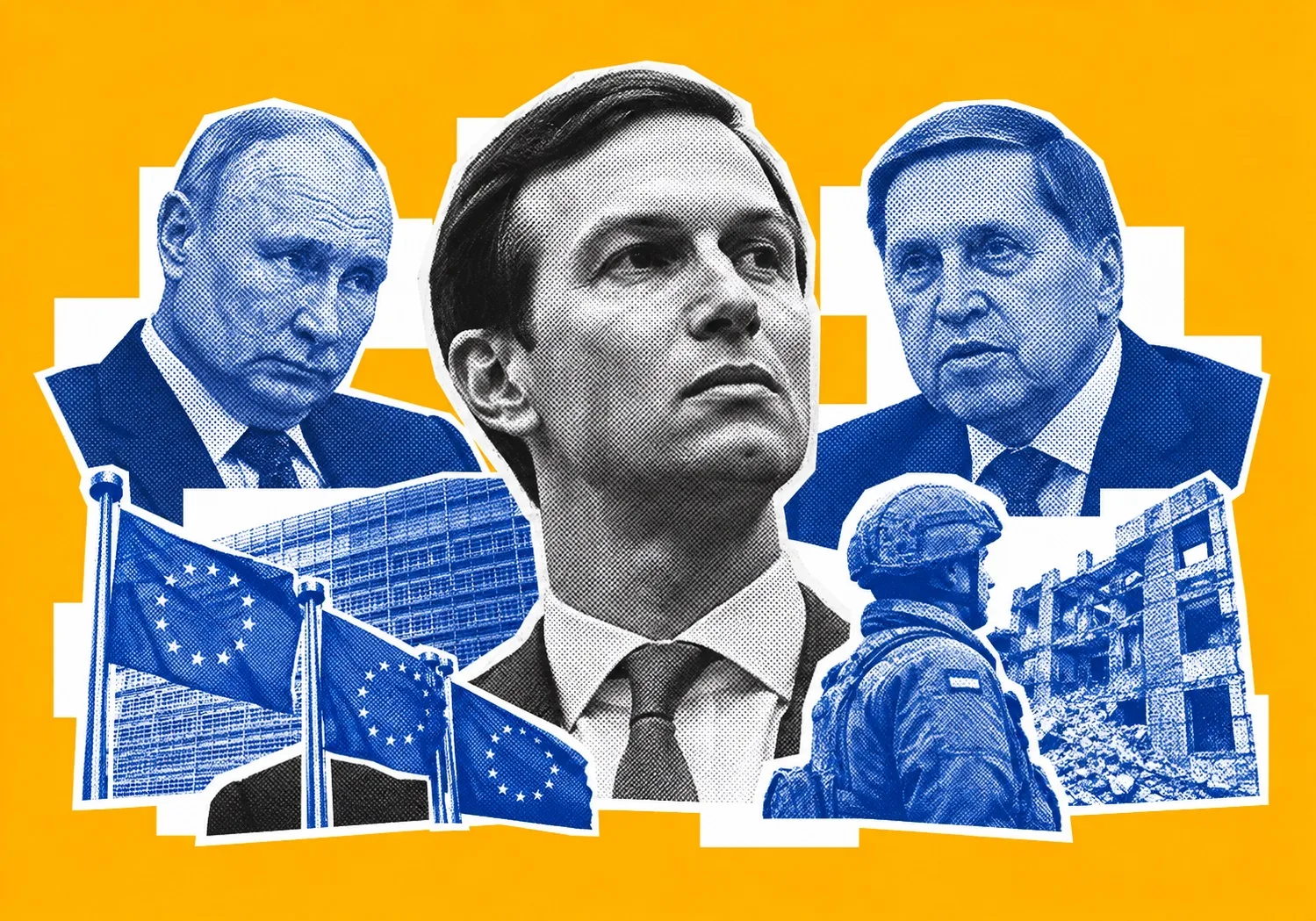
A sharp dispute between Moscow and Washington over whether European powers will join the next round of Ukraine peace negotiations has exposed a deepening rift over who will shape Europe’s post-war security. On November 16, Kremlin foreign policy adviser Yuri Ushakov rejected claims by US envoys Jared Kushner and Steve Witkoff that European representatives would participate in upcoming talks, insisting the format remains strictly trilateral.
The disagreement emerged after a renewed diplomatic effort involving Ukraine, Russia and the United States.
Representatives of the three countries met in Abu Dhabi in November, resuming direct trilateral discussions after a nine-month interruption. American envoys Jared Kushner and Steve Witkoff subsequently travelled to Moscow, where they met Russian President Vladimir Putin on November 12.
Following the Moscow meeting, the American negotiators indicated that European representatives would participate in the next round of discussions. Their statements suggested that the diplomatic process could move beyond the existing trilateral arrangement to address questions requiring broader international involvement.
The Kremlin offered a different account.
Speaking on November 16, Ushakov said that the next round remained under discussion as a meeting involving only Russia, Ukraine and the United States. According to the Russian official, no agreement had been reached to expand the format, and no date had been established for the next meeting.
He also suggested that one or more additional trilateral rounds might be necessary before European participation could be considered.
Moscow wants European governments to clarify what they intend to achieve and how they would contribute to a negotiated settlement, Ushakov said.
The conflicting accounts leave a fundamental diplomatic question unresolved: whether Washington can secure Moscow's acceptance of European participation or whether Russia will continue to insist on negotiating through a narrower channel.
Europe Has Already Chosen Its Negotiating Team
European governments have moved ahead with preparations despite the uncertainty surrounding Moscow's position.
At an informal European Council meeting in Dublin on November 13, EU leaders agreed that Europe's negotiating team would include France, Germany, Italy, Poland and the United Kingdom, together with representatives of EU institutions.
The arrangement brings together five influential European countries, including Britain, which is outside the European Union but remains a major participant in European defence cooperation.
European Council President António Costa presented the decision as a means of coordinating Europe's contribution to the diplomatic process rather than relying on separate national initiatives.
The proposed structure also reflects the different responsibilities that European governments and institutions would have in implementing any eventual agreement.
The European Union would play a central role in Ukraine's European integration, economic recovery and long-term reconstruction. Security guarantees would require coordination among participating governments, the Coalition of the Willing and NATO.
However, the Dublin decision did not establish an internationally agreed negotiating format. It determined who would represent Europe if European participation is incorporated into the talks.
That distinction has become particularly important following Ushakov's rejection of the American account.
Why Europe's Seat at the Table Matters
The dispute concerns more than diplomatic representation.
Any agreement ending the war would have implications for military deployments, defence commitments, sanctions, reconstruction financing and Ukraine's relationship with European institutions.
Many of these responsibilities would fall directly on European governments, regardless of whether they participate in the negotiations that establish them.
Security guarantees are one example.
If European countries are expected to provide military assistance, training, equipment or other commitments intended to deter renewed Russian aggression, their governments would need to determine the scope, financing and political conditions of those obligations.
Similarly, Ukraine's accession to the European Union cannot be negotiated or guaranteed by Washington and Moscow alone. Enlargement requires decisions through the EU's own institutional procedures and the agreement of member states under the applicable rules.
Post-war reconstruction raises comparable questions.
European governments and institutions are among Ukraine's principal financial and economic partners. A comprehensive recovery programme would require coordination over public financing, private investment, infrastructure rebuilding and long-term economic integration.
A settlement negotiated without those actors could therefore encounter significant difficulties during implementation.
This creates a practical limitation for any exclusively trilateral process: the United States, Ukraine and Russia can discuss a settlement, but they cannot independently commit European institutions or governments to obligations requiring their consent.
Kushner's Three-Pillar Framework Depends on European Cooperation
The dispute over participation is particularly significant because the American diplomatic initiative itself relies heavily on European institutions.
On November 16, Kushner outlined three principal elements of the US approach: credible security guarantees against future Russian aggression, a pathway towards Ukrainian membership of the European Union, and a comprehensive post-war economic recovery programme.
The reconstruction component would be developed with European partners, the World Bank and other international participants.
Kushner also confirmed that he and Witkoff had spoken with Ushakov before holding consultations with Ukrainian and European representatives, including national security advisers from Germany, France, Britain, Poland and Italy, as well as EU and NATO officials.
Those discussions addressed the possibility of direct engagement between European representatives and Russia, alongside preparations for another multilateral meeting.
Yet the publicly described framework remains a diplomatic proposal rather than a finalised agreement.
There are no publicly confirmed details establishing the precise legal obligations behind the proposed security guarantees, the division of reconstruction costs or the mechanisms that would ensure compliance with a future settlement.
Nor does a proposed pathway to EU membership establish an accession timetable or override the Union's established enlargement procedures.
The absence of these details matters because the feasibility of the framework depends not only on negotiations with Moscow but also on commitments that European governments and institutions must be willing and legally able to undertake.
Brussels Insists on a Ceasefire Before Wider Security Negotiations
European officials have also challenged the order in which Moscow wants negotiations to proceed.
Speaking after a meeting of EU foreign ministers in Brussels on November 16, EU foreign policy chief Kaja Kallas argued that securing a ceasefire must take priority over broader discussions about Europe's security arrangements.
She said Russia's demands continued to include restrictions affecting Ukraine's sovereignty, NATO and European security.
Kallas outlined several European positions: Ukraine's independence and territorial integrity must be respected, occupied Ukrainian territories must not receive legal recognition as Russian, and deported Ukrainian children must be returned.
She also called for accountability for war crimes, compensation for destruction caused by Russia and an end to Russian sabotage and cyberattacks across Europe.
She argued that Europe should not negotiate a replacement security order while the fighting continues.
This creates a substantive disagreement alongside the procedural dispute.
Moscow has sought discussions addressing the wider European security system, while European officials insist that the immediate priority is ending hostilities and preventing renewed aggression.
The disagreement is particularly sensitive because Russia's earlier security proposals included restrictions on NATO's activities and enlargement, issues that directly affect the sovereignty and defence policies of European states.
For Brussels, accepting negotiations over those arrangements before a ceasefire could risk linking an end to the war with concessions extending beyond Ukraine.
A Test of European Influence and Transatlantic Coordination
The current negotiations expose a broader challenge for European governments: maintaining influence over a diplomatic process primarily driven by Washington while preserving the cooperation needed to support Ukraine.
The United States has direct diplomatic channels with Moscow and Kyiv and can use those contacts to explore compromises that might be difficult to achieve in a larger negotiating forum.
A narrower format may simplify initial discussions, particularly when the parties remain divided over territorial questions and security guarantees.
However, excluding European governments from decisions that would require their financial, military or institutional participation creates a different set of obstacles.
European countries retain substantial influence through their military assistance to Ukraine, sanctions policies, reconstruction commitments and participation in NATO.
The European Union also controls its own enlargement decisions and important elements of its economic relationship with Russia.
These instruments give European governments a role in implementing any settlement, even if Moscow refuses to recognise them as direct negotiating partners.
The joint team agreed in Dublin is therefore an attempt to coordinate existing influence rather than create an entirely new diplomatic institution.
It also provides Washington with a more clearly defined European counterpart for discussions over security guarantees, economic recovery and the wider political consequences of a settlement.
Whether that coordination translates into direct participation in negotiations with Russia remains uncertain.
Berlin Talks Could Clarify the Next Stage
The immediate diplomatic focus is shifting towards further consultations between Ukraine, the United States and European partners.
According to reporting by Axios on November 17, Witkoff and Kushner are expected to meet Ukrainian and European officials in Berlin on Thursday, November 19.
The discussions are expected to focus on security guarantees and Ukraine's post-war economic recovery.
The planned meeting offers an opportunity to develop common positions before another round involving Russia, although it does not establish that Moscow has accepted direct European participation.
Several developments will indicate whether the current disagreement can be resolved.
The first is whether Russia formally accepts a broader negotiating format and agrees to meet European representatives directly.
The second is whether Washington and European governments establish a common sequence for ceasefire negotiations, security guarantees and wider discussions about European security.
A third concerns the substance of the proposed settlement: whether security commitments and reconstruction arrangements become sufficiently detailed to identify the governments, institutions and financial mechanisms responsible for implementing them.
For Ukraine, the central requirement remains that any agreement preserve its ability to make sovereign decisions about its territory, security and international partnerships.
The coming diplomatic meetings will test whether the United States can maintain negotiations with Moscow while giving European governments a meaningful role in shaping commitments they may ultimately be asked to fulfil.
Until the negotiating format is agreed by all participating parties, Europe's representation remains an unresolved question rather than an established feature of the peace process.
Sources: [Reuters,](https://www.reuters.com/world/kremlin-aide-denies-russia-agreed-include-europe-ukraine-peace-talks-2026-11-16/ ) [European Council,](https://www.consilium.europa.eu/en/meetings/european-council/2026/11/13/ ) [Associated Press,](https://apnews.com/article/2a96d57210055edd2e76f71693e0a37c ) [Financial Times,](https://www.ft.com/content/8d28a5be-af56-421f-a33d-779a0fcc7ad4 ) [European External Action Service,](https://www.eeas.europa.eu/eeas/foreign-affairs-council-press-conference-high-representative-kaja-kallas-6_en ) [Anadolu Agency,](https://www.aa.com.tr/en/americas/us-envoy-kushner-says-path-to-eu-membership-is-key-pillar-of-ukraine-peace-efforts/4127110 ) [Axios](https://www.axios.com/2026/11/17/witkoff-kushner-ukraine-europe-russia-berlin-meeting )