
Russia Cuts Payouts to Families of Killed Soldiers as Regional Budgets Collapse

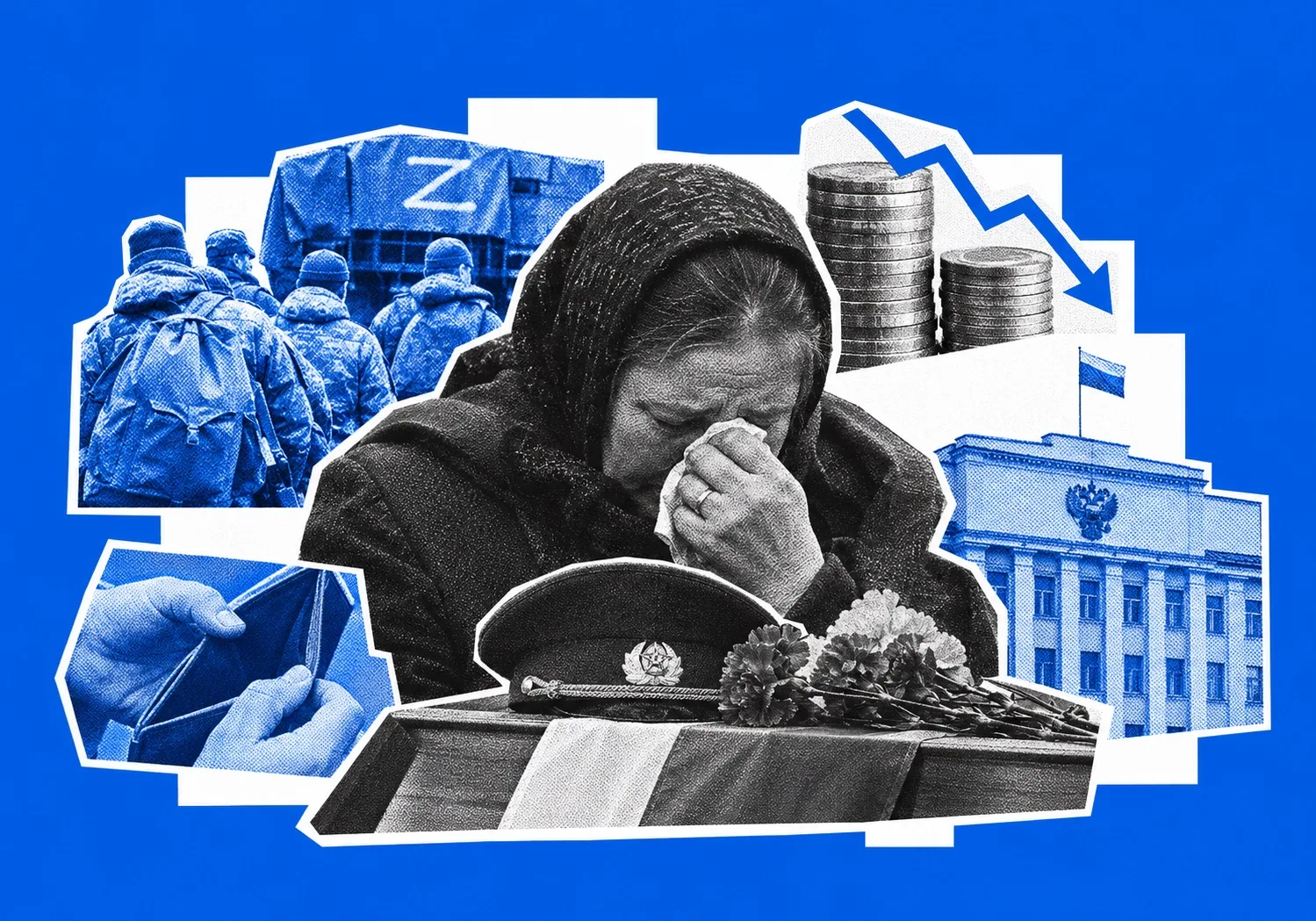
At least 12 Russian regions have slashed, delayed, or canceled financial support for families of soldiers killed in Ukraine. Facing a combined budget deficit of over 1.5 trillion rubles, local authorities are running out of funds, while the Kremlin pushes to delay federal compensation by up to seven months.
The cuts come as the Russian government considers changes that could extend the processing and payment period for death benefits from approximately one month to as long as seven months. Together, the measures illustrate the growing financial pressures associated with sustaining Russia’s war effort.
Saratov Slashes Compensation by 90%
One of the most significant reductions took effect in Saratov Oblast on November 1. Under regional government decree No. 714-P, the one-time payment to families of soldiers killed in Ukraine fell from 1 million rubles to just 100,000 rubles.
The new amount is distributed among eligible family members rather than paid separately to each relative. The revised rules apply primarily to applications submitted from November 1, while earlier applications are subject to transitional provisions.
Saratov became the fifth Russian region since the beginning of autumn to reduce, postpone, or eliminate these regional benefits, according to The Moscow Times.

Similar measures were introduced earlier in 2026 in Kemerovo, Kirov, Omsk, Orenburg and Ulyanovsk oblasts, as well as Bashkortostan and Khakassia. The combined total has reached at least 12 regions, according to an investigation published by Important Stories on November 5.
These reductions concern additional regional compensation rather than the complete abolition of federal benefits. Nevertheless, they can substantially reduce the total financial support available to bereaved families.
“There Is No Money to Bury Them”
The situation in Khakassia illustrates how the financial crisis is affecting families directly. Regional death-related payments had effectively stopped as early as November 2025, prompting the local branch of the All-Russia People's Front to appeal to prosecutors.
Ksenia Buganova, head of the organization's regional branch, described families struggling to cover funeral expenses after receiving the bodies of soldiers killed in Ukraine.
“There is no money to bury them,” she said, calling it disgraceful that families receiving a soldier's body in a zinc coffin do not know where to find the money for a funeral.
The remarks, reported by Novaya Gazeta, reveal a growing contradiction in Russia's wartime compensation system: financial promises made to military families are increasingly difficult for regional authorities to fulfill.
Moscow Wants Families to Wait Up to Seven Months
Beyond the regional cuts, the federal government has proposed changes to the deadlines for processing death-related compensation.
Under the existing framework described in the proposal, payments are generally expected within 30 days after the required documentation has been received.
However, a government-backed bill submitted to the State Duma would establish a different timetable. Authorities would have a six-month period to examine documents and verify the circumstances of a soldier's death, followed by an additional 30 days for payment.
This could extend the overall process to approximately seven months.
The proposal has not yet become law. If adopted, it could leave some families waiting significantly longer for federal financial assistance, even as regional benefits are being reduced.
The changes would also create additional uncertainty for households that depended on military income and expected compensation following a relative's death.
Regional Budgets Are Running Out of Room
The reductions are occurring against the backdrop of deteriorating public finances across Russia.
Regional administrations have been required to finance several costly wartime programs, including compensation for soldiers' families, enlistment bonuses and incentives for recruiters.
According to Russia's Ministry of Finance, the country's regions ended 2025 with a combined budget deficit exceeding 1.5 trillion rubles.
Sberbank has projected that the combined shortfall could reach 2 trillion rubles in 2026.

As regional revenues struggle to keep pace with spending commitments, authorities are increasingly forced to choose between maintaining wartime incentives and financing essential public services.
The pressure has already extended into healthcare. An investigation by Important Stories found that at least 19 Russian regions reduced planned healthcare spending in 2026, with cuts totaling more than 100 billion rubles.
The reductions affected programs for modernizing primary healthcare and payments to medical workers.
This indicates that the financial burden of the war is reaching well beyond the military sector, affecting services used by the wider civilian population.
Russia Is Also Cutting Military Recruitment Bonuses
Financial pressure is not limited to compensation for soldiers killed in combat. Several Russian regions have also reduced the bonuses offered to men signing contracts with the Ministry of Defence.
In Smolensk Oblast, the enlistment bonus was cut for the second time, falling from 1.6 million to 1.1 million rubles in November.
Mordovia introduced an even sharper reduction on September 15, lowering the payment from 3 million to 800,000 rubles. Officials attributed the decision to insufficient regional budget resources.
Other reductions included Irkutsk Oblast, where bonuses fell from 2.1 million to 1.8 million rubles, and Sverdlovsk Oblast, where they declined from 2.7 million to 2.5 million rubles, as The Insider reported.
Saint Petersburg also substantially reduced its recruitment incentives. On October 16, the city lowered the one-time payment from 3.5 million to 1 million rubles. According to Fontanka, recruitment information centers subsequently quoted figures as low as 400,000 rubles.
The reductions suggest that regional authorities are reassessing the financial incentives that helped sustain Russia's military recruitment throughout the war.
In 2022, regional leaders competed to offer increasingly generous payments to attract contract soldiers. Economist Natalia Zubarevich told Bloomberg that this competition has now ended.
The shift could complicate recruitment in regions where financial incentives have been a major reason for joining the military. However, the impact on actual enlistment numbers remains uncertain.
Russia's War Spending Is Squeezing Civilian Budgets
The financial strain extends to the federal level.
Russia's federal budget deficit has reached approximately 5.8 trillion rubles, according to RBC, while military expenditure has risen to roughly 17 trillion rubles, around 40% above the previously planned level cited in reporting by Important Stories.
The combination of substantial military commitments and weakening budget balances has narrowed the government's options for financing other priorities.
Bloomberg reported in June that Finance Minister Anton Siluanov and central bank officials had considered reductions in military spending as part of efforts to stabilize public finances. Vladimir Putin instead instructed officials to identify alternative solutions, placing greater pressure on civilian expenditure.
The government has also expanded its borrowing options. On November 5, Prime Minister Mikhail Mishustin authorized the Finance Ministry to raise up to an additional 1 trillion rubles on the domestic market beyond the previously established borrowing limit, according to a government decree.
The broader consequences are becoming visible in regional public services. In Primorsky Krai, budget shortages have reportedly led to the withdrawal of security personnel from several schools and kindergartens in Nakhodka. Parents also reported the cancellation of a school bus service.
According to The Moscow Times, the regional government reduced spending on education by 644 million rubles, while healthcare, utilities and transport each faced cuts exceeding 1 billion rubles.
At the same time, the regional government's reserve fund was increased by 1.5 billion rubles, with authorities saying the additional resources would support participants in the war against Ukraine and their families.
The contrast reflects the difficult budgetary choices facing Russian regional governments: maintaining wartime commitments while reducing spending on services used by civilians.
The Financial Cost of War Is Reaching Russian Households
Russia's system of military payments was initially designed to make enlistment financially attractive and provide families with substantial compensation in the event of a soldier's death.
Four years into the full-scale invasion, that system is increasingly constrained by regional budget deficits and competing spending priorities.
For families of fallen soldiers, the consequences are immediate. In some regions, previously promised payments have been reduced by hundreds of thousands or even millions of rubles. Elsewhere, compensation has been postponed or abolished at the regional level.
For potential recruits, falling enlistment bonuses could reduce the financial appeal of military service, particularly in economically disadvantaged areas.
Meanwhile, cuts to healthcare, education and other public services are extending the economic consequences of the war to people with no direct connection to the military.
With regional deficits projected to reach 2 trillion rubles in 2026 and federal borrowing requirements continuing to rise, Russian authorities face mounting pressure to balance the costs of the war against domestic financial obligations.
Sources: Important Stories, Bloomberg, Saratov Regional Government, The Moscow Times, Important Stories, Russian State Duma