
Russia Bombs Ukrainian Aid Centre as Civilian Death Toll Rises

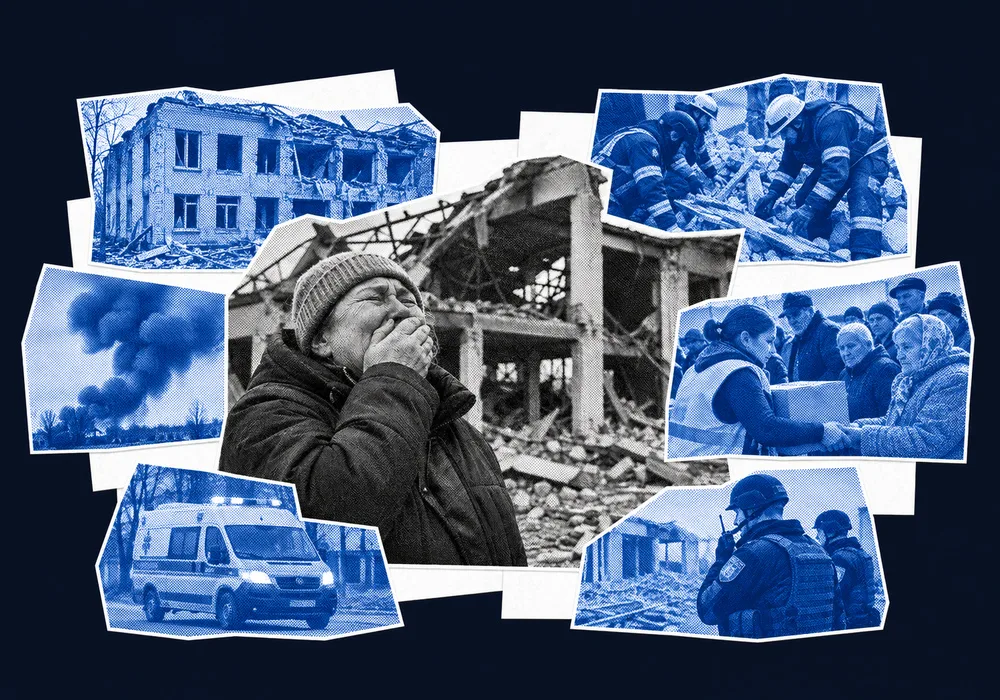
A Russian airstrike on a humanitarian aid distribution centre and shelter in Zaporizhzhia region killed at least 31 people, with dozens still missing. The attack came immediately after a local humanitarian ceasefire in southern Ukraine expired, raising further questions about Moscow’s willingness to pursue de-escalation.
Russian forces bombed a school used as a humanitarian aid distribution centre and a neighbouring shelter in Komyshuvakha, Zaporizhzhia region, on 2 November. By the following day, the death toll had risen to at least 31 people, while nearly 50 remained missing and five were reported injured. Rescue operations continued amid fears that additional victims could be trapped beneath the rubble.
The school had been used to distribute humanitarian assistance to residents who remained in the frontline settlement. There were no classes taking place because of the proximity of Russian forces. Local residents regularly gathered there to receive aid, making the site an established civilian relief point rather than an active educational facility.
According to Ukrainian officials, the initial strikes hit the school while people were arriving to collect humanitarian packages. Subsequent bombs struck the shelter where civilians had taken refuge. The attack also killed two rescue workers and four police officers who had responded to the initial bombing. Further Russian attacks in the area complicated rescue efforts and increased the danger to emergency personnel.

The incident highlights the growing risks faced by civilians and first responders in settlements close to the frontline. Humanitarian distribution points, shelters and emergency services have become increasingly exposed to Russia’s use of guided aerial bombs against populated areas.
The timing undermines claims of humanitarian de-escalation
The bombing occurred shortly after the expiration of a limited ceasefire in Kherson region, which had enabled a humanitarian operation to evacuate residents from Russian-occupied Oleshky. The temporary arrangement, which lasted from 27 October until 1 November, was among the most significant localised humanitarian pauses between Ukraine and Russia since the beginning of the full-scale invasion.
The Oleshky operation had raised hopes that limited agreements could facilitate further evacuations and aid deliveries, even without a broader political settlement. The subsequent attack in Komyshuvakha demonstrated how fragile such arrangements remain and how quickly humanitarian progress can be reversed by renewed violence.
Ukrainian President Volodymyr Zelenskyy argued that Russia had rejected an opportunity to continue humanitarian cooperation. Kyiv had proposed further measures following the evacuation operation, but the bombing instead reinforced concerns that Moscow was unwilling to translate limited humanitarian arrangements into a wider reduction in hostilities.
The sequence of events also complicates international efforts to present local ceasefires as potential building blocks for negotiations. A humanitarian pause can create opportunities for civilian protection, but its effectiveness depends on both sides maintaining the agreed restrictions and ensuring that relief operations are not exposed to renewed attacks.
A wider campaign against Ukraine’s infrastructure
The attack on Komyshuvakha formed part of a much broader Russian assault across Ukraine overnight. According to Zelenskyy, Russian forces launched 289 attack drones, 17 ballistic missiles and 59 cruise missiles, targeting infrastructure in nine regions.
Energy facilities sustained significant damage, prompting emergency power cuts. Several power plants were reportedly forced to halt operations, while attacks on medical facilities in Kharkiv resulted in dozens of injuries and the evacuation of more than 200 patients. The scale of the barrage placed additional pressure on Ukraine’s air defence systems and emergency services.
The combination of attacks on humanitarian facilities, energy infrastructure and medical institutions illustrates the cumulative effect of Russia’s campaign. Beyond immediate casualties, repeated strikes disrupt electricity supplies, healthcare provision, civilian mobility and the ability of local authorities to maintain basic services.
For frontline communities, the consequences extend beyond individual attacks. Humanitarian distribution centres and emergency shelters are essential to maintaining civilian life in areas where access to food, medical assistance and safe evacuation routes is increasingly limited.
International pressure and the limits of diplomacy
The attack comes as Washington prepares to mediate another round of Russia-Ukraine negotiations in Abu Dhabi on 10–11 November. The planned discussions are expected to address de-escalation, humanitarian measures and post-war security arrangements.
The timing creates an uncomfortable diplomatic backdrop. While negotiations are being prepared, Russia continues to conduct large-scale attacks that undermine civilian protection and reinforce Ukraine’s demand for stronger security guarantees. The Komyshuvakha bombing is likely to strengthen Kyiv’s argument that diplomatic engagement must be accompanied by credible mechanisms to prevent further attacks.
The incident also raises questions about the practical limits of humanitarian diplomacy. Temporary agreements can facilitate evacuations and aid deliveries, but they do not provide lasting protection for civilians unless violations carry meaningful consequences and the parties are able to enforce the arrangements.
For European governments, the attack reinforces the need to maintain support for Ukraine’s air defence capabilities, emergency response infrastructure and humanitarian operations. It also demonstrates why any future settlement will require more than declarations of intent: civilian protection must be supported by enforceable security arrangements capable of surviving renewed military escalation.
Russia’s bombing of a humanitarian aid centre in Komyshuvakha is therefore not only another episode in the war’s mounting civilian toll. It is a direct challenge to the premise that limited humanitarian cooperation can develop into a broader process of de-escalation while attacks on civilian infrastructure continue.
Sources: United Nations in Ukraine, Hromadske