
Russia and Iran Deepen Arms Ties with New Missile Deal

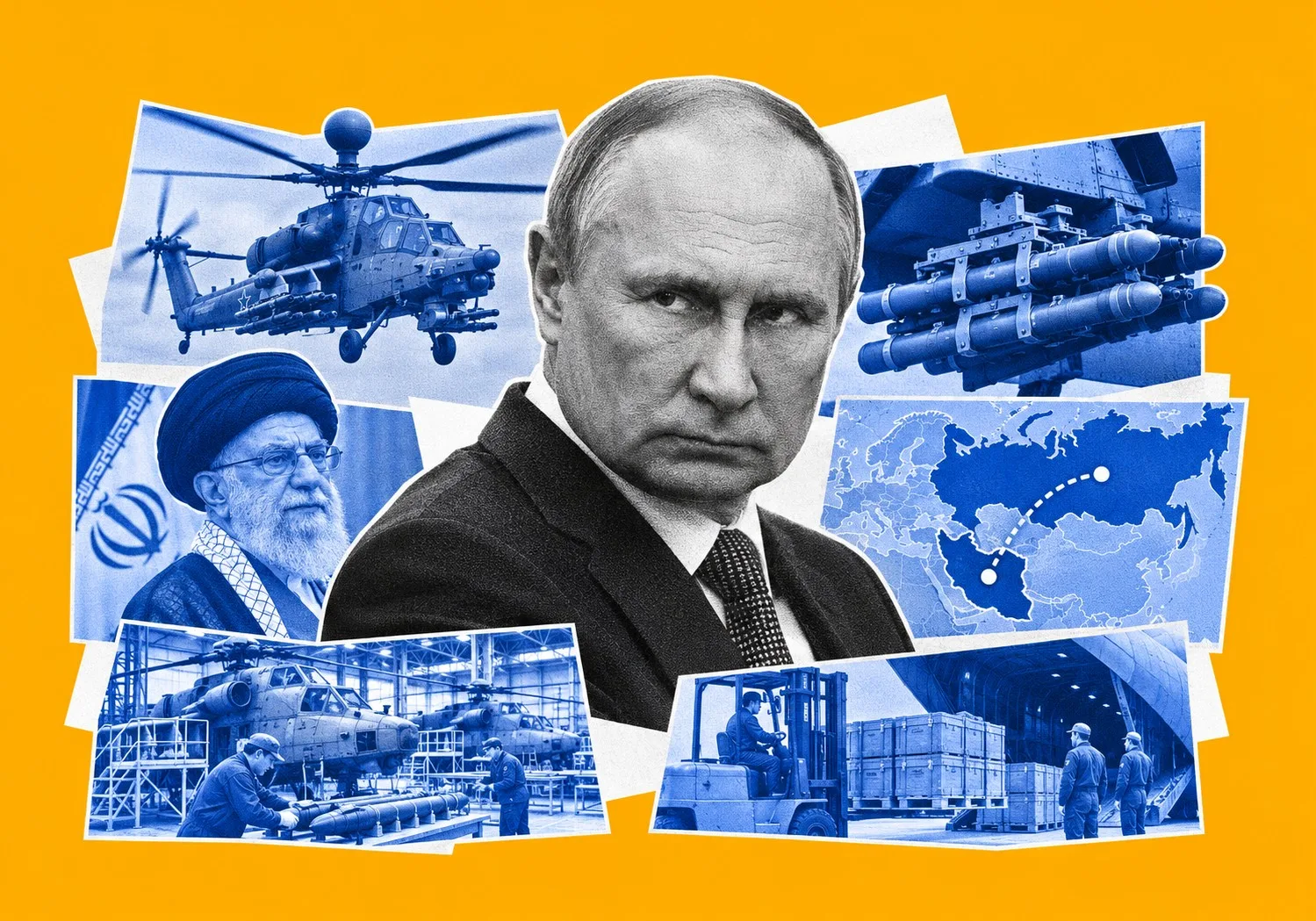
Russia agreed to supply Iran with 90 helicopter-mounted launchers for precision-guided missiles used against Ukraine, according to leaked defence records. The deal comes amid military cooperation that has expanded since Russia invaded Ukraine in 2022. Tehran has supplied Moscow with Shahed attack drones and ballistic missiles, while Russia has provided aircraft and weapons technology. Delivery of the launchers has not been confirmed.
The records, obtained by Ukrainian private intelligence firm Dallas Analytics and examined by the Financial Times and The Guardian, include a May 2024 production schedule. It identifies the customer as K-10, a designation linked to Iran in other internal documents.
Russian arms manufacturer Vympel was responsible for producing the launchers, with deliveries scheduled between late 2024 and December 2025.
Vympel had asked another manufacturer, the Mechanical Engineering Design Bureau, to accelerate component deliveries. Delays threatened nine contracts, including orders for Russia's armed forces.
The APU-L launcher is designed primarily for Russia's Mi-28 attack helicopters. Each can carry two LMUR precision-guided missiles, also known as Izdeliye 305.
Russian forces have used these missiles extensively in Ukraine since 2022. They can strike moving vehicles and other ground targets. Operators can monitor the missile in flight and adjust its course towards the target.
Iran announced plans to acquire Mi-28 helicopters in November 2023. Photographs published in January 2026 appeared to show one of the aircraft at an aviation facility in Tehran.
The documents do not establish whether LMUR missiles were included in the order.
Shaheds Become Gerans
By May 2024, when Vympel prepared its production schedule, Iranian-designed Shahed drones had been striking Ukraine for more than 18 months.
Iran began supplying Russia with attack drones within months of Moscow's full-scale invasion in February 2022. The first publicly documented use of a Shahed-136 came that September, when Ukrainian forces recovered wreckage near Kupiansk in the Kharkiv region.
Russia subsequently launched Shahed-131 and Shahed-136 drones against Ukrainian cities, residential buildings, power stations and other infrastructure. The aircraft were renamed Geran-1 and Geran-2 in Russian service.

Ukrainians became familiar with their distinctive engine noise during repeated night-time attacks. Shaheds played a major role in Russia's strikes on Ukraine's electricity network during the winter of 2022–23, when extensive damage caused prolonged power cuts.
Iran also supplied Mohajer-6 drones, which can conduct reconnaissance and carry weapons.
In March 2026, the Stockholm International Peace Research Institute (SIPRI) estimated that Iran had supplied Russia with approximately 7,000 Shahed-136 drones since the invasion.
Moscow had also acquired the means to manufacture them.
According to Bloomberg, Russia signed a $1.75 billion agreement with Iran in early 2023 covering Shahed-136 drones and the transfer of production technology. The agency reported the arrangement in January 2026, citing an anonymous Western security official.
The agreement helped Russia establish production of Geran-2 drones at the Alabuga industrial complex in Tatarstan, initially with Iranian technical assistance.
Russian engineers subsequently modified the drones' navigation systems, communications equipment and payloads.
A September 2026 study by the Center for Strategic and International Studies documented further adaptations intended to counter Ukrainian air defences. These included changes to propulsion systems and the introduction of new variants.
Many Geran drones are now manufactured in Russia rather than imported from Iran. SIPRI researchers concluded that domestic production could continue even if further Iranian supplies were interrupted.
Missile Contracts Worth Billions
Alongside drones and manufacturing technology, Russia purchased Iranian ballistic missiles.
In September 2024, US Secretary of State Antony Blinken announced that Moscow had received Fath-360 short-range ballistic missiles. Washington also reported that Russian military personnel had undergone training in Iran to operate them.
Britain, France and Germany condemned the transfers and announced additional sanctions. Tehran denied supplying the missiles.
The Fath-360 deal formed part of a much larger arms relationship. In January 2026, Bloomberg reported that Russian contracts for Iranian ballistic and surface-to-air missiles dating from October 2021 were worth approximately $2.7 billion.
The estimate, attributed to a Western security official, included hundreds of Fath-360 missiles, nearly 500 other short-range ballistic missiles and approximately 200 surface-to-air missiles.
Iran also supplied millions of rounds of ammunition and artillery shells, according to the same assessment.
The official estimated that Russia had spent more than $4 billion on Iranian military equipment since late 2021. The figure covered contracts concluded both before and after the full-scale invasion of Ukraine.
The reported contract values do not establish that every weapon ordered was delivered or used in combat.
Russian Aircraft and Air Defences
While Iran was supplying drones and missiles to Moscow, it was also receiving Russian military aircraft.
Iran obtained Yak-130 training aircraft in 2023. These can prepare pilots for modern fighters and undertake limited combat missions.
Tehran subsequently pursued Su-35 fighter jets and Mi-28 attack helicopters.
In February 2026, Carnegie Endowment researcher Nikita Smagin reported evidence that Iran had acquired up to six Mi-28 helicopters. His research also identified Russian armoured vehicles and small arms delivered to Iran.
The Su-35 agreement has been more difficult to fulfil. On 2 November 2026, Iranian military spokesman Mohammad Akraminia said Tehran did not expect to receive the fighters until the war with the United States and Israel had ended. Deliveries had not been independently confirmed.
Air defence equipment has become another major part of Iran's purchases from Moscow.
In February 2026, the Financial Times reported a contract worth approximately €495 million for Russian Verba portable air defence systems.
The agreement covered 500 launch units, 2,500 missiles and 500 night-vision sights. Deliveries were scheduled between 2027 and 2029.
The Verba system is designed to engage low-flying aircraft, helicopters and cruise missiles. Its limited range and altitude restrict its effectiveness against aircraft operating at greater heights.
Reuters reported the agreement but could not independently verify the contract documents.
SIPRI found that Russia was Iran's only supplier of major conventional arms during the decade ending in 2025. Its researchers also questioned how much protection Russian-made aircraft and air defence systems had provided against American and Israeli attacks.
Missile Technology
Beyond finished weapons, Russian engineers have been involved in Iranian missile development.
In September 2026, the Financial Times revealed a previously undisclosed programme involving Russian missile specialists and Iranian engineers.
The project, code-named C430L, began in 2023 and focused on ramjet propulsion technology for supersonic cruise missiles.
Russian engineers examined Iranian flight-test data, advised on technical problems and travelled to Iran for consultations.
The programme involved Russian state arms exporter Rosoboronexport and missile manufacturer NPO Mashinostroyenia.
A functioning ramjet engine would allow a cruise missile to sustain supersonic speeds. This would reduce the time available for air defence systems to detect and intercept the weapon.
Fabian Hinz, a missile specialist at Conflict Armament Research, told the Financial Times that the programme involved technology Iran had been seeking for decades.
The newspaper reported that Iran had built and tested a ramjet propulsion system. It found no evidence, however, that a missile developed with Russian assistance had entered operational service.
Documents examined by journalists showed that technical discussions continued into 2026.
The Iran War
Since the United States and Israel launched their military campaign against Iran on 28 February 2026, attention has shifted towards possible Russian intelligence assistance to Tehran.
A Ukrainian intelligence assessment reviewed by Reuters in April alleged that Russian satellites had surveyed military facilities and other strategic locations across the Middle East.
According to the assessment, Russian satellites conducted at least 24 surveys covering 46 sites in 11 countries between 21 and 31 March.
The locations included American military bases, airports and oil facilities. Some were subsequently targeted by Iranian missiles or drones.
Western and regional security sources also told Reuters that Russian satellite activity had increased and imagery had been shared with Iran.
The reports did not establish that Russian intelligence directly enabled particular Iranian attacks.
European intelligence agencies have separately raised concerns about possible Russian transfers of explosive drones to Tehran. Moscow denies supplying weapons for use in Iran's current military campaign.
President Donald Trump has also played down reports of substantial Russian assistance. In October, he said Moscow was doing very little, if anything, to help Tehran.
Russia and Iran signed a 20-year strategic partnership treaty in January 2025. It provides for military and intelligence cooperation but contains no obligation for either country to defend the other in a war.
Russia's continuing invasion of Ukraine has placed competing demands on its defence industry. The production delays described in Vympel's May 2024 correspondence show that manufacturers were struggling to fulfil domestic and foreign orders simultaneously.
The war in Iran has created another problem for Ukraine: competition for Western air defence missiles.
Ukraine depends on American-made Patriot interceptors to defend against Russian ballistic missile attacks. Those weapons are also in high demand in the Middle East.
SIPRI researcher Pieter Wezeman warned in March 2026 that increased demand from the region could reduce the availability of air defence missiles for Ukraine.
Sources: The Guardian, Bloomberg,SIPRI,CSIS