
Russia’s Secret Drone Expansion Plan Relies on Chinese Supply Chains

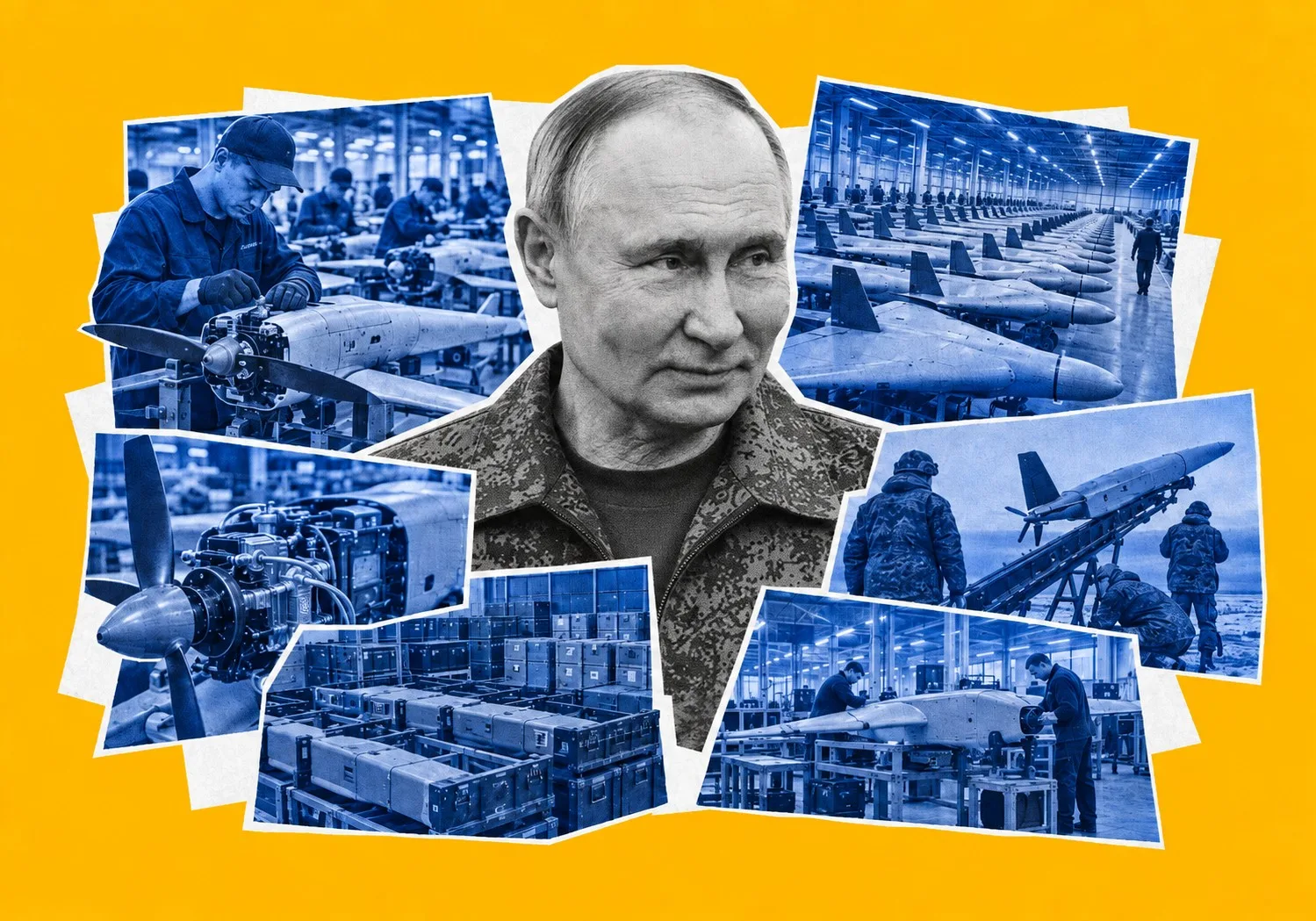
As Moscow moves to implement a covert plan to supercharge its domestic kamikaze drone manufacturing, a quiet logistics operation runs around the clock in the industrial flatlands of Russia’s Tatarstan region. The expansion of state firm Rosatom’s Alabuga-Volokno factory in Tatarstan is designed to allow Moscow to make an additional 500 tons of military-grade aerospace carbon fiber each year by 2029. This material is required to build the structural airframes, wings, and fuel tanks of the drones.
The production increase would translate to an additional 28,000 weaponized drones every year, according to expert estimates—representing a 78 percent increase in the production of weapons like those that have struck near the Polish border and left scores of Ukrainian civilians dead.
Ukraine estimates that Russia can currently produce more than 36,000 kamikaze drones, known as Gerans, annually.

According to internal documents obtained and published by Politico and The Telegraph, the Kremlin’s expansion targets are sustained by a direct Chinese supply chain.
The records show that the Jilin Chemical Fiber Group, a Chinese state-owned enterprise, exported 46 tons of polyacrylonitrile tow to Alabuga-Volokno.
This chemical precursor is required to manufacture the carbon fibre needed for the scale-up.
Without it, the structural integrity of the expanded drone production lines cannot be maintained.
The revelation moves past academic debates over microchip smuggling.
It documents a state-to-state industrial pipeline where a pillar of the Chinese state apparatus supplied a component manufacturer in Russia's defense sector.
For policymakers in London, Brussels, and Washington, the documents highlight the erosion of Western economic sanctions.
Customs Codes and Cover Stories
To understand the documents, look at the tradecraft required to move restricted materials across international borders.
Dated from this year and bearing the corporate logo of Alabuga-Volokno, the manifests outline a coordinated deception.
The cargo, consisting of two forty-foot shipping containers laden with polyacrylonitrile tow, was mislabelled under civilian customs codes reserved for synthetic fibres like nylon and polyester.
By substituting the dual-use classification with a civilian cover code, the handlers avoided automated border checks and regulatory triggers.
Weapons analysts who have analyzed the data calculate that the 46 tons of precursor provide enough raw material to manufacture structural carbon fibre components for up to 1,300 long-range kamikaze drones modeled on Iranian Shahed designs.
The documents surfaced through the Ukrainian Security and Cooperation Centre, a Kyiv-based think tank, which transmitted the cache to British and American authorities.
Subsequent reviews by US congressional committees and Western intelligence services confirmed the authenticity of the manifests.
Representatives for Rosatom insisted their enterprises operate in compliance with applicable laws, dismissing claims of wrongdoing as misunderstandings of Russian customs procedures.
The Jilin Chemical Fiber Group maintained silence, and the Chinese embassy in Washington issued denials, stating that Beijing controls dual-use items and has not provided lethal weaponry to the conflict.
Beyond Grey Markets
The notion that a state-owned enterprise could dispatch dozens of tons of aerospace chemical precursors to a sanctioned Russian nuclear subsidiary without the knowledge or facilitation of the central government requires examination.
Former intelligence officials note that corporate autonomy in China’s heavy industrial sector does not extend to supplying primary raw materials for a foreign power's wartime bombing campaign.
The Chinese state maintains oversight over strategic sectors like synthetic fiber manufacturing.
The shipments represent an institutional choice rather than a corporate smuggling ring.
This reality challenges the narrative that Russia’s military-industrial complex relies solely on commercial intermediaries, shell companies in Central Asia, and grey markets.
Economic data compiled by the Kiel Institute indicates that Beijing provides over 60 percent of the components and materials necessary to keep the Russian military functioning.
Previous disclosures generally captured these dependencies at the periphery through microelectronics routed through secondary jurisdictions.
The Alabuga documents record a direct industrial bridge linking Chinese state manufacturing to sanctioned Russian defense infrastructure.
China supplies the material support for Russia's domestic weapons production.
This industrial integration alters the economic dynamics of the conflict.
The industrial capacity of an Asian superpower acts as a buffer against Western financial penalties.

Diplomatic Friction in Washington and Beijing
The timing of this disclosure intersects with international maneuvers across multiple capitals.
As Donald Trump’s peace envoys travel to Kyiv following meetings in Moscow, and as Western leaders prepare for leadership summits in Washington with Chinese President Xi Jinping, diplomatic assumptions are tested.
Washington has threatened to tighten secondary sanctions on Chinese financial institutions and industrial firms supporting the Russian military.
Punitive measures have frequently hesitated to strike directly at major state-owned chemical and material giants due to potential ripple effects across global supply chains.
Pro-Ukraine legislators in the United States and European parliaments are utilizing the shipping manifests to demand secondary sanctions against Jilin Chemical Fiber Group.
For the White House, the dilemma involves balancing trade truces and bilateral economic warfare against export control enforcement.
For decades, the Western-led international order relied on the premise that global financial plumbing and technological monopolies constituted leverage over nations challenging the rules-based system.
That premise assumed access to Western markets outweighed alternative bilateral alignments.
By forming a sanctions-resistant economic bloc, Moscow and Beijing have demonstrated that alternative supply corridors can neutralize financial deterrence.
The international economy is fragmenting into insulated spheres.
Western export controls accelerate the economic alignment of Washington’s geopolitical adversaries.
Russia secures the stream of raw materials required to sustain structural manufacturing.
Beijing's defense-industrial ecosystem deepens its commercial integration and secures reciprocal technological exchanges with Moscow, maintaining diplomatic deniability.
The operational cost is visible in the skies over Ukraine.
Ukrainian air defences face an industrial adversary supported by bilateral state evasion.
The transit of 46 tons of chemical precursor outlines the mechanics of post-Western industrial supply chains.
Sources: Politico, The Telegraph