
Volvo, Mercedes, and Bolt Back AI Giant’s Autonomous Driving Tech in Europe

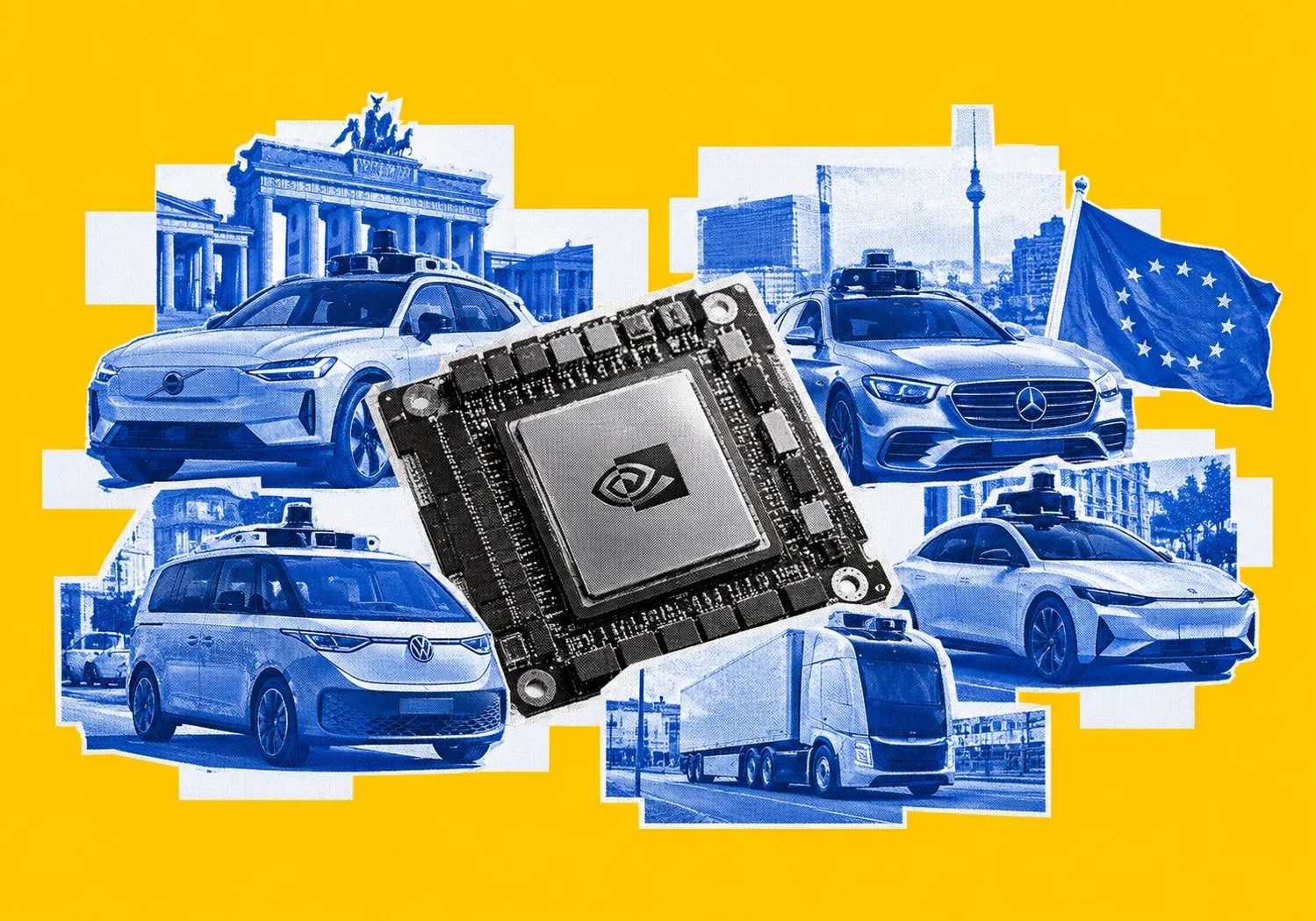
At GTC Berlin, NVIDIA unveiled expanded partnerships with European automotive leaders - including Volvo Cars, Mercedes-Benz, Volkswagen, and Bolt - to supply the underlying AI hardware and software for next-generation vehicles. As European carmakers shift from costly in-house software to NVIDIA's Hyperion architecture and Alpamayo stack, the continent's autonomous driving push faces a crucial shift: balancing faster deployment with growing reliance on a single US tech giant.
For years, autonomous driving has been an expensive exercise in technological independence. Manufacturers built their own systems, collected their own road data, and spent heavily on software that could not easily be transferred between vehicles. NVIDIA is offering a different arrangement. Its Hyperion computing architecture, Alpamayo driving software, and Halos safety technology provide a common foundation on which companies can develop their own automated driving products.
The attraction is straightforward. Sharing the underlying technology could reduce development costs and bring vehicles to market sooner. But it also places a growing part of the industry's software and computing infrastructure in the hands of a single American supplier.
Bolt’s robotaxi ambitions begin with data, not passengers
Bolt's agreement offers perhaps the clearest indication of how far Europe's robotaxi industry still has to travel.
The mobility company has selected NVIDIA's Alpamayo Stack for a programme involving future Lucid vehicles built around the Hyperion architecture. Its first planned activity is not a commercial taxi service but the collection of real-world driving data in Madrid in 2027. That work remains subject to regulatory approval. Germany has been identified as a priority for a subsequent rollout.
Bolt is targeting a fleet of at least 25,000 level 4-capable Lucid vehicles, while its broader ambition is to have 100,000 autonomous vehicles operating across Europe and the wider UNECE region by 2035. Its partnerships with Pony.ai and Stellantis remain part of that strategy.
Those figures describe intended scale, not vehicles already carrying passengers without drivers.
The distinction matters because level 4 autonomy requires a vehicle to operate without human intervention within defined conditions. Collecting driving data is an essential part of developing that capability, but it does not establish that the vehicle is ready for unrestricted commercial use.

Spain already has a framework for such testing. The Directorate-General for Traffic introduced its ES-AV rules in June 2025, covering the testing and supervision of automated and remotely operated vehicles across SAE levels 2 to 5.
Bolt's Madrid programme will therefore have to satisfy regulatory requirements before it can begin gathering data on public roads. Further authorisation would be needed before the company could turn the technology into a commercial passenger service.
This makes 2027 an important development milestone rather than a promised launch date for driverless taxis.
Volvo takes a more cautious route
Volvo Cars is approaching the same technology from a different direction.
The Swedish manufacturer is expanding its NVIDIA partnership to incorporate Hyperion, Halos OS and Alpamayo into future vehicle generations. Its initial commercial applications will focus on supervised driver assistance, with integration planned across new models leading up to 2030.
That approach keeps the human driver responsible for supervising the system. It also allows Volvo to introduce increasingly sophisticated automation without immediately assuming the regulatory and technical burden of a fully driverless vehicle.
For manufacturers selling cars to private customers, this gradual progression offers a different commercial proposition from the robotaxi model. An advanced assistance system can become part of an existing vehicle range. A driverless taxi service must establish an operational environment in which the vehicle can function independently.
Mercedes-Benz is pursuing both more advanced automation and near-term assistance capabilities. It is extending its collaboration with NVIDIA on level 3 and level 4 driving while preparing to seek German regulatory approval for MB.DRIVE ASSIST PRO, its urban point-to-point assistance system.
The difference between those levels is commercially significant. Level 3 systems can take responsibility for driving under specified conditions but still require a human to resume control when requested. Level 4 systems must handle the driving task independently within their approved operational limits.
NVIDIA can supply technology intended for both. It cannot remove the need to prove that each application operates safely.
A common architecture changes the economics
The centrepiece of NVIDIA's offering is Hyperion, a reference architecture combining computing hardware with a defined arrangement of sensors.
The Hyperion 10 configuration includes 14 exterior cameras, four interior cameras, nine radars and one lidar sensor. Rather than designing every component of the computing and sensor system independently, manufacturers can build around a shared technical foundation.
This could have considerable consequences for automotive research and development.
A proprietary autonomous driving system requires extensive engineering work before a manufacturer can begin refining how the vehicle behaves in traffic. Standardised architectures allow more of that foundational work to be reused, potentially freeing engineering teams to concentrate on vehicle-specific functions and integration.
It is not simply a question of buying processors. NVIDIA is extending its role into the software that interprets driving situations and the tools used to assess whether automated decisions are safe.
That makes the relationship more consequential than a conventional automotive supply contract.
Volkswagen Commercial Vehicles has already demonstrated its autonomous ID. Buzz AD platform using Hyperion as a common computing and sensor architecture. Swedish freight technology company Einride is developing its next-generation Einride Driver on the same foundation for autonomous trucks.

Public transport is another prospective application. TIER IV and the Technical University of Munich are planning to integrate Hyperion into autonomous transit systems in Germany.
These businesses serve different markets and operate vehicles with different requirements. Their adoption of a shared architecture nevertheless creates opportunities to reuse development tools and testing methods across the industry.
For smaller operators, access to established technology could make autonomous vehicle development more financially manageable. For traditional manufacturers, it raises uncomfortable questions about the value of maintaining expensive internal systems that duplicate functions available from outside suppliers.
NVIDIA stands to benefit whichever company ultimately sells the vehicle or operates the service.
Safety evidence becomes part of the product
Computing capability alone will not determine when autonomous vehicles become commercially viable in Europe.
Manufacturers must also demonstrate that their systems meet the applicable safety requirements. This is particularly demanding for vehicles expected to make driving decisions without continuous human supervision.
NVIDIA's newly introduced Halos SAFE framework is designed to organise that evidence. Developed with validation partners including dSPACE, IVEX and TÜV Rheinland, it aims to connect simulation results, testing and safety assessments in a measurable, traceable process.
The emphasis on traceability is important. A manufacturer needs more than evidence that its system performed successfully during selected demonstrations. It must be able to document how the technology was evaluated and establish a defensible basis for its safety claims.
European regulatory requirements give this work commercial urgency. EU Regulations 2018/858 and 2019/2144, together with Implementing Regulation 2022/1426, form part of the framework governing vehicle approval and automated driving systems.
A standardised safety process could make it easier for manufacturers to organise the evidence required under these rules. It does not, however, amount to regulatory approval. Authorities retain responsibility for determining whether a particular vehicle and system satisfy the relevant requirements.
That distinction limits how quickly common technology can translate into common commercial deployment.
The financial argument for simulation
Physical testing remains one of the most expensive elements of autonomous driving development. Vehicles must encounter a wide range of traffic conditions, while engineers need sufficient evidence to evaluate their performance.
NVIDIA is attempting to reduce the amount of testing that must take place on public roads.
Its expanded development offering includes Alpamayo 2 Edge, AlpaJudge, Foundation4D and Cosmos 3 Nano model variants. The company is also developing data-factory initiatives with Uber and a Volkswagen Group workflow led by Porsche using Microsoft Azure.
The Porsche-led approach combines simulation and data-processing technologies, including Cosmos Data Factory and Omniverse NuRec. The stated potential benefits are substantial: reductions of up to 90% in repeated physical test drives and up to 85% in development cycles.
These are projected efficiency gains, not evidence that road testing can be dispensed with.
Simulation can allow engineers to examine driving situations repeatedly without deploying a physical vehicle each time. It can also support the production and assessment of data used to improve automated driving systems.
But the more development shifts into simulated environments, the more important it becomes to establish that the resulting evidence corresponds to real-world performance.
This is where NVIDIA's computing and safety businesses begin to reinforce one another. The company is supplying tools for developing automated driving behaviour while also offering a framework intended to support its validation.
For carmakers facing years of development expenditure, that combination could be difficult to ignore.
Europe’s new automotive dependency
The emerging business model creates opportunities for manufacturers that can move quickly, but it also changes where technical control sits within the industry.
European carmakers have traditionally treated proprietary engineering as a source of competitive advantage. As automated driving becomes more dependent on AI models, large computing systems and extensive data infrastructure, maintaining complete independence becomes increasingly costly.
Adopting NVIDIA's platforms allows manufacturers to share part of that burden. It also means that competitors may rely on the same foundational technology even when their vehicles, customers and commercial strategies differ.
Independent software suppliers whose businesses depend on closed, proprietary driving systems could face pressure as common architectures gain acceptance. Internal automotive development departments may encounter similar questions about the costs of maintaining alternative platforms.
None of this means manufacturers are abandoning their own engineering capabilities. Volvo's supervised approach, Mercedes-Benz's work on higher levels of automation, and Bolt's multi-partner strategy show that companies are still making different decisions about how and when to deploy the technology.
Nor does a common platform guarantee that those decisions will produce successful commercial services.
The immediate advantage for NVIDIA is that it can participate in several competing approaches simultaneously. Its systems may support a privately owned car with supervised assistance, a commercial truck operating autonomously or a future robotaxi fleet.
European regulators, meanwhile, must evaluate the safety of each application rather than the commercial appeal of the shared platform beneath it.
The tension is becoming clearer. Manufacturers have an economic incentive to standardise as much of their automated driving technology as possible. Regulatory approval remains tied to the behaviour and safety of particular systems in particular operating conditions. As more European vehicles come to depend on common AI infrastructure, the industry will have to establish where the benefits of shared technology end and responsibility for individual vehicle performance begins.
Sources: Nvidia News, Bolt, Larazon, Reuters, Volvo Cars