
NVIDIA DSX Platform: Tackling Europe’s Grid Constraints and Water Limits in AI Data Center Buildouts

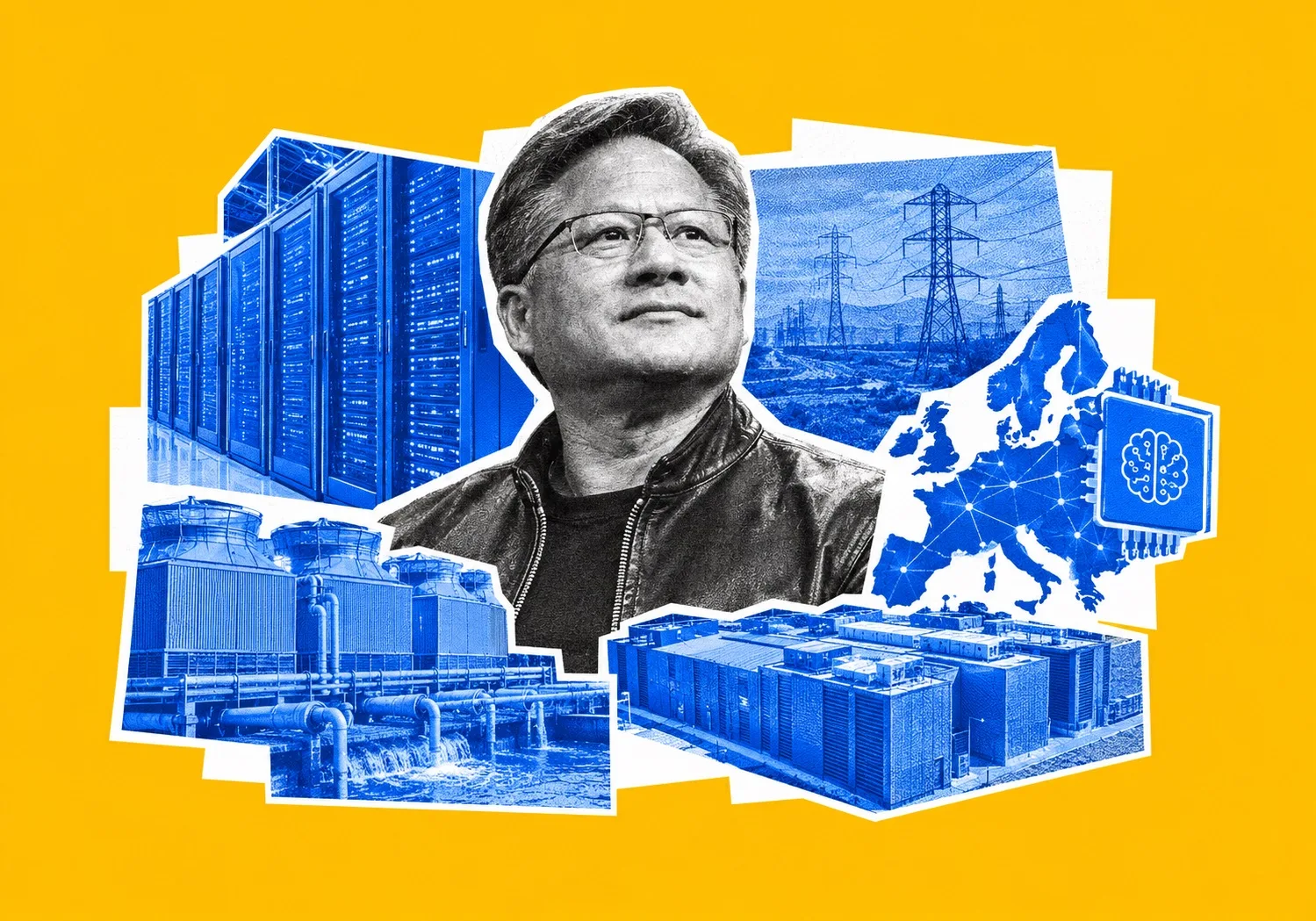
NVIDIA has launched its DSX AI Factory Platform, partnering with European industrial leaders to address severe power grid bottlenecks and environmental water restrictions. By introducing dynamic power management (DSX MaxLPS) and zero-water liquid cooling, the architecture allows data center operators to scale AI computing within existing utility allocations while cutting deployment times from months to weeks.
A conventional data centre is generally designed around a relatively predictable electricity requirement. Once operating, it draws power to support its installed equipment, leaving utilities to accommodate that demand.
AI facilities complicate this arrangement. Their concentrated computing loads can place substantial pressure on local networks, particularly where grid capacity is already heavily committed.
NVIDIA's DSX Flex software is intended to make those facilities more responsive to the electricity system around them. Instead of treating power availability as a fixed operating condition, the platform can adjust computing workloads according to utility requirements, electricity prices, and demand-response events.
It also coordinates electricity drawn from the grid with onsite renewable generation and energy storage.
The practical implications became clearer in an early trial involving NVIDIA, Emerald AI, EPRI, Nebius and the UK's National Grid. A Blackwell Ultra GPU cluster reduced its electricity draw by as much as 40 per cent during simulated grid events while continuing to support critical workloads.

That result does not establish how every commercial AI installation would perform during a genuine network emergency. It does, however, offer evidence that some computing demand can be adjusted without bringing essential operations to a halt.
For European utilities, such flexibility could make a meaningful difference. A facility capable of reducing demand during periods of grid stress presents a different planning challenge from one requiring its maximum allocation continuously.
It could also change the relationship between data centre developers and local authorities. Projects would have an additional means of demonstrating that their electricity requirements need not translate directly into an inflexible burden on surrounding infrastructure.
There are limits. Flexible consumption cannot create grid capacity where none exists, and operators still need reliable supplies for workloads that cannot be interrupted. The value of DSX Flex will depend partly on how much computing activity can be shifted or moderated in real operating conditions.
More AI output from the same electricity supply
Another part of NVIDIA's strategy addresses the electricity already allocated to a facility.
DSX MaxLPS manages power dynamically across computing equipment rather than assuming that every component must operate at a fixed maximum level. NVIDIA says this approach can produce the same number of AI tokens while using up to 30 per cent less electricity.
The alternative is to use the efficiency improvement to accommodate more GPUs and generate additional output without increasing the facility's existing power allocation.
Early tests indicate the scale of that trade-off.
Lambda recorded a 24 per cent increase in cluster token generation and supported 19 per cent more GPU capacity on HGX B200 systems. In Iceland, Nscale reported 49 per cent higher inference throughput and 37 per cent more managed GPU capacity across four GB300 NVL72 racks operating within a 264-kilowatt power budget.
These are proof-of-concept results rather than guarantees of equivalent performance across all installations. Their significance lies in showing how software-based power allocation can affect the economics of computing infrastructure.
A developer unable to obtain a larger grid connection might still expand its commercial computing capacity. That would be particularly attractive in European markets where new electricity connections are difficult to secure.
But there is an important distinction between improving energy efficiency and reducing total energy consumption.
If operators use the available savings to install more processors, the facility may continue drawing much the same amount of electricity while producing more AI output. Such an outcome would improve productivity without necessarily relieving pressure on the local grid.
For policymakers, that distinction will matter when assessing claims about the environmental benefits of AI infrastructure.
Cooling without consuming millions of litres of water
Electricity is only one resource constraint. Removing heat from increasingly dense computing equipment has become another major engineering problem.
Traditional cooling towers rely on evaporation to release heat, consuming considerable quantities of water. Air cooling, meanwhile, becomes harder to apply as more powerful AI processors are concentrated into individual racks.
NVIDIA's DSX reference architecture uses closed-loop liquid cooling combined with outdoor dry coolers. Liquid carries heat away from the computing equipment, while the dry coolers transfer it to the surrounding air without relying on water evaporation.
Under suitable conditions, this arrangement can bring facility cooling water consumption close to zero.
NVIDIA estimates that a 2-gigawatt deployment using DSX could save 54 million litres of water each day compared with conventional cooling towers. The company equates that volume to the daily consumption of approximately 180,000 households.
The figure illustrates the potential scale of water savings, although it is based on NVIDIA's estimates rather than measured performance from a completed deployment of that size.
Climate also matters. During periods of high outdoor temperatures, dry cooling may require supplementary mechanical cooling to maintain the necessary operating conditions. That can increase electricity demand even when evaporative water consumption remains minimal.
European developers will therefore need to assess the combined energy and water performance of individual sites rather than assume that one cooling design delivers identical benefits everywhere.
The wider commercial incentive is clear. Where water abstraction is tightly regulated, reducing consumption can remove a substantial obstacle from the planning and approval process.
From construction sites to factory-built infrastructure
NVIDIA is also attempting to shorten the time between securing a site and bringing AI computing capacity online.
Its DSX POD concept packages infrastructure into standardised, factory-tested modular units built around the forthcoming Vera Rubin platform, with deliveries scheduled to begin in early 2027.
Working with companies including Schneider Electric, Vertiv, Bull, Dell, HPE and Lenovo, NVIDIA aims to reduce on-site deployment periods from roughly six months to as little as 14 days.
That shorter timetable applies to sites prepared in advance. It does not eliminate the need for grid connections, planning permission or the other infrastructure required before installation.
The change concerns where much of the engineering work takes place.
Instead of assembling and testing numerous systems individually at a construction site, manufacturers can integrate them into standardised units before delivery. That offers an opportunity to reduce onsite complexity and improve consistency between installations.
NVIDIA is extending the same philosophy into the design process.
Its DSX Sim software and SimReady Central Library, available through Hugging Face, support digital models of facilities before physical construction begins. Engineers can use these digital twins to examine how electrical equipment, cooling systems, and computing infrastructure interact.
This becomes particularly valuable when facilities combine equipment from several manufacturers. Identifying a thermal or electrical design problem in a simulation is generally less disruptive than discovering it after installation.
Open-source DSX OS components, including Config Manager, Rack Management Service and Cluster Readiness Engine, are intended to automate parts of configuration, monitoring and infrastructure readiness.
Together, these tools point towards a more repeatable manufacturing process for AI infrastructure, although the proposed deployment savings remain dependent on site preparation and successful integration.
Why Europe's industrial companies matter
The DSX initiative also reveals how much the AI industry now depends on companies traditionally associated with electrical engineering, industrial automation and building systems.
Siemens, ABB, Schneider Electric, AVEVA, Dassault Systèmes, Eaton, Trane Technologies and Vertiv are among the companies integrating equipment or engineering software into the ecosystem.
Their involvement is more substantial than a conventional supplier relationship.
ABB incorporated digital models of its medium-voltage switchgear and uninterruptible power systems into Omniverse DSX during 2026. Siemens developed IEC and UL blueprints for Vera Rubin infrastructure, supporting electrical, thermal, and acoustic simulation before construction.
Such integration brings industrial engineering decisions closer to the earliest stages of computing-system design.
It also gives established European equipment manufacturers a potentially influential position in the expansion of AI infrastructure. Their products are becoming part of the reference architectures around which future facilities may be designed.
For NVIDIA, the advantage is an ecosystem capable of supporting its computing platforms beyond the processor itself. For industrial partners, it creates opportunities to supply increasingly specialised power distribution, cooling and control systems.
Traditional data centre operators may face a more difficult adjustment. Facilities built around water-intensive cooling or relatively inflexible power consumption could become less competitive against installations designed from the outset to accommodate resource constraints.
The pressure will not come solely from computing performance. It may also arise from the conditions imposed by utilities, environmental regulators and local planning authorities.
Europe's AI infrastructure expansion is consequently becoming an industrial engineering challenge as much as a computing one. Faster processors remain valuable, but their commercial usefulness increasingly depends on whether developers can provide the electricity, cooling and physical facilities required to operate them.
NVIDIA's proposed architecture gives operators more ways to work within those constraints. Yet the choice between using efficiency gains to reduce resource demand and using them to expand computing capacity remains unresolved.
A data centre that produces substantially more AI output within its existing electricity allocation may be a commercial success. For a European grid already struggling to accommodate new connections, the more consequential question is whether that same facility can reliably surrender part of its allocation when the surrounding electricity system needs it.
Sources: Nvidia News, TNW, ABB, CNBC