
AI’s Energy Boom Sparks a European Grid Crisis: Will Consumers Foot the Bill?

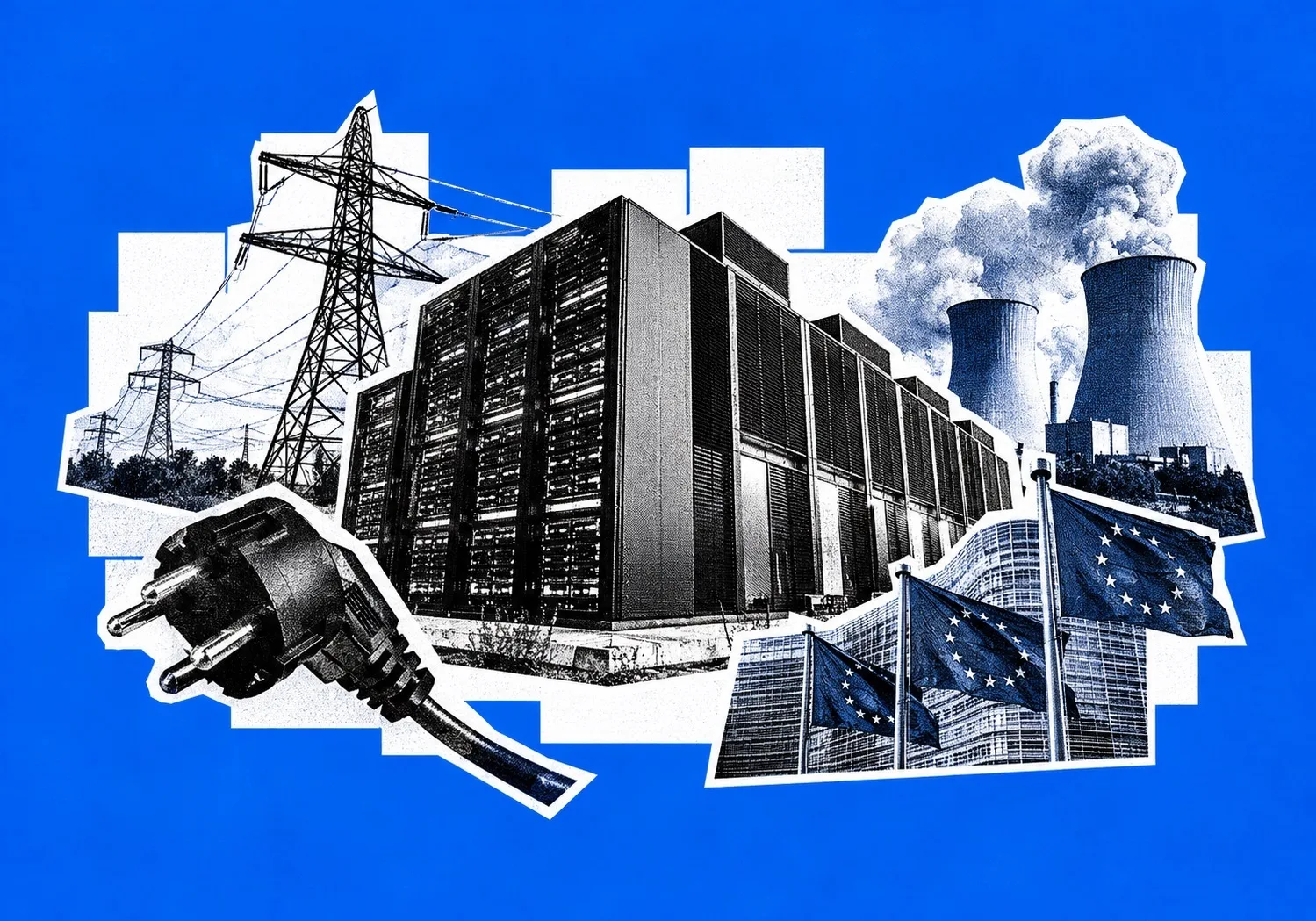
As data centres overwhelm electricity networks across Europe, regulators are scrambling to stop speculative grid requests from driving up household utility bills.
The survey, conducted by Kekst CNC among 1,832 executives in 78 countries between August and October 2026, points to considerable uncertainty about the scale of the increase. Almost a third of respondents expect demand to exceed projections significantly. Just 3% anticipate lower consumption.
The International Energy Agency estimates that data centres consumed 485 terawatt-hours of electricity worldwide in 2025. That figure could reach 950 TWh by 2030, equivalent to roughly 3% of global electricity consumption. Demand from specialised AI data centres is expected to triple.
Yet electricity consumption is only part of the problem. Across Europe, companies are seeking connections to networks that were never designed to handle so many large, concentrated loads arriving within such a short period.
Some of those facilities may never be built.
The problem with reserving power that may never be used
For electricity network operators, a request for grid capacity is not the same as an operating data centre. Nevertheless, developers seeking connections can influence investment decisions long before construction begins.
Research by Capgemini found that 67% of energy companies encounter speculative data centre applications. An estimated 19% of requested grid capacity may never translate into operational projects.
That distinction matters enormously when network upgrades involve expensive transmission lines, substations and other infrastructure with long operating lives.
Developers have commercial reasons to secure electricity access early. A site with an attractive grid connection can become more valuable to investors, even if its eventual development remains uncertain. But when numerous companies pursue the same strategy, the combined applications create a distorted picture of future electricity needs.
Network operators must then decide whether to invest in capacity that might remain unused or delay projects that genuinely need power.
Capgemini's findings indicate that 77% of energy companies already struggle with load forecasting. AI compounds that difficulty because its electricity requirements are concentrated in facilities whose development schedules and ultimate capacity can change.
Traditional electricity planning relied on relatively predictable patterns of household consumption, population growth and industrial activity. Large data centres introduce a different proposition: substantial demand arriving at individual locations, sometimes years before operators can establish how much of the proposed capacity will actually be used.
The danger is not only a shortage of electricity. It is also the possibility of building the wrong infrastructure, in the wrong places, for customers who never arrive.
Why consumers could inherit the bill
Electricity networks are generally financed through regulated charges distributed across users. That approach makes sense for infrastructure serving a broad customer base, but becomes more contentious when a small number of commercial projects drive a disproportionate share of expansion.
According to National Grid Partners, 83% of energy firms warn that the costs of data centre-driven network upgrades could be transferred to households under existing tariff arrangements.
Consider a transmission upgrade designed to serve several proposed data centres. If the network operator invests and only some facilities proceed, the infrastructure still has to be financed. Unless regulations assign the risk to the developers requesting capacity, other network users may be left paying for assets built around demand that failed to materialise.
This is where AI's infrastructure boom becomes a political issue.
European households already contribute to the maintenance and modernisation of electricity systems. Asking them to absorb additional costs associated with speculative commercial projects would make the distribution of financial risk increasingly difficult to defend.
Traditional manufacturers face a related problem. Energy-intensive industries compete with data centres for available network capacity, potentially confronting higher operating costs and delays to their own investment plans.
Major energy companies, including RWE, have raised concerns about transferring the costs of data centre expansion to domestic customers and established industrial users.
The disagreement is not over whether electricity networks need investment. They do. It concerns which customers should finance upgrades and who should bear the consequences when projected demand proves inaccurate.
Britain moves to make developers pay for their place in the queue
The UK's energy regulator, Ofgem, has proposed a direct response to speculative applications.
In July 2026, it put forward a mandatory Data Centre Commitment Fee requiring developers to deposit between 2.5% and 7.5% of construction costs.
The proposal would make reserving network capacity a more consequential financial decision. Developers would have to demonstrate a degree of commitment before occupying space in connection queues.
Such a requirement could discourage companies from seeking multiple connections without sufficiently mature projects behind them. It would also distinguish developers prepared to commit capital from those primarily interested in preserving future options.
The European Commission is pursuing related changes through its Strategic Roadmap for Digitalisation and AI in the Energy Sector.
Its approach includes greater transparency in connection queues, flexible grid agreements and provisions commonly described as use-it-or-lose-it: capacity reservations should not remain indefinitely available to projects that fail to progress.
European Commissioner Teresa Ribera has also emphasised the need to protect households from rising energy bills associated with the expansion.
Neither approach eliminates the underlying demand for electricity. Instead, both attempt to make the market for grid access more credible.
A connection request would become less of a speculative commercial asset and more of a commitment carrying financial and regulatory obligations.
Europe's data centre geography is becoming an energy problem
The pressure is particularly acute in countries where data centre development is concentrated.
Ireland faces the most striking imbalance. Moody's projects that data centres could account for as much as 30% of the country's electricity consumption by 2035.
In the Netherlands, the corresponding figure could reach 17%. The UK and France are projected to see data centres account for at least 5.7% of national demand by the same year.
Germany faces a somewhat different challenge. Data centre requirements are approaching 5–10% of peak load, adding pressure to an electricity system already constrained by network bottlenecks.
These figures reveal why national electricity generation statistics cannot fully explain the problem.
A country may have sufficient electricity production overall while lacking transmission capacity in the locations where data centres want to operate. Building additional generation elsewhere does not automatically resolve a congested regional connection.
That geographical imbalance could influence where future investment goes.
Nordic locations with accessible electricity capacity may gain an advantage over established technology centres where grid connections are increasingly difficult to secure. For developers, reliable access to power could become as important as the commercial attractions that previously determined where facilities were built.
The distribution of electricity infrastructure may consequently play a larger role in shaping Europe's digital economy.
Can technology companies reduce their dependence on public grids?
Some of the largest technology companies have another option: finance their own electricity infrastructure.
Dedicated generation, including nuclear power, renewable energy and storage, can reduce dependence on congested public networks. Long-term power purchase agreements can also help companies secure electricity supplies and provide greater financial certainty for generation investments.
These arrangements address different aspects of the problem. A power purchase agreement can secure a commercial supply of electricity, but it does not necessarily eliminate the need for transmission capacity. Generation located behind the meter, serving a facility more directly, can reduce its reliance on the wider network.
Both approaches favour companies with sufficient capital and the ability to make long-term commitments.
Smaller developers may find themselves at a disadvantage if public grid connections become harder to obtain while large technology groups increasingly secure dedicated energy arrangements.
There are potential benefits for electricity infrastructure businesses. Grid operators and transmission equipment manufacturers stand to gain from investment in network reinforcement, while regions with abundant accessible power can attract new industrial activity.
But investment alone will not resolve the question of who carries the risk.
A privately financed generation project places more responsibility on its commercial backers. A public network upgrade funded through general tariffs can distribute that responsibility much more widely, including to consumers who receive little direct benefit from the data centre it was intended to serve.
A new test for Europe's electricity regulators
For decades, electricity regulation largely assumed that expanding networks to accommodate growing demand would benefit the wider economy. The arrival of large AI facilities complicates that assumption.
A data centre can be a substantial electricity customer, but its contribution to network costs depends on the terms under which it connects. The financial consequences of its failure to proceed depend on those terms too.
Regulators must therefore make decisions before they know how much proposed demand will materialise.
Restricting connections too aggressively risks delaying genuine investment. Allowing developers to reserve capacity without meaningful obligations risks expensive overbuilding and longer queues for other users.
The emerging British and European approaches are attempts to manage that uncertainty through deposits, transparency and enforceable development commitments rather than relying solely on increasingly unreliable forecasts.
Their effectiveness will depend on whether they change developers' behaviour without obstructing viable projects.
There is a further complication. As larger technology companies pursue dedicated electricity supplies, public networks could increasingly serve a different mix of customers from the one regulators originally expected. Some of the most commercially powerful users may be able to reduce their exposure to network constraints, while households and conventional industries remain dependent on shared infrastructure.
That makes tariff design more than a technical exercise. It determines whether the financial risks created by AI expansion stay with the companies pursuing it or are distributed among electricity consumers.
Europe's regulators are being asked to approve investments that may shape power networks for decades, often based on projects that exist only as connection applications. The most consequential decision may come before a single data centre begins operating: whether its developer, or the wider public, is responsible for the capacity reserved in its name.
Sources: NG Partners, Capgemini, IEA, Bloomberg, The National News