
Multiple Dead and Injured in Canadian Military Base Fire as Cause Remains Unknown

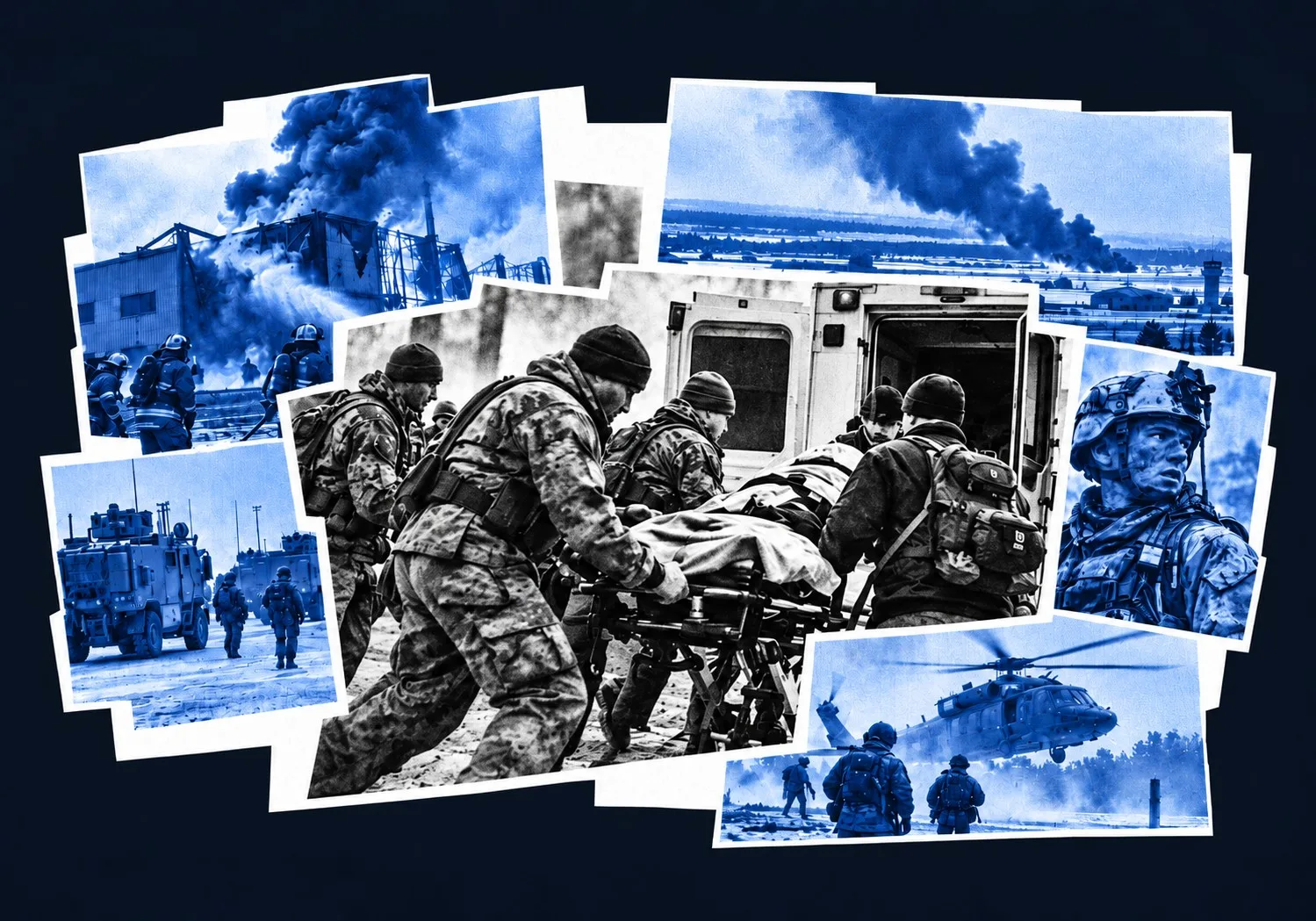
At least seven people are dead and dozens injured after a live-fire training exercise at Canadian Forces Base Wainwright triggered a major fire on Saturday. Driven by 100 km/h wind gusts, the blaze tore across Canada's busiest training installation, straining regional medical services and drawing messages of solidarity from NATO allies while officials investigate the exact cause.
It was a severe breakdown on Canada’s primary training base.
CFB Wainwright hosts both the Canadian Manoeuvre Training Centre and the 3rd Canadian Division Training Centre. Spanning more than 148,000 acres (approximately 600 square kilometers) across east-central Alberta, the installation stands as one of the Canadian Armed Forces' primary and largest combined-arms training properties.

As of 2021, the base had 1,310 military and civilian personnel stationed there, according to census data reported by Reuters. On a typical day, the site accommodates approximately 690 active military personnel alongside 300 civilian workers, contractors, and range maintenance technicians. Its vast live-fire ranges accommodate heavy armor maneuvers, artillery fire, and combined-arms exercises.
In the absence of an official statement confirming the cause of the fire, unconfirmed reports have emerged regarding the operational circumstances.
Citing unnamed military sources, Canadian network Global News reported that live ordnance or ammunition may have inadvertently struck a natural gas line or gas well during the live-fire exercise.
Natural gas pipelines and extraction wells traverse the base's operational land, where safety buffer zones and firing arcs are standardly enforced to separate exercises from industrial energy infrastructure.
Confirming a "serious incident creating a major fire," Prime Minister Mark Carney offered his support to those affected.

Defence Minister David McGuinty described the situation as "very, very active and delicate," adding that he could not recall an equivalent incident in recent Canadian memory while declining to officially confirm the cause or exact casualty figures.
Further information will be released in the "coming hours and days," McGuinty added. He confirmed that federal and provincial agencies were fully engaged. "The Canadian Armed Forces, the Department of National Defence, partners across the federal government, including Public Safety, are working with the Government of Alberta and municipal governments to mobilize all necessary support," Defence Minister said.
Leadership across the military structure echoed the gravity of the situation.
Chief of the Defence Staff General Jennie Carignan issued an official statement outlining the immediate priorities.
"This is a profoundly difficult moment for the entire Canadian Armed Forces. Our immediate focus remains on supporting those affected, assisting emergency response efforts, and ensuring the well-being of our members, their families, and the surrounding community," General Carignan noted.
Commander of the Canadian Army Lieutenant-General Michael Wright confirmed that army personnel and civilian responders were working directly with municipal authorities while range officers secured the site for technical investigators.
Code Orange: Emergency Services Mobilise Across Alberta
The mass-casualty event severely strained medical and emergency networks across Alberta.
With the base situated approximately 200 kilometers east of Edmonton, regional medical logistics mobilized rapidly.

Edmonton’s Royal Alexandra Hospital declared a code orange protocol to clear emergency trauma units, coordinating alongside the University of Alberta Hospital.
Emergency transport relied heavily on Highway 14 and regional air ambulance services, including Shock Trauma Air Rescue Service (STARS) helicopters, which deployed to triage and transport critical patients.
Local medical facilities, including the Wainwright Health Centre, managed initial stabilization before patients were transferred to tertiary trauma centers.
Dr Warren Thirsk, an emergency physician at the hospital, described the scene: "It is more patients than any of us want to count right now. It's a disaster. It's a one in every 15 to 25-year disaster."
Inter-provincial support mobilized quickly. Alberta Premier Danielle Smith called the fire "significant and tragic." Saskatchewan Premier Scott Moe deployed emergency equipment across the border, while British Columbia Premier David Eby offered full operational assistance.
‘A Disaster Inside the Fence’: A Military Town in Shock
For the neighbouring town of Wainwright, located just north of the base with a population of about 6,600 according to Reuters, the boundary between base and town barely exists. Mayor Bruce Pugh highlighted the deep civil-military integration shaping the community.
"We have neighbours who are either serving or former members of the Canadian Armed Forces. We're integrated, our kids play in the same hockey teams, attend the same schools," Mayor Pugh said.
Pugh noted that this will likely stand as the largest mass-casualty disaster in the municipality's recorded history. In a town where local firefighters from the Wainwright Fire Department, civilian technicians, and military families live side by side, an operational disaster inside the fence becomes an immediate municipal crisis.
The emergency response involved coordinated deployments between municipal emergency personnel, regional volunteer and professional fire departments, and the Department of National Defence's internal fire and rescue services.
High-wind advisories issued across the Alberta prairies on Saturday created severe operational headwinds, with gusts reaching up to 100 km/h that fueled the rapid spread of grass and brush fires across the range boundary.
Local authorities maintained strict traffic advisories to clear roads for emergency vehicles moving patients toward Edmonton. The municipality confirmed on social media that while the fire had crossed the base fence into the surrounding district, no evacuation orders had been issued for residents.
‘Canada Does Not Carry This Grief Alone’: NATO Allies Respond
The disaster prompted immediate reactions across NATO, reflecting Wainwright’s status as a multinational training ground where international allies frequently participate in joint exercises.
Admiral Giuseppe Cavo Dragone, chair of the NATO Military Committee, posted an official statement on social media on Sunday morning.
"Canada does not carry this grief alone. All 32 allied chiefs of defence stand with you and the Canadian Armed Forces," Admiral wrote.
Dragone emphasized that Wainwright is where not only Canadian troops train, but many NATO allies alongside them, extending condolences for the dead and wishing full recovery for the injured.
Latvian President Edgars Rinkēvičs also offered condolences: "Terrible news about the explosion at the Canadian Forces Base in Wainwright. My sincere condolences to the families and friends of the victims. Latvia stands in solidarity with our Canadian friends and allies at this tragic moment."
Questions Over Range Safety as Military Investigators Move In
The Department of National Defence confirmed that formal technical reviews and investigations are underway. In addition to civilian energy regulators assessing land-use boundaries around local infrastructure, military investigative bodies—including the Canadian Forces National Investigation Service (CFNIS)—are tasked with examining adherence to standard live-fire safety regulations and operational protocols during the exercise.