
Spain Train Crash: 68 Dead in High-Speed Rail Collision Suspends Rail Traffic to Andalusia

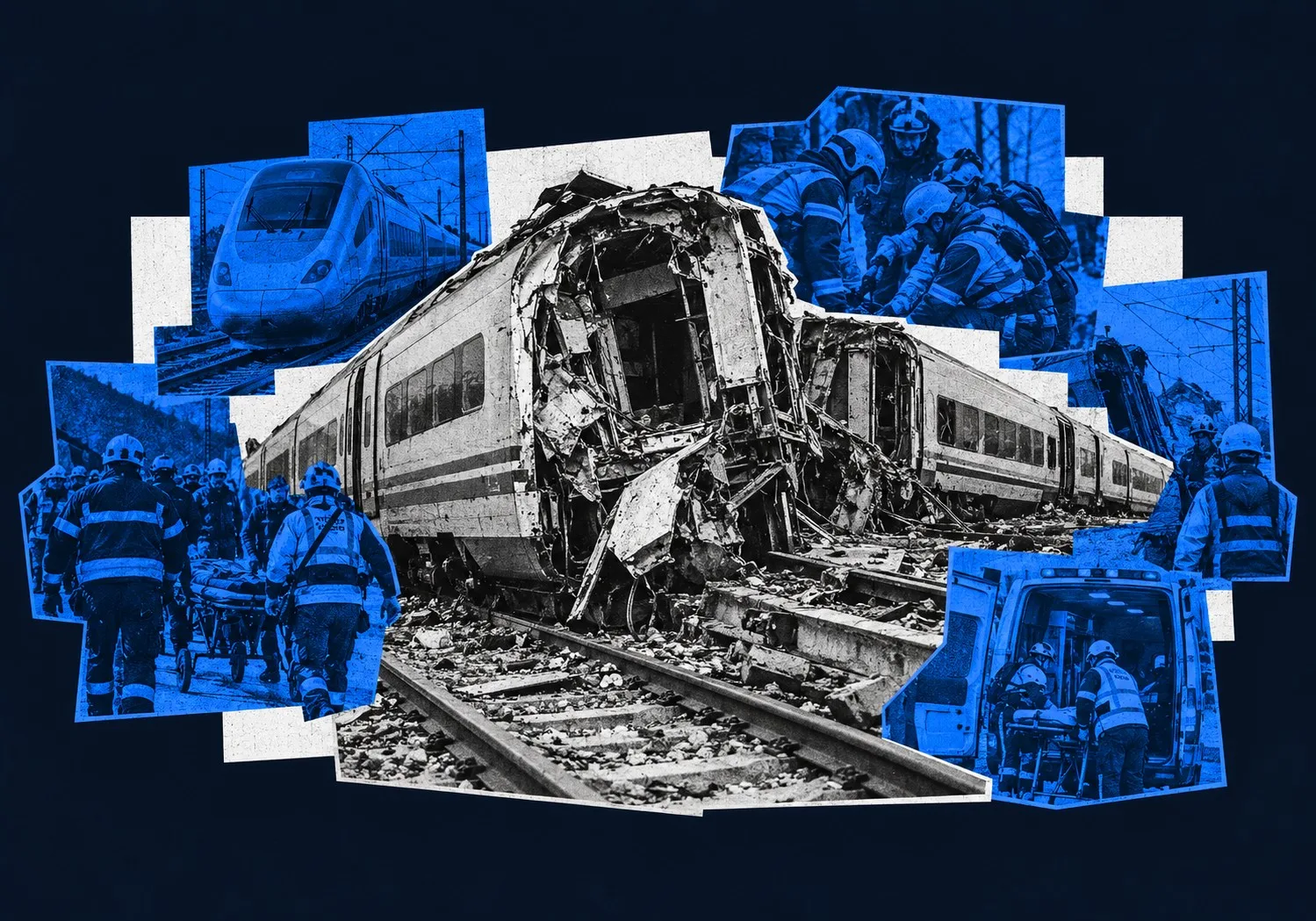
At least 68 people have been killed and nearly 80 injured after two high-speed passenger trains collided near the towns of Mora and Orgaz in Toledo province, central Spain.The violent impact involved a Renfe high-speed service carrying 397 passengers and a stationary Iryo express train carrying 147 passengers on the main rail line connecting Madrid to Seville.

The collision occurred at 08:54 local time (07:54 GMT) on Wednesday, 28 October 2026, following a computer malfunction in the automated signalling system that brought traffic to a standstill across the region.
High-speed rail services between Madrid and the southern region of Andalusia remain completely suspended while emergency services conduct search and recovery operations in the central region of Castilla-La Mancha.
The force of the impact derailed both train services along an elevated section of track roughly 118 kilometres south of Madrid, throwing at least two passenger carriages down the embankment below.

Emergency teams rushed to the scene to search through the wreckage of the derailed carriages, where twisted metal, broken panels, and debris lay scattered across the terrain.
Manuel Galán, the mayor of the nearby municipality of Urda, prepared a local sports hall at the request of emergency services to accommodate the injured and support affected families.
Regional authorities confirmed that at least 73 people required hospital treatment, including 15 passengers who remain in serious condition.
The regional leader of Castilla-La Mancha, Emiliano García-Page, indicated that the death toll could rise further as search teams work to reach the bottom sections of the overturned carriages.
Spanish Prime Minister Pedro Sánchez declared three days of official national mourning from the crash site in Castilla-La Mancha, confirming that all of Spain is in mourning.
Sánchez announced that any failures in the security system or operational negligence uncovered by investigators would be addressed with the utmost severity.
Spain’s main political parties, which were actively preparing for next month's general election, immediately suspended all planned campaign activities for the day.
Alberto Núñez Feijóo, leader of the main opposition People’s Party, expressed concern over the tragedy and stated that the immediate priority must remain attending to the victims and supporting emergency teams.
Additionally, the Spanish Football Federation postponed all 24 Copa del Rey matches scheduled for Wednesday.
System Blackout
High-speed rail services throughout Spain operate under continuous automated train protection architectures, including the LZB signaling system on the Madrid–Seville line.
The LZB system continuously monitors train speeds, tracks vehicle positions, maintains safe operational intervals, and automatically applies brakes if a train approaches an occupied section or an active stop signal.
At approximately 08:30 local time, a computer communications malfunction interrupted the LZB system, disabling automated control across a 63-kilometre stretch of the line.

The sudden blackout caused the system to execute an automatic safety protocol, halting at least six trains traveling along the corridor.
Among the halted services was an Iryo express train departing Madrid Atocha for Seville at 07:54 with 147 passengers on board, including a baby.
With automated signaling disabled across the stretch, operational control over train movements was transferred to a 24-hour central rail traffic command centre operated by state infrastructure manager ADIF in Madrid.
Under standard railway safety protocols, when automated signaling goes down, traffic must be managed under strict fallback procedures to prevent trains from entering occupied blocks.
However, operators inside the Madrid central command centre issued instructions to the trailing Renfe train to resume normal travel operations.
The Renfe service, which had departed Madrid at 08:00 carrying 397 passengers, proceeded down the track for approximately 25 kilometres over a 17-minute period.
At 08:54, while traveling through a section allowing speeds up to 200 kilometres per hour, the Renfe train struck the rear of the stationary Iryo train, which remained stopped behind an active stop signal between Mora and Orgaz.
Transport Minister Óscar Puente confirmed that the collision involved a train from state-owned operator Renfe and a service from private rail company Iryo.
Puente characterized such rear-end collisions as highly unlikely under standard operating conditions and stated that the decision to resume traffic past a stop signal was an operational error made under inexplicable circumstances.
"It was the control centre, through its operators, that made the decision to resume traffic, under circumstances that, from our point of view, are inexplicable," Puente stated during a press briefing.
"Clearly, it was a wrong decision. I am not attributing responsibility to anyone, I am just stating the facts," the minister added.

The Human Element
Initial disclosures from the Ministry of Transport revealed that erroneous instructions to resume normal travel past active stop signals were given to more than one train along the affected section that morning.
Disaster was avoided on another part of the line because an individual train engineer directly questioned the instruction issued by the Madrid command centre.
Rather than accelerating to normal line speed, the engineer insisted on operating under "on-sight" rules.
Under on-sight operation protocols, a train driver is permitted to advance past a stop signal only at a greatly reduced speed, maintaining continuous visual control over the track ahead to ensure it is clear of obstructions or stationary vehicles.
"And it was the engineer of one of the trains who corrected the command centre and told them he can’t resume normal operation—it has to be an on-sight operation," Puente explained.
The command operator agreed to the driver's request, permitting that specific train to proceed at reduced speed.
Passenger accounts reflected the sudden nature of the collision.
Miguel, a passenger traveling with colleagues in the rear car of one of the trains, described hearing a massive roar and an enormous thud lasting for 10 seconds before seeing the wrecked carriage of the other train through the window.
The contrast between the driver who questioned the command centre and the train that proceeded at normal speed underscores how manual fallback procedures depend on individual operator decisions when central commands conflict with active track signals.
Pattern of Failures
Wednesday’s collision near Toledo represents the deadliest rail accident in Spain since July 2013, when 80 people were killed and 145 injured after a high-speed train derailed on a sharp bend near Santiago de Compostela.
It is also the second fatal collision between high-speed trains on the Madrid–Seville line within nine months, involving services operated by the same two companies, Renfe and Iryo.
On January 18, 2026, an Iryo train traveling from Malaga to Madrid derailed near Adamuz, in Cordoba province, and collided with an oncoming Renfe train heading to Huelva, killing 46 people and injuring over 100.
Preliminary findings by accident investigators in that case indicated that a pre-existing rail fracture contributed to the derailment.
Spain's broader rail network recorded additional fatal accidents earlier in 2026.
On January 20, a commuter train crashed near Gelida, outside Barcelona, after a retaining wall collapsed onto the tracks during heavy rainfall, resulting in one death and 41 injuries.
On February 12, a passenger train traveling from Madrid to Badajoz struck a car at a railroad crossing near Talavera de la Reina in Toledo province, killing the driver of the vehicle.
Prior to 2026, Spain’s high-speed rail network—the largest in Europe—had operated without a fatal crash since its opening in 1992, with the exception of the 2013 Santiago de Compostela derailment on a conventional curve.
Prime Minister Sánchez addressed the cluster of incidents, stating that it was unacceptable for a country like Spain to suffer two high-speed train accidents in the same year and committing to further strengthen safety measures to rebuild public confidence.

Automation Paradox
The Toledo disaster illustrates the technical and operational challenges associated with transitions between automated and manual management in critical infrastructure.
Automated train control systems such as LZB are designed to remove human error from speed management and signal compliance under standard operating conditions.
When a computer communications failure disables digital signaling, traffic management falls back entirely to manual control room operations.
This requires dispatchers and controllers to manage train movements without the real-time visual tracking and automatic speed enforcement tools that normally prevent collisions.
This operational transition occurs within a liberalized rail market.
Following European market reforms, private operators such as Italian-backed Iryo entered the Spanish rail network to compete against state-owned operator Renfe on infrastructure managed by state enterprise ADIF.
This multi-operator framework increases the volume and frequency of train services across shared high-speed corridors.
When primary digital safeguards experience technical failures, manual override protocols represent the sole mechanism for maintaining safe separation between competing fleets.
The decision-making process during automated outages remains a critical focal point for railway safety management across shared European rail corridors.
Election Fallout
The tragedy occurred weeks before Spain’s general election, immediately altering the national political focus.
Both Prime Minister Pedro Sánchez and opposition leader Alberto Núñez Feijóo suspended campaign rallies and public appearances to focus on the emergency response and administrative oversight.
Political discussions surrounding the crash center on the management of state infrastructure, technical oversight of rail operators, maintenance standards, and emergency protocols within state bodies ADIF and Renfe.
The government faces questions regarding operational procedures in central control rooms during system blackouts.
The Independent Authority for Technical Investigation of Railway Accidents (AITAT) has formally launched a technical inquiry into the collision.
Investigators are focusing on the root cause of the LZB computer failure, the sequence of decisions made inside the ADIF control centre, the communication logs between dispatchers and train drivers, and the enforcement of "on-sight" speed protocols during manual overrides.
What Comes Next
High-speed rail connections between Madrid and the southern region of Andalusia remain fully suspended while recovery teams work at the crash site and investigators examine the damaged section of track.
Rail operators have organized alternative transport arrangements for thousands of passengers affected by the line closure.
The technical inquiry led by AITAT will evaluate manual authorization rules, central command procedures, and driver override authority during signaling blackouts.
The findings will determine what operational modifications and regulatory updates are necessary to secure high-speed rail management when automated safety systems fail.
Sources: The Guardian, BBC, Euronews, Reuters