
Merz Links EU Budget Approval to Guaranteed Funding for Ukraine

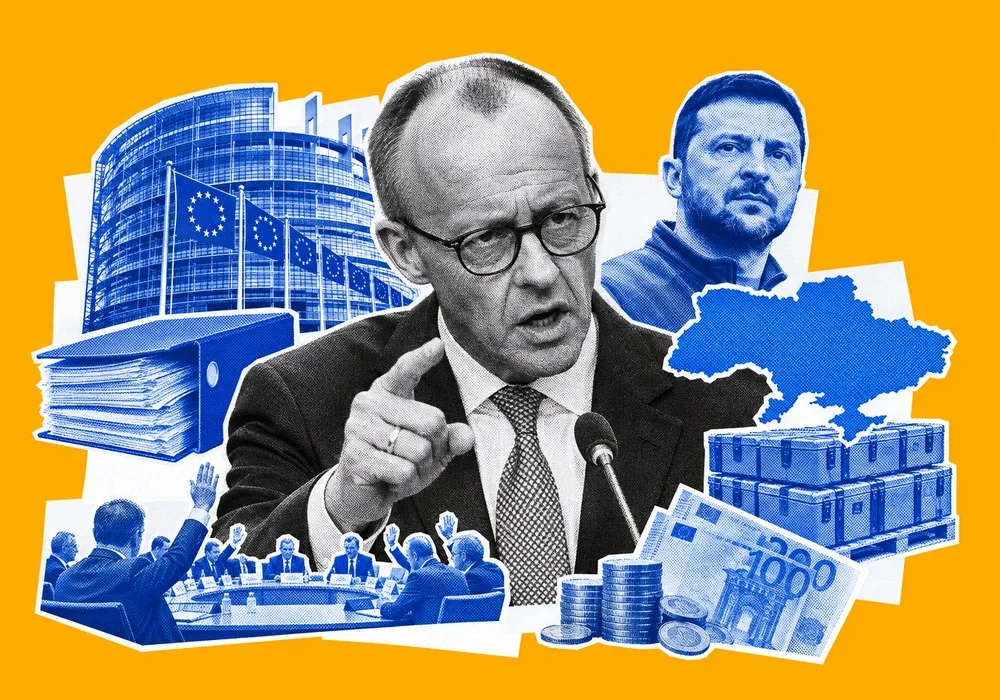
German Chancellor Friedrich Merz is using Germany’s financial influence within the European Union to push all member states into committing to Ukraine’s long-term financial support. The move could turn negotiations over the bloc’s next seven-year budget into a decisive test of European solidarity with Kyiv.
German Chancellor Friedrich Merz has threatened to block approval of the European Union’s 2028–2034 budget unless all member states commit to financing Ukraine in 2027 and beyond. In a letter to European Council President António Costa, Merz made Germany’s support for the next Multiannual Financial Framework conditional on a collective commitment to cover Ukraine’s growing financial needs.
The intervention comes as Kyiv faces an estimated €70 billion funding shortfall in 2027. Berlin argues that every EU member must make a fair contribution to addressing the deficit, rather than allowing a small group of countries to shoulder most of the financial burden. Merz has described such a commitment as a prerequisite for progress on other budgetary matters.
The timing is significant. The German chancellor is seeking to secure agreement ahead of an upcoming meeting of EU leaders in Dublin, where the financing gap is expected to feature prominently. By linking two major financial negotiations, Berlin is attempting to prevent disagreements over Ukraine from being postponed while discussions on the bloc’s long-term budget continue.
Financial Pressure on Reluctant Member States
Germany's position carries particular weight because it is the EU's largest net contributor to the common budget. Merz is therefore using Berlin's financial leverage to pressure governments that have resisted further commitments to Kyiv. Four countries – Hungary, Slovakia, Bulgaria and the Czech Republic – have indicated that they do not intend to contribute to additional financial assistance for Ukraine.
Hungary, Slovakia and the Czech Republic previously secured exemptions from contributing to interest payments on the €90 billion loan agreed for Ukraine last December. Their resistance illustrates the growing difficulty of maintaining a common European financing policy as the war continues and national political considerations increasingly shape decisions in Brussels.
The political calendar could make negotiations even more complicated. Upcoming elections in several EU countries, including Italy and Poland, may strengthen domestic opposition to additional financial commitments. Governments facing electoral pressure could be reluctant to approve measures that opponents might portray as excessive spending abroad.
Merz's proposal consequently goes beyond securing another financial package. It seeks to establish a principle under which continued European budgetary cooperation is tied to shared responsibility for Ukraine's economic stability.
A Growing Gap Between Commitments and Financial Needs
The scale of Ukraine's projected deficit highlights the urgency of the negotiations. Although EU leaders agreed to a €90 billion loan last December, Kyiv estimates that it will require another €70 billion in 2027 to maintain essential state functions and meet its financial obligations amid continued Russian aggression.
The European Union has indicated that it could cover approximately two-thirds of the additional requirement, equivalent to around €45 billion. The European Commission is examining different financing mechanisms, including the possibility of issuing additional joint debt. Brussels hopes to reach an agreement before the end of the year.
However, the remaining funding requirements and disagreements over how the assistance should be distributed leave significant uncertainty. The European Council has already instructed the Commission to prepare proposals addressing Ukraine's 2027 budget shortfall, but the political conditions for implementing them remain unsettled.
Merz has also called for a reliable multi-year financing framework from 2028 onwards. This would cover not only Ukraine's immediate needs but also longer-term obligations, including interest payments on outstanding debt.
Implications for European Unity
The German initiative exposes a fundamental challenge for the EU: maintaining a unified financial strategy towards Ukraine while member states increasingly disagree over the costs and duration of support. Berlin's willingness to connect the next seven-year budget to Ukraine's financing could make it harder for governments to avoid the issue through temporary exemptions or postponed decisions.
For Kyiv, the immediate priority is securing predictable funding for 2027. Uncertainty over external financing could complicate budget planning, public expenditure and the maintenance of essential services while the country remains at war. A multi-year arrangement would offer greater stability and reduce the need for repeated emergency negotiations among European governments.
For the EU, the dispute is also a test of its capacity to translate political declarations into binding financial commitments. Germany's approach could strengthen the bloc's collective position by making continued support a shared obligation. However, it also risks deepening divisions between net contributors and governments unwilling to participate in further assistance.
The negotiations will therefore have consequences beyond the next budgetary cycle. Their outcome will help determine whether the EU can sustain a coordinated financial commitment to Ukraine over several years, or whether support will remain vulnerable to national political changes and disagreements over burden-sharing.
Sources: Ukrainska Pravda, Financial Times