
Marine Le Pen Vows to End New French Funding for Ukraine if Elected

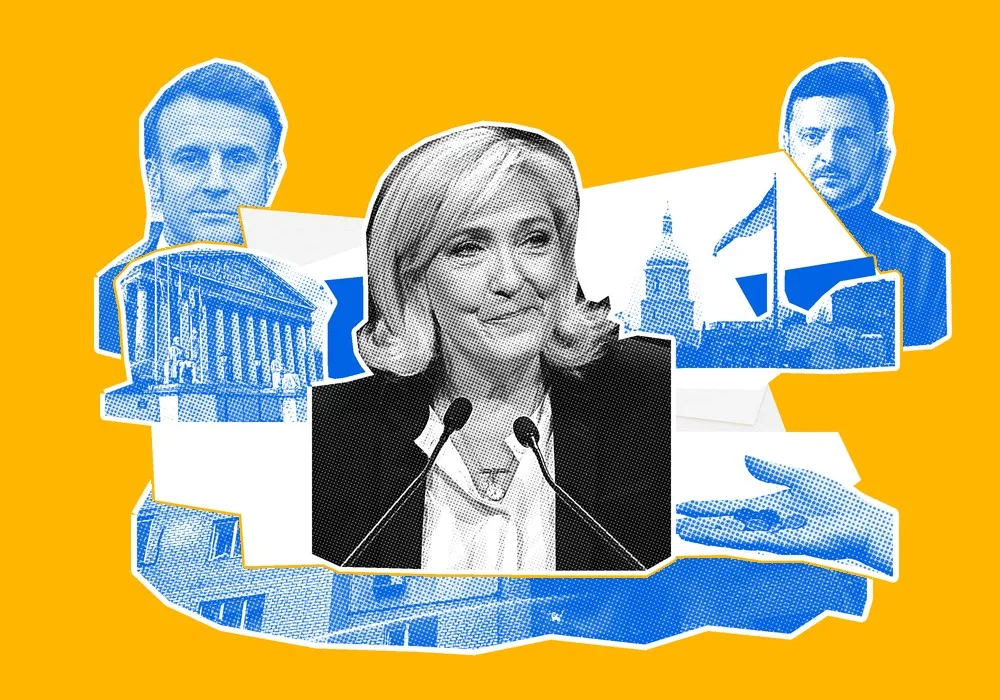
Marine Le Pen says France would stop providing new financial aid to Ukraine if she wins the 2027 French presidential election. After meeting Ukrainian ambassador Vadym Omelchenko in Paris on 16 November, the National Rally frontrunner said she would honour France’s commitment to the EU’s €90 billion loan and continue equipment donations and humanitarian aid. Le Pen cited the state of France’s public finances. She gave no figures for the aid she would retain or the savings she expected from ending new bilateral funding. The pledge comes as Ukraine prepares for its fifth wartime winter.

Le Pen described the meeting as cordial and said she had reiterated her “unwavering support for Ukraine”. The National Rally said the two had discussed the course of the war and that Le Pen had stressed the need to keep pursuing peace. They also discussed Ukraine’s ambitions to join the EU and NATO and possible cooperation in defence, digital technology and civil nuclear energy. Le Pen has previously opposed Ukraine’s accession to the EU, a goal the current French government backs.
Le Pen asked Omelchenko to tell President Volodymyr Zelenskyy that she was willing to meet him in Paris or Brussels. Zelenskyy had invited her to Kyiv in late October. The Ukrainian side said the invitation still stood after Monday’s talks, while Le Pen’s statement named only the French and Belgian capitals as possible venues.
Emmanuel Macron had already challenged the case for cutting aid in a social media post over the weekend.
He warned that Europe would be weaker if Russia imposed its terms on Ukraine by force. He argued that reducing the resources available to Kyiv would push it towards an “unjust peace” and leave both Ukraine and the rest of Europe more vulnerable.
That argument also underpins France’s work with Britain on guarantees intended to deter another Russian attack after a ceasefire.
The Kremlin Visit and the Russian Loan
Le Pen’s past dealings with Russia have returned to the campaign. In March 2017, Vladimir Putin received her at the Kremlin weeks before the first round of France’s presidential election. During that visit she backed lifting EU sanctions imposed over Russia’s actions in Ukraine. Three years earlier, her party, then called the National Front, had borrowed €9.4 million from the Moscow-based First Czech Russian Bank.

The debt later passed to a Russian company after the bank failed. The party announced in September 2023 that it had repaid the outstanding balance in full.
National Rally president Jordan Bardella defended the party’s position on Monday, saying he had condemned Russia’s violation of Ukrainian sovereignty and arguing that France faced competing demands on public spending. Elabe’s 14 November survey put her on 31% to 33% in the first-round scenarios it tested. Jean-Luc Mélenchon of France Unbowed generally drew 17% to 17.5%.
Whether Le Pen can stand is still unresolved. In July the Paris Court of Appeal upheld her conviction for misusing European Parliament funds and reduced her ban on holding elected office. She took the case to the Court of Cassation. Senior French legal figures have since disagreed over her eligibility while that appeal is pending. The court has said it could rule by early April 2027, ahead of the election.
What France Gives Ukraine Today
France and Ukraine signed a ten-year security agreement in February 2024.
It provides for military and civilian assistance, training and defence-industrial cooperation. If Russia launches another armed attack in the future, the agreement provides for consultations within 24 hours at either side’s request.

Its spending pledge of up to €3 billion in additional support applied to 2024. The broader agreement allows either side to end it with six months’ written notice. In March 2024, the National Assembly backed the government’s statement on the agreement by 372 votes to 99. National Rally deputies abstained.
Public Sénat, citing Kiel Institute figures through August 2026, put French bilateral allocations since the full-scale invasion at €7.91 billion across military, financial and humanitarian aid. The figure includes the value of equipment and excludes France’s share of EU support. France has supplied Caesar howitzers, armoured vehicles and Mirage 2000-5 fighter jets, along with pilot and technician training. Its foreign ministry separately reported more than €471 million allocated to humanitarian assistance as of 1 July 2026, including funding for UN agencies and aid organisations.
France also pays for repairs and equipment that keep essential services running. Its foreign ministry says it financed and delivered 150 generators in January 2026. A €200 million French fund set up in 2024 has supported 19 infrastructure reconstruction projects, including in the energy sector. Paris renewed the fund in 2026 with a further €71 million to help finance French companies’ work on Ukrainian infrastructure.
Civilian funding is still being committed. On 9 November, France, Ukraine and the European Bank for Reconstruction and Development convened a donor conference in Paris to finance repairs to the protective structure over Chornobyl’s destroyed reactor. A Russian drone damaged it in February 2025. Donors pledged €303 million in total, and France raised its own commitment to €40 million.
G7 foreign ministers meeting under France’s presidency also agreed this month to increase financial and material support for Ukraine’s energy sector ahead of winter.
France and the United Kingdom launched the Coalition of the Willing in 2025 and co-chair it.
According to the French foreign ministry, it now brings together 36 countries. Its members coordinate aid and pressure on Moscow and have drawn up plans for a multinational force that could deploy at Ukraine’s invitation after a credible halt to hostilities. The plans centre on strengthening Ukraine’s armed forces and deterring renewed aggression. The force’s planners have been working through a joint headquarters in Paris, and Britain announced a November exercise in Poland to rehearse preparations for a possible deployment.
Paris also co-leads two groups within the Ukraine Defence Contact Group, often called the Ramstein format. It works with Germany on integrated air and missile defence and with the United States on artillery. France is part of a smaller diplomatic group as well. At the EU summit in Dublin on 13 November, European Council President António Costa named France, Britain, Germany, Italy and Poland as the five countries that would work with EU institutions to represent Europe in peace negotiations.
What the €90 Billion Loan Covers
The EU loan covers 2026 and 2027. The bloc borrows the money on capital markets with backing from its budget. About €60 billion is earmarked for defence and €30 billion for economic support. On Monday, the Council of the EU approved a payment of just under €8 billion through the Ukraine Facility, around €5 billion of it drawn from the loan. That funding helps Kyiv keep its public administration running and finance recovery and reforms.
The loan is also tied to major French defence projects. In July, Kyiv announced an initial order of 16 French Rafale fighters and plans to order four Franco-Italian SAMP/T NG air defence systems. The joint declaration said financing would be sought from the loan’s 2026 and 2027 tranches. The first Rafale transfers are planned after Ukrainian crews complete training.
Those projects show why the commitment Le Pen singled out matters for France’s own defence industry as well as for Kyiv.