
Marine Le Pen Offers to Debate Zelenskyy as She Vows to End French Financial Aid to Ukraine

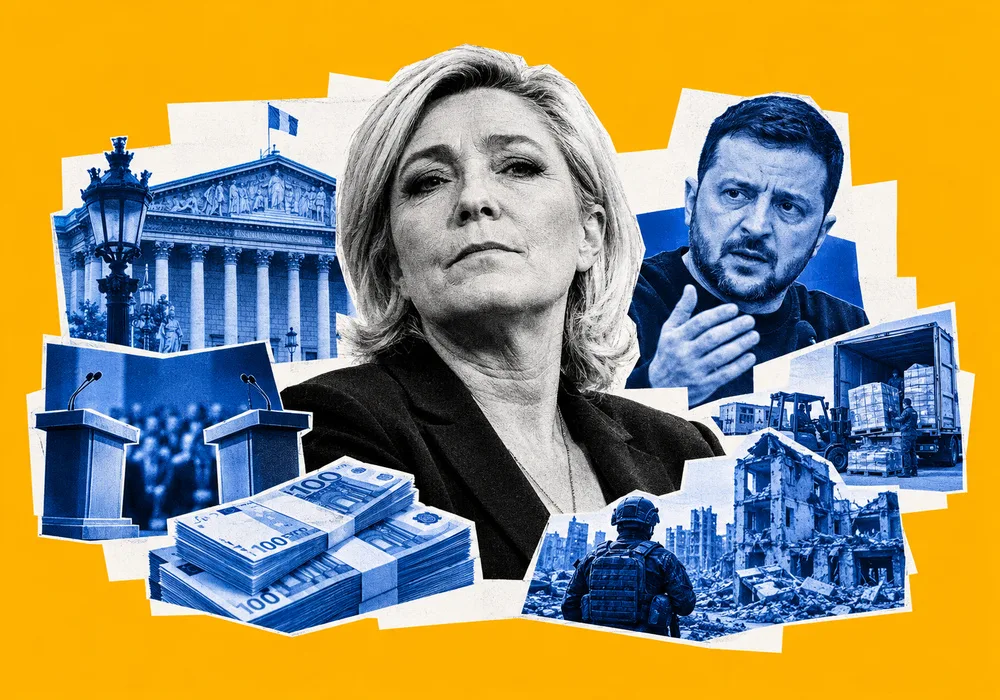
French far-right leader Marine Le Pen has offered to travel to Ukraine to debate President Volodymyr Zelenskyy over French support for Kyiv after pledging to end financial assistance six months into a potential presidency. The dispute has brought Ukraine policy to the forefront of France’s 2027 presidential campaign, exposing divisions over European security, military cooperation and the cost of supporting Ukraine.
Marine Le Pen, the leader of France’s far-right National Rally (RN), has said she is ready to travel to Ukraine to discuss the future of French assistance with President Volodymyr Zelenskyy. Her offer follows a public disagreement over the value of French-Ukrainian military cooperation and the financial commitments Paris has made since Russia launched its full-scale invasion. Speaking to French television channel CNews on Thursday, 15 October, Le Pen said she would be willing to meet the Ukrainian president if he wanted to discuss the issue directly. “If Mr Zelenskyy wishes us to discuss it, I will gladly come to Ukraine,” she said, while maintaining that France no longer had sufficient financial resources to continue providing assistance at the current level. Le Pen also stressed that she had no personal disagreement with Zelenskyy, presenting the dispute as a question of political priorities and public spending rather than a personal conflict.
The exchange comes as France approaches its 2027 presidential election, with Le Pen and the National Rally seeking to strengthen their position by presenting an alternative to the policies of President Emmanuel Macron’s administration. Support for Ukraine has become an important part of this political divide, particularly as France faces pressure to address its public finances while maintaining its commitments to European security. Le Pen’s willingness to debate Zelenskyy does not, however, signal a change in her position. She continues to argue that French financial assistance should end after a transitional period if she wins the presidency, raising questions about the future of Paris’s relationship with Kyiv and its role in Europe’s response to Russia’s war.
Le Pen Plans to End Financial Assistance After Six Months
On 14 October, Le Pen told Belgian broadcaster VRT News that France would continue providing financial assistance to Ukraine for the first six months of a potential presidency before bringing it to an end. She justified the proposal by pointing to France’s financial difficulties, arguing that the country could no longer afford its existing commitments. According to Le Pen, the six-month period would provide a transition rather than an immediate withdrawal of support, giving Ukraine time to prepare for a change in French policy. She estimated the cost of French assistance at approximately €6 billion annually and argued that Paris should reconsider its spending priorities. Her proposal reflects the National Rally’s broader position that France should reduce its external financial commitments and focus more heavily on domestic economic challenges.
Such a decision would represent a substantial shift in French policy towards Ukraine. France is one of Europe’s major military powers and an important partner for Kyiv in defence cooperation, diplomatic initiatives and financial support. However, the figures cited in the political debate need to be distinguished carefully, as estimates of French assistance may include both bilateral contributions and funding channelled through European Union mechanisms. These categories do not necessarily represent direct transfers from the French government to Ukraine. Le Pen’s proposal therefore raises two separate questions: how much France is contributing through different channels and whether withdrawing that support would produce the savings she anticipates without creating additional strategic costs for France and its European partners.
Zelenskyy Argues That Military Cooperation Benefits France
Zelenskyy has challenged the argument that assistance to Ukraine represents a one-sided financial burden for France. In an interview with the Financial Times, the Ukrainian president argued that military cooperation benefits French defence capabilities and industry while giving European partners access to lessons learned on the battlefield. Ukraine has accumulated extensive operational experience since Russia’s full-scale invasion, including in air defence, drone warfare, electronic warfare and the adaptation of weapons systems under combat conditions. Zelenskyy pointed to cooperation involving the Franco-Italian SAMP/T air defence system and the Franco-British SCALP/Storm Shadow cruise missiles, arguing that lessons from Ukraine’s battlefield experience can help improve the capabilities of its partners.
The argument reflects a broader debate over Ukraine’s role in Europe’s emerging security architecture. European governments are increasingly examining how Ukraine’s experience can inform military modernisation, procurement decisions and preparations for future threats. For France, cooperation with Kyiv potentially offers benefits beyond the immediate delivery of equipment or financial assistance, including practical knowledge about the performance of military systems under sustained attack. Zelenskyy’s position is that supporting Ukraine should therefore be understood as a strategic partnership rather than simply an expenditure. Le Pen’s proposed withdrawal would force a future French government to determine how much of this cooperation could continue without the existing level of financial support and whether reducing assistance would weaken a relationship that also serves French defence interests.
Macron Reaffirms France’s Commitment to Kyiv
French President Emmanuel Macron reaffirmed his country’s commitment to Ukraine following talks with Zelenskyy in Brussels on 15 October. Against the backdrop of continued Russian attacks, Macron emphasised the importance of providing Ukraine with the means to defend itself and protect its population and infrastructure. His position contrasts directly with Le Pen’s proposal, reflecting a fundamental disagreement over whether French assistance should be treated primarily as a budgetary burden or as an investment in European security. French Foreign Minister Jean-Noël Barrot also criticised the proposed withdrawal, warning that ending assistance could bring the consequences of the war closer to France itself.
The disagreement comes as European governments attempt to maintain support for Kyiv while addressing domestic financial pressures and strengthening their own armed forces. France plays a significant role in European defence policy, and changes in its approach could influence negotiations over funding, military assistance and the continent’s long-term security priorities. A reduction in French support would not automatically end all cooperation with Ukraine, but it could complicate joint initiatives and place additional pressure on other European partners. For Macron’s administration, continued assistance remains part of a broader effort to prevent Russian aggression from undermining European stability. For Le Pen, the same commitments represent an area in which a future government should substantially reduce spending.
French Political Rivals Condemn Le Pen’s Proposal
Le Pen’s proposal has drawn criticism from several French politicians who may compete against her in the 2027 presidential election. Former prime minister Gabriel Attal, representing the Renaissance political movement, has argued that support for Ukraine should be viewed as a matter of French security rather than a discretionary contribution. Raphaël Glucksmann, a prominent centre-left politician, has criticised the proposed withdrawal as a concession to Russian President Vladimir Putin, warning that weakening Ukraine could undermine Europe’s wider security interests. Former prime minister Édouard Philippe, leader of the Horizons party, has also condemned Le Pen’s position, arguing that European countries should maintain their support for Kyiv rather than reduce it at a critical moment in the war.
These reactions illustrate the extent to which Ukraine policy is becoming a dividing line in French politics. Le Pen’s position is consistent with the National Rally’s emphasis on national sovereignty, reduced external commitments and the prioritisation of domestic spending. Her opponents argue that the potential costs of withdrawing support could outweigh any immediate budgetary savings, particularly if a weakened Ukraine creates additional security challenges for European states. The debate is therefore not limited to the amount of assistance France can afford. It also concerns how the country defines its national interests, what responsibilities it should assume as a major European power and whether sustained support for Ukraine is necessary to deter further Russian aggression.
French Contributions and the Wider European Funding Debate
The scale of France’s contribution has become central to the dispute. According to figures from the Kiel Institute for the World Economy cited by Euronews, France had committed approximately €27 billion in support for Ukraine since Russia’s full-scale invasion in February 2022. This included around €7.9 billion in bilateral assistance and approximately €19 billion channelled through European mechanisms. Germany, by comparison, had committed more than €50 billion, making it the largest European contributor in absolute terms according to the same reporting. These figures demonstrate that French support extends beyond direct bilateral assistance and forms part of a wider European effort to sustain Ukraine’s military and economic resilience.
Any decision by France to reduce its contribution could therefore have implications for negotiations within the European Union, particularly as member states consider how to finance Ukraine’s future defence and public spending needs. Le Pen has also opposed Ukraine’s accession to the EU, arguing that membership could threaten French agricultural interests and place additional pressure on the bloc’s Common Agricultural Policy. She has warned that the scale of Ukraine’s agricultural sector could intensify competition for French producers. These positions suggest that a Le Pen presidency could bring broader disputes with Brussels over European funding, agricultural policy and the future of Ukraine’s integration into the bloc. The extent of any changes would depend on the policies adopted by a future government and the negotiations with France’s European partners.
Ukraine Becomes a Key Issue Ahead of France’s 2027 Election
The exchange between Le Pen and Zelenskyy highlights how Russia’s war against Ukraine continues to shape domestic politics across Europe. Ahead of the 2027 presidential election, French candidates will face pressure to explain how they intend to balance domestic economic concerns with the country’s security commitments. Le Pen proposes ending financial assistance after a six-month transition, while Macron’s administration maintains that continued support is necessary to help Ukraine defend itself and protect European stability. Her offer to debate Zelenskyy has brought these competing positions into sharper focus, but it does not resolve the underlying disagreement over the financial and strategic consequences of withdrawing assistance.
The outcome of the election could have implications well beyond France’s bilateral relationship with Ukraine. As one of Europe’s leading military powers, France plays an important role in defence cooperation, diplomatic coordination and negotiations over assistance to Kyiv. A significant shift in Paris’s policy could complicate European efforts to maintain a common approach to Russia and place additional responsibilities on other countries. At the same time, the consequences would depend on the specific funding mechanisms affected, the position of a future French government and the response of other EU member states. For now, the dispute remains part of the political contest ahead of 2027, but it raises a broader question for Europe: whether domestic budgetary pressures will lead governments to reduce their commitments to Ukraine or reinforce the argument that supporting Kyiv is essential to the continent’s long-term security.
Sources: Financial Times, Euronews