
Malta’s Unresolved Murder Case Raises Questions Over Judicial Accountability and Press Freedom

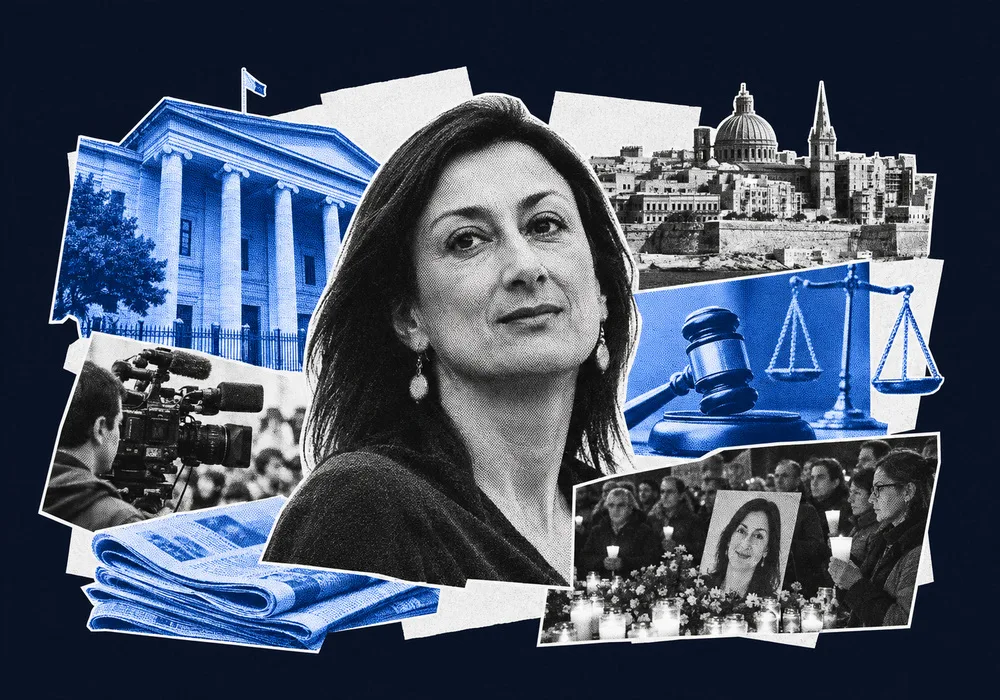
Nine years after investigative journalist Daphne Caruana Galizia was assassinated, her three sons are continuing their campaign for justice. The acquittal of businessman Yorgen Fenech, now under appeal amid allegations of jury bias, has renewed scrutiny of Malta’s judicial system and its ability to hold powerful figures accountable.
The assassination of Maltese investigative journalist Daphne Caruana Galizia remains one of Europe’s most prominent cases involving violence against the press. On 16 October 2017, she was killed by a car bomb near her home in Bidnija, Malta, shortly after publishing another entry on her investigative blog, Running Commentary. For years, her reporting had exposed alleged corruption, money laundering and links between political figures and powerful business interests. Her investigations reached across Malta’s two dominant political parties, making her a target of hostility among influential figures from both sides of the political establishment.
Caruana Galizia’s work included investigations into the Panama Papers disclosures and financial arrangements involving companies connected to Maltese political and business circles. Among the subjects of her reporting was businessman Yorgen Fenech, whose business interests included a consortium involved in a controversial government contract for a power station. Her assassination triggered widespread protests and a political crisis that ultimately led to the resignation of then-Prime Minister Joseph Muscat in 2019. An independent public inquiry subsequently concluded that the Maltese state had created an atmosphere of impunity in which the journalist’s murder could take place.
The Acquittal That Reopened the Case
Although several people involved in the assassination have been convicted, questions about who commissioned the murder have remained unresolved. In 2022, brothers George and Alfred Degiorgio pleaded guilty to carrying out the killing and were sentenced to 40 years in prison. In 2025, Robert Agius and Jamie Vella, who were convicted of supplying the explosives used in the attack, received life sentences.
The most significant development in the search for the alleged mastermind came in September 2026, when a Maltese jury acquitted Fenech of charges of complicity in the murder and criminal conspiracy. Prosecutors had accused the businessman of organising and financing the assassination. The verdict, delivered by an eight-to-one jury majority, brought an end to one of the longest-running criminal trials in Maltese history but left the victim’s family without a judicial determination of who ordered the killing.
The decision subsequently became the subject of further legal controversy. Caruana Galizia’s sons, Paul, Andrew and Matthew, examined publicly available statements made by jurors and identified posts suggesting that some members had expressed hostility towards their mother before the trial. One juror had criticised the use of public money to provide police protection for the journalist, while another had previously written that he could not stand her. On 17 September, Maltese police arrested and questioned three jurors. Investigators also reportedly discovered a private WhatsApp conversation involving members of the jury, containing further indications of possible bias.
Five days later, Malta’s Attorney General, Victoria Buttigieg, appealed Fenech’s acquittal. A panel of three judges is expected to determine whether the verdict should stand or whether the case should return to trial. The appeal has introduced another stage of uncertainty into proceedings that have already lasted nearly a decade.
A Family Campaign Against Institutional Failure
The three brothers have spent much of the period since their mother's assassination pursuing investigations, challenging official decisions and bringing the case to the attention of European institutions and international media. Their efforts began immediately after the murder, when they questioned whether the Maltese authorities could investigate the case independently. They raised concerns about potential conflicts of interest among officials involved in the investigation and sought the removal of individuals whose personal or professional connections could undermine public confidence in the proceedings.
Their campaign has also exposed the pressure placed on the journalist's family. Matthew Caruana Galizia, who had worked with his mother on several investigations, became a target of online harassment and conspiracy theories following the assassination. The brothers have faced threats, public attacks and repeated attempts to discredit their efforts to preserve evidence and pursue accountability.
Their work has increasingly extended beyond Malta. The family has sought support from international media organisations, press freedom groups and European institutions, arguing that the case concerns more than the murder of one journalist. It raises broader questions about the protection of investigative reporting, the independence of law enforcement and the ability of democratic institutions to investigate crimes involving politically connected business interests.
The brothers have also established the Daphne Caruana Galizia Foundation, which continues to advocate for press freedom and accountability. Their campaign has become an important part of the wider European discussion about the risks faced by investigative journalists exposing corruption and abuses of power.
Delays Continue to Undermine Confidence
The latest developments suggest that the investigation has not reached a definitive conclusion even beyond the criminal proceedings against those convicted of the assassination. On 14 November 2026, Maltese Police Commissioner Angelo Gafà addressed continuing delays in a separate investigation into the alleged leaking of confidential information relating to the murder inquiry.
Gafà said that investigators had been waiting for five years for a court-appointed expert to analyse data extracted from a suspect's mobile phone. The device had been seized in 2021, but the analysis had not been completed. Several individuals, including Fenech and former Prime Minister's chief of staff Keith Schembri, have faced charges over suspicions that confidential information concerning the investigation was disclosed. Both have acknowledged under oath receiving and passing on information related to the murder investigation.
The police commissioner attributed the delay to the court-appointed expert and defended the police's handling of the case. Nevertheless, the length of time required to examine evidence and establish the circumstances surrounding the alleged leaks illustrates the institutional difficulties that continue to affect the proceedings.
For Malta, these unresolved issues have implications beyond the criminal case itself. The country is an EU member state whose institutions are expected to uphold judicial independence, protect journalists and ensure that allegations involving powerful individuals receive effective scrutiny. The murder investigation has repeatedly tested these commitments, drawing attention to the relationship between political influence, business interests and the institutions responsible for enforcing the law.
A European Test for Press Freedom
The case has become a wider test of how European democracies respond when journalists investigating powerful interests are subjected to violence. The European Union has repeatedly emphasised the importance of media freedom, the protection of journalists and the rule of law. However, the prolonged proceedings in Malta demonstrate the difficulties of translating these principles into effective accountability when investigations involve influential networks and potential institutional conflicts of interest.
The outcome of the appeal against Fenech's acquittal will therefore carry significance beyond the immediate interests of the Caruana Galizia family. A decision to order a retrial would reopen the question of criminal responsibility for the assassination, while upholding the acquittal would leave the family's efforts to establish who commissioned the murder facing further obstacles.
Nine years after the bombing, the three brothers continue to demand answers. Their campaign has kept the case in the European public debate, preventing the passage of time and the convictions of several perpetrators from bringing the investigation to an end. The unresolved question is no longer simply whether those who carried out the assassination have been punished, but whether Malta's institutions can establish accountability at the highest levels of the case.
Sources: MaltaToday, Le Monde