
How Russia’s War Economy Fuels Kyrgyzstan’s Boom - and Triggers a New EU Sanctions Crackdown

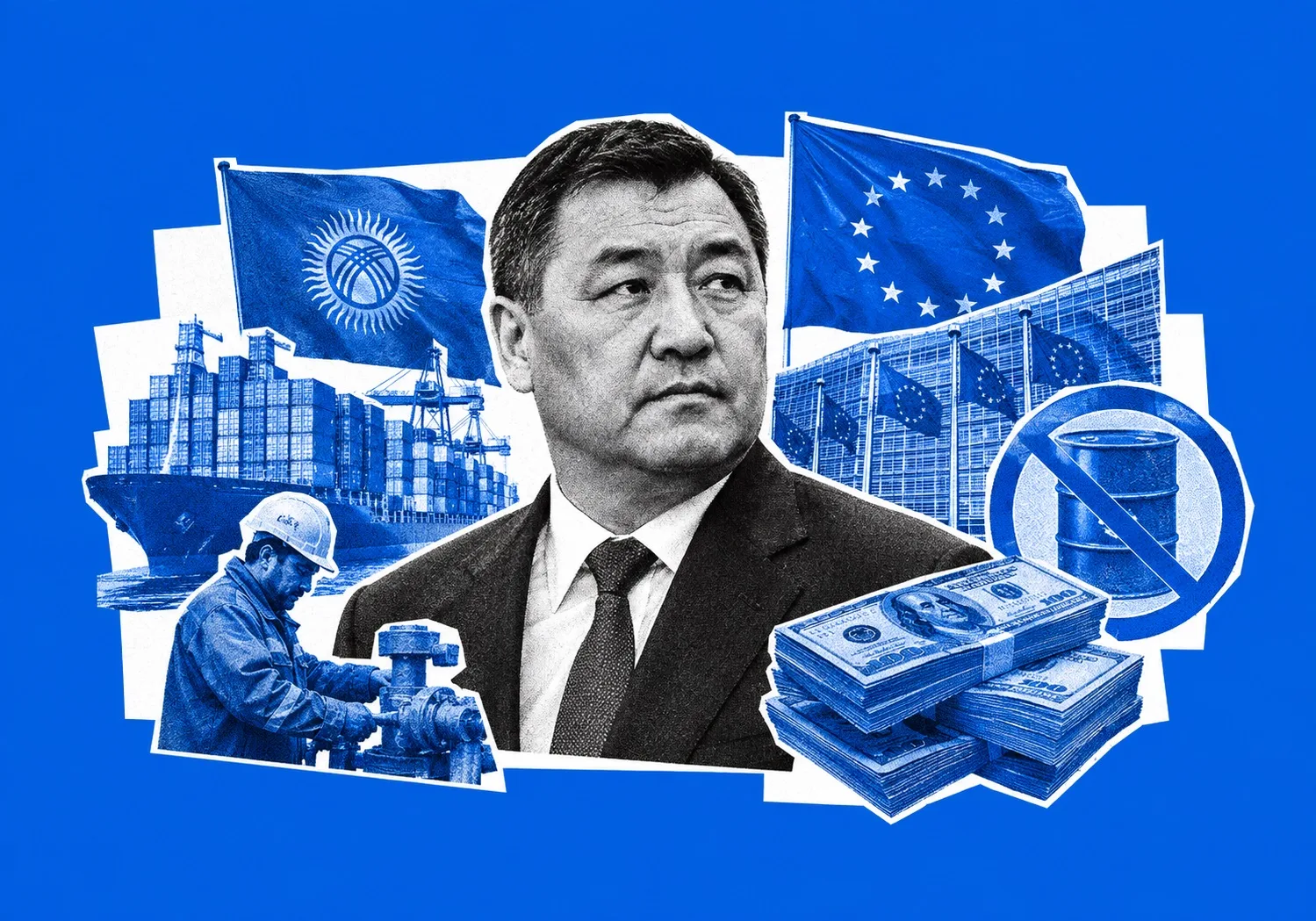
Since 2022, Kyrgyzstan has recorded 9% annual economic growth, driven by a massive surge in Western and Chinese re-exports to Russia. As Bishkek transforms into a primary transshipment hub for dual-use technology and machinery, the EU is shifting from targeting Moscow to restricting third-country trade routes under its new anti-circumvention mechanism.
The numbers alone do not prove that all of this trade is sanctions evasion. Kyrgyzstan has its own growing economy, rising retail activity, state investment, gold revenues and construction demand. But the composition and direction of some trade flows have become difficult for western governments to ignore.
The result is a new phase in sanctions enforcement: Europe is increasingly targeting not only Russia, but the third-country routes through which restricted technology can reach it.
A trade route built by the war
Russia's invasion changed the commercial geography of Eurasia almost overnight. Western companies left the Russian market, while Moscow legalised parallel imports, allowing domestic buyers to obtain branded goods through alternative channels.
Kyrgyzstan was unusually well positioned to benefit.
Its membership of the Eurasian Economic Union gives it a common customs framework with Russia. Goods cleared through Kyrgyz customs can subsequently move into Russia without the kind of standard border controls that would exist between unrelated customs jurisdictions. Historical economic ties and extensive labour migration between Kyrgyzstan and Russia provided an additional foundation for the relationship.
Kyrgyzstan therefore became part of a broader network linking Russia to alternative suppliers and transit states, alongside countries such as Kazakhstan, Armenia, Turkey and the United Arab Emirates.
For traders, the attraction was straightforward. Goods that could no longer move directly from western markets into Russia could be redirected through an intermediary jurisdiction. The intermediary captured the margin, while Russian buyers retained access to products that sanctions were intended to make harder to obtain.
That model helped produce an extraordinary increase in Kyrgyz imports.
EU exports jumped 345 per cent between 2021 and 2022, then more than doubled again in 2023. Even after declining in 2024 and 2025, the value of EU exports remained dramatically above the pre-war baseline.
The most important question is not simply how much Europe sells to Kyrgyzstan. It is what Europe is selling.
The machinery behind the numbers
Industrial products represented about €1.93bn, or roughly 90 per cent, of EU exports to Kyrgyzstan in 2025.
Machinery and mechanical appliances accounted for €556mn. Transport equipment was worth €408mn, while chemical products reached €286mn. Precision and optical instruments added another €69mn.
Some of these categories have obvious civilian uses. That makes the trade difficult to police through a simple ban.
The more sensitive issue concerns goods identified by the EU, US, UK and Japan as part of the Common High Priority list - commercial products that have been found in Russian weapons systems and are considered important to Russia's military-industrial production.
European Commission data cited in the briefing shows Kyrgyz imports of these high-priority goods increasing by about 800 per cent compared with pre-war levels. Kyrgyz exports of the same categories to Russia increased by roughly 1,200 per cent.
The discrepancy between the original European destination and the eventual Russian destination is precisely where sanctions enforcement becomes complicated.
CNC metalworking machinery, telecommunications equipment, modems and radio devices can have legitimate markets in a developing economy. But when imports of sensitive categories rise sharply at the same time as their onward movement to Russia accelerates, the distinction between ordinary commerce and sanctions circumvention becomes much harder to sustain.
EU Sanctions Envoy David O'Sullivan has pointed specifically to radio equipment and CNC machinery being imported into Kyrgyzstan with the apparent primary purpose of onward transmission to Russia's military-industrial complex.
This is where the Bishkek boom acquires a different significance.
From loopholes to third-country controls
The European response in April 2026 went beyond the traditional model of sanctions, under which restrictions are imposed directly on Russian companies, banks and individuals.
As part of the EU's 20th sanctions package, Brussels activated Article 12f of Regulation 833/2014 for the first time. The mechanism allows the EU to restrict exports of specified sensitive goods and technologies to third countries where there is an ongoing, systemic risk that those products will be re-exported to Russia.
Kyrgyzstan became an early test of that approach.
The restrictions cover specific categories including CNC metalworking centres, classified under CN code 8457 10, and telecommunications routing and switching equipment under CN code 8517 62, alongside modems and radio equipment.
The significance lies less in the individual products than in the jurisdictional logic.
For years, the effectiveness of western sanctions depended partly on the willingness and capacity of third countries to prevent their territory becoming a back door into Russia. Article 12f gives the EU a mechanism for responding when diplomatic pressure is no longer considered sufficient.
That changes the calculation for intermediary economies.
A government does not necessarily have to be accused of formally joining Russia's war effort to face restrictions. It can instead find itself caught in a sanctions system designed around the risk created by its trade channels.
The policy is therefore moving from a Russia-centred model towards a network-centred one.
Washington and London are targeting different nodes
The US and UK have taken a somewhat different route.
Washington has concentrated on individual companies and financial intermediaries. In 2023, the US Treasury sanctioned Kyrgyz entities including RM Design and Development, Progress Lider, GTME Tekhnologii and Cargoline over alleged supplies of dual-use electronics and aviation equipment to Russia. In January 2025, it targeted Keremet Bank for facilitating cross-border settlements with Russia's sanctioned Promsvyazbank.
Britain has focused heavily on the financial infrastructure supporting alternative trade.
Its sanctions have included Grinex, Meer, TengriCoin, Old Vector and Capital Bank of Central Asia, linked to the A7A5 rouble-pegged stablecoin ecosystem.
The differences matter because the trade network itself has become more sophisticated.
When conventional banking channels become restricted, traders can seek alternative settlement mechanisms. A7A5 provides one such route, allowing Russian and Central Asian intermediaries to settle transactions without relying on the conventional western banking architecture and its links to SWIFT and western clearing systems.
Sanctions enforcement is consequently no longer only about stopping a machine at a border. It is also about identifying the companies arranging the shipment, the banks settling the transaction and the digital assets providing the payment infrastructure.
The network has several points of entry - and western governments are beginning to attack different points simultaneously.
Bishkek's construction boom has more than one engine
It would be too simple to describe Kyrgyzstan's economic growth as a sanctions-evasion story.
GDP expanded by about 11 per cent in 2023 and by 10 per cent during the first nine months of 2025. Construction grew by almost 30 per cent, while retail and wholesale trade increased by 11 per cent.
Gold mining and high bullion prices, government investment, retail trade and the crypto-financial sector have all contributed.
Yet re-exporting is estimated to have generated 30-40 per cent of overall economic growth between 2022 and 2025. That makes the sanctions-driven trade shift more than a marginal phenomenon.
The physical transformation of Bishkek is part of that equation. New residential towers, roads, airport infrastructure and logistics facilities require capital, labour and demand. The arrival of South Asian construction workers reflects the labour requirements created by that expansion.
But infrastructure built during a period of exceptional trade growth can become a liability if the underlying flows are suddenly disrupted.
The same intermediary position that generates revenue can expose banks, importers, logistics companies and developers to external regulatory shocks. If western restrictions broaden, legitimate businesses can be caught alongside those deliberately exploiting sanctions loopholes. Access to western currencies, finance and advanced industrial goods can become harder even for companies with no direct involvement in prohibited trade.
That is the structural risk hidden beneath the headline growth figures.
The price of being a bridge
Kyrgyzstan's position is valuable precisely because it connects economic systems that western sanctions were designed to separate. But that also makes it vulnerable to the next stage of sanctions policy.
The EU's use of Article 12f signals that Brussels is prepared to treat persistent third-country re-export risks as a problem requiring direct trade restrictions. The US approach adds pressure through corporate and financial sanctions. Britain's focus on crypto infrastructure targets another layer of the same system.
For Bishkek, the choice is not simply between trade with Russia and compliance with Europe. Its economy has become entangled in a wider network in which legitimate commerce, re-export activity, financial intermediaries and sensitive industrial technology can occupy the same channels.
That creates a difficult asymmetry. The profits from acting as a bridge accrue quickly to traders, logistics companies and parts of the wider economy. The consequences of becoming an enforcement target can arrive later, through banks losing access to international finance, companies facing sanctions and exporters finding western technology increasingly unavailable.
The geography of sanctions has changed accordingly. Russia may remain the principal target, but the pressure is moving along the routes that keep its economy supplied. For countries such as Kyrgyzstan, the question is no longer simply how much trade they can attract from a disrupted Eurasian market. It is how much of that trade they can afford to keep when the jurisdictions on either side begin treating the intermediary itself as part of the sanctions problem.
Sources: Infobae, Politico, The Guardian, The Times of Sentral Asia