
Islam Projected to Overtake Christianity as World’s Largest Religion by 2035

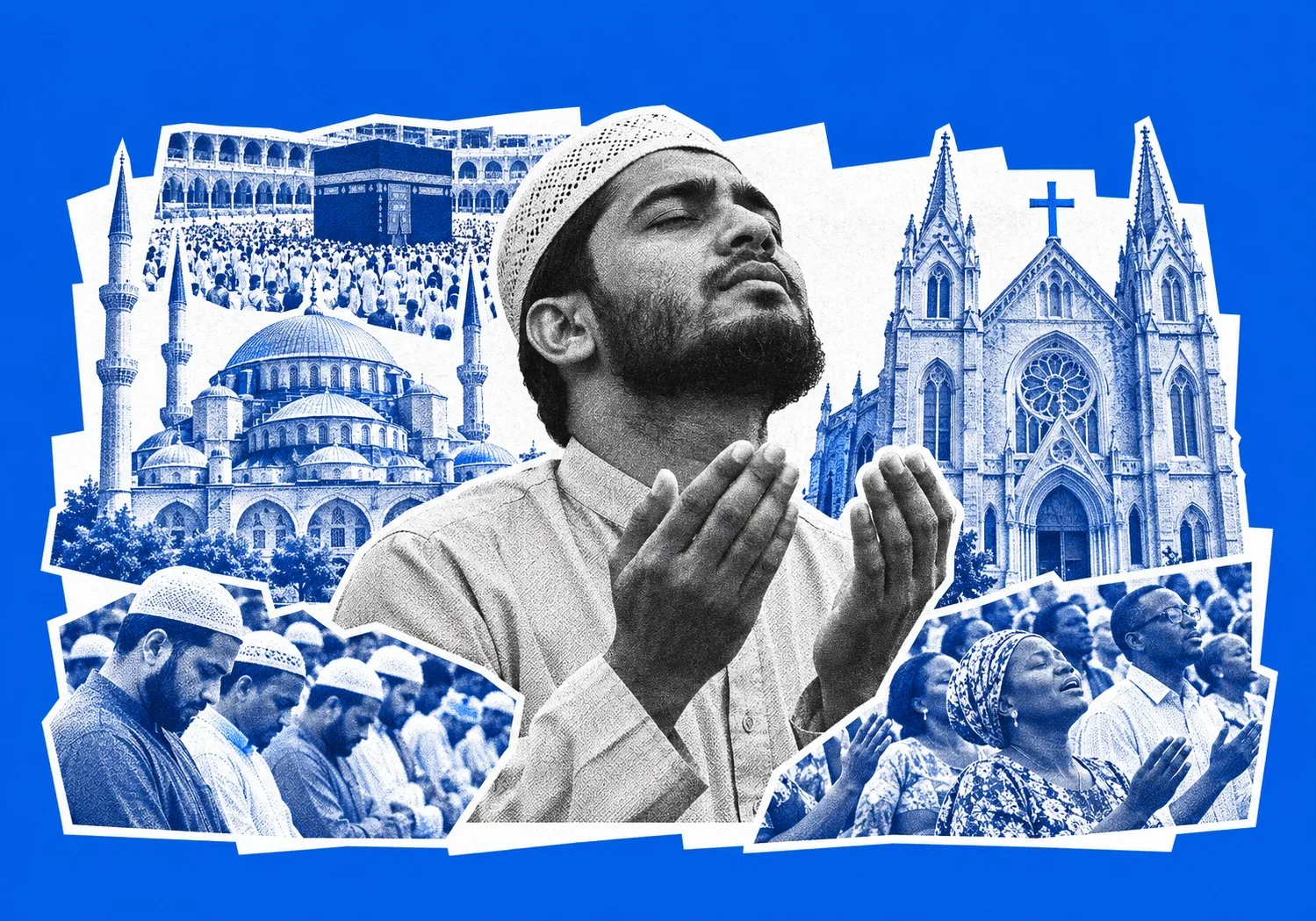
Higher birth rates and a younger population are driving Muslim population growth, according to new Pew Research Center projections. The Christian population is also expected to grow, with most of that increase coming from sub-Saharan Africa, while Christianity’s share of Europe’s population is projected to decline. The study, published on 18 November, projects more than 3.6 billion Muslims and just under 3 billion Christians by 2070 if recent demographic trends continue.

Age is central to the projected crossover.
In 2020, one-third of Muslims worldwide were under 15, compared with fewer than a fifth of Buddhists and people with no religious affiliation. A larger proportion of Muslims therefore have their childbearing years ahead of them, giving the population momentum that can continue even as families become smaller.
Pew estimates that Muslim fertility will fall from 3.1 children per woman in 2020–2025 to 2.2 towards the end of the projection period.
Its model assumes that fertility differences between religious groups will gradually narrow as education and access to contraception become more equal. Lower fertility, however, does not immediately mean fewer births: a large generation reaching adulthood can have more children overall than a smaller generation whose members have bigger families.
Over the five decades, Muslim births are projected to exceed Muslim deaths by at least 1.6 billion. The main explanation for the expected increase is this balance of births and deaths, rather than people changing religion.
The geography is also changing. Roughly six in ten Muslims lived in Asia and the Pacific in 2020; by 2070, that proportion is expected to fall to about half, while sub-Saharan Africa’s share rises to around a quarter. Pakistan is projected to replace Indonesia as the country with the largest Muslim population.
These shifts place the demographic story well beyond the Middle East, with which Islam is often associated in European political debate. They also mean that the experiences of Muslim communities will remain shaped by different national circumstances. Becoming the largest religious group worldwide would not make Muslims a majority everywhere, or even in most regions.
Christianity Moves South
Christianity’s projected loss of first place comes alongside an increase of about 687 million followers between 2020 and 2070. Its share of the world’s population would remain broadly steady at 29%, despite declining Christian proportions in many countries.
Growth in sub-Saharan Africa explains the difference. The region’s Christian population is projected to increase by about 896 million, more than offsetting a combined decline of around 210 million elsewhere. The Democratic Republic of the Congo is expected to overtake the United States as the country with the largest Christian population.
Pew demographer Conrad Hackett warned the Washington Post against assuming that “if Muslims are the largest, it comes at the expense of Christians”.
The African projections show both populations expanding. Sub-Saharan Africa had about 700 million Christians in 2020 and is expected to have roughly 1.6 billion by 2070, accounting for 54% of Christians worldwide. Over the same period, its Muslim population is projected to rise from 369 million to around 980 million. Both faiths would gain substantially from the region’s population growth.
Christians and Muslims together are expected to account for about 95% of sub-Saharan Africa’s population in 2070, much as they did in 2020. Their numbers would change far more dramatically than their combined share.
Gina Zurlo, a researcher in religious demography at Harvard Divinity School, told the Associated Press that Christian-Muslim relations were “extremely important” as populations changed. She pointed to misunderstandings between the faiths and called for more interreligious education. “Personal contact is important,” she said. Her response shifts attention from the size of each community to relationships between them: the ranking alone offers little insight into how people will share neighbourhoods, schools or public institutions. Those questions will have to be addressed within particular societies, rather than answered by a global population total.
Europe Takes Another Path
Europe’s Christian population is projected to fall from 505 million in 2020 to 324 million in 2070, reducing its share of the continent’s population from 67% to 52%. Ageing and low fertility account for much of the decline, alongside people leaving Christianity. Immigration would add Christians, but too few to offset those losses.
Muslims are expected to rise from 6% to 13% of Europe’s population. People with no religious affiliation would increase from a quarter to roughly a third, remaining the continent’s second-largest religious category.
Migration contributes substantially to the Muslim increase, although it does not explain all of it. In Pew’s hypothetical scenario without further migration, Muslims would still rise to 9% of Europe’s population by 2070 because of their younger age profile and higher fertility relative to other groups.
The figures cover Europe as a whole, including countries outside the European Union, and conceal considerable national variation. They should not be read as a forecast for every European society. Nor does the global crossover imply a similar outcome on the continent: under these projections, Christians would retain a narrow European majority, while people with no religious affiliation would continue to outnumber Muslims.
The Secular Paradox
The number of people identifying with no religion is projected to rise in 141 countries and territories but fall worldwide. China, home to much of the world’s unaffiliated population, accounts for the difference.
Around 1.3 billion people in China were religiously unaffiliated in 2020. That number is expected to fall to 917 million by 2070 as the country’s population contracts, even though the proportion identifying with no religion remains broadly unchanged. The projected decline would outweigh increases elsewhere, bringing the unaffiliated share of the world’s population down from 24% to 17%.
Britain and France, meanwhile, are among the countries expected to acquire unaffiliated majorities. Secularisation in those societies could continue alongside a global decline in the proportion of people with no religion. The two trends concern populations growing at different rates, rather than a single worldwide movement towards or away from faith.
“Unaffiliated” also has a specific meaning in the research. It includes people who describe themselves as atheist, agnostic or having no religion, some of whom hold spiritual beliefs or follow religious practices. A declining unaffiliated population would not necessarily mean an equivalent increase in religious observance.
There is also a difference between leaving a religion and becoming less religious while retaining its name. Research published in Nature Communications in 2025 examined how those changes unfold across generations. Its authors, from institutions including the universities of Lausanne and Oxford, identified a sequence: participation in public worship tends to decline first, the personal importance of religion follows, and formal affiliation is shed last.
That helps explain why identity figures can lag behind changes in everyday practice. A younger generation may attend services less often than its parents while still describing itself as Christian, Muslim or Buddhist. In such a society, a stable religious share can coexist with a gradual weakening of religious commitment.
The researchers found evidence of this pattern across different faith traditions, challenging the idea that secularisation belongs exclusively to Western Christianity. But they cautioned that the available evidence could not establish whether every country would follow the same path. The study describes a possible process of generational change; it does not provide a timetable for the disappearance of religion.
A Forecast, With Limits
Pew’s projections cover 201 countries and territories and count people according to their stated religious identity. Someone who describes themselves as Christian is included regardless of church attendance or whether their beliefs conform to religious teaching. The categories also combine denominations, so a shift between Christian churches does not count as leaving Christianity. The results therefore estimate the size and distribution of religious communities, rather than their observance or political outlook. Nor does the model establish whether someone’s identification reflects active belief, family tradition or cultural belonging; those can produce the same answer to a census question.
The greater uncertainty is how future generations will identify themselves. The model carries forward recently observed patterns of religious switching, but faster disaffiliation could alter the results. Pew acknowledges that its earlier projections underestimated the growth of people with no religion: their global share rose between 2010 and 2020, when it had been expected to begin falling. Religious identity had changed faster than the model anticipated. If that happens again, the numbers — and the timing of the projected crossover — could change too.
Sources: Pew Research Center, The Washington Post