
Russian Influence Operations Expand from Election Interference to Street Protests Across Europe

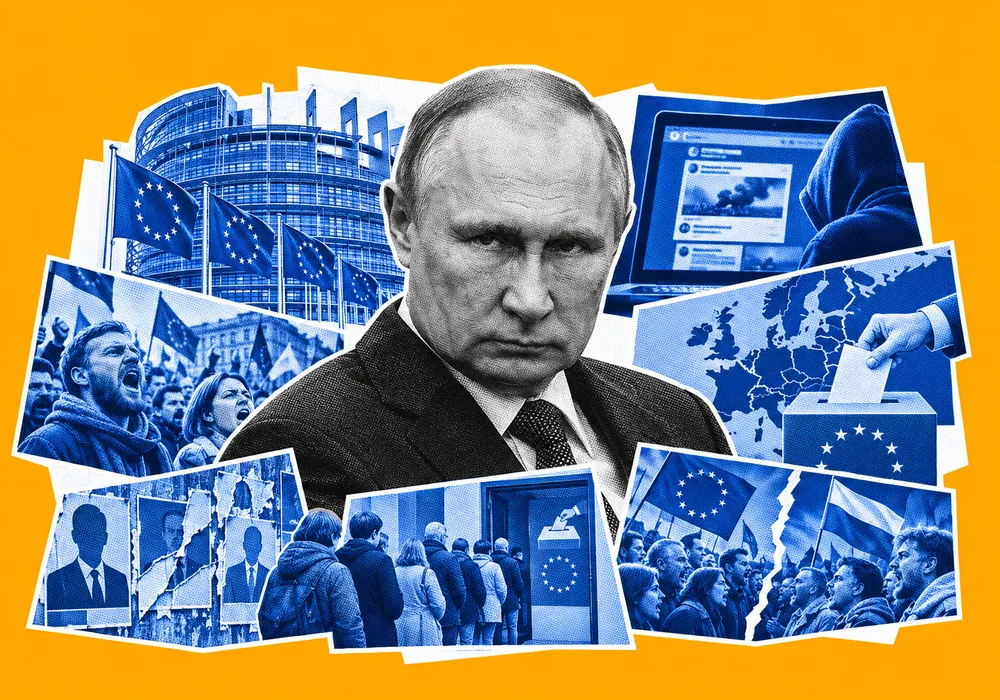
Russian influence operations are increasingly exploiting both electoral campaigns and domestic social tensions across Europe. Fake social media networks have amplified far-right political messages in several countries, while pro-Russian groups have sought to mobilise protests against national defence policies. Recent investigations in Germany and new EU sanctions highlight how information manipulation can connect online activity, street mobilisation and political pressure ahead of a crucial European election cycle in 2027.
A network of more than 550 fake accounts on X amplified messages from far-right parties during the Netherlands’ October 2025 election, according to a report by disinformation-focused NGO Alliance4Europe. At least 225 accounts had identifiable links to Nigeria, while the network published more than 23,000 posts promoting political messages. Researchers subsequently traced its activity to Hungary’s April 2026 election and Sweden, where they identified 8,505 accounts in August.
The network’s geographical movement illustrates how coordinated online influence operations can be adapted to different national political environments. Rather than concentrating on a single election, operators can reuse accounts, infrastructure and communication techniques to exploit political divisions across several countries. Researchers have already identified accounts following Serbian profiles ahead of the country's early presidential election, which must take place no later than 27 December 2026.
Alliance4Europe warns that these activities are likely to intensify around major European elections scheduled for 2027. France is among the countries already appearing in the targeting patterns identified by researchers. The organisation argues that the speed of influence operations, the use of advanced artificial intelligence models and the falling cost of producing large volumes of political content have significantly increased the scale of the threat.
Russia Exploits Domestic Protests and Political Grievances
Electoral interference is only one dimension of the problem. Russia-linked influence networks can also exploit existing social tensions, amplify protests and promote narratives that weaken public support for government policies. Demonstrations do not necessarily originate from foreign interference, but external actors can use them to increase political pressure, deepen divisions and influence the environment in which voters make decisions.
An investigation published by German outlet CORRECTIV on 20 November illustrates this mechanism through protests against compulsory military service in Germany. The investigation examined the campaign Schulstreik gegen Wehrpflicht (School Strike Against Conscription), which presents itself as an independently organised student movement. CORRECTIV found that structures connected to the Socialist German Workers' Youth (SDAJ), the youth organisation of the German Communist Party (DKP), played a significant organisational role in the campaign.
The investigation identified links extending beyond public messaging. According to CORRECTIV, the SDAJ's federal leadership registered the German internet domain associated with the protest campaign. The organisation also confirmed that it had registered a server for the initiative, describing its involvement as support for the movement against militarisation and compulsory military service.
CORRECTIV further documented longstanding political and organisational contacts between the DKP and Russian communist structures, including the Communist Party of the Russian Federation. These connections included visits to Russia and occupied Ukrainian territories, participation in events involving Russian officials and the dissemination of Russian government narratives about the war against Ukraine.
The investigation also traced the historical role of communist organisations in attempts to influence Germany's peace movement during the Cold War. It described how Soviet-era structures used political organisations and protest networks to advance Moscow's foreign policy interests. The current campaign against conscription therefore raises questions about the extent to which established political networks can provide organisational infrastructure for contemporary influence activities.
The findings do not establish that the German protests themselves were organised or directly financed by the Russian state. However, they demonstrate how groups with documented pro-Russian political connections can become involved in domestic mobilisation around sensitive issues such as military readiness, defence spending and conscription.
From Street Mobilisation to Electoral Pressure
The political significance of such activities extends beyond individual demonstrations. In Germany, opposition to compulsory military service intersects with wider debates about the country's defence capabilities, its responsibilities within NATO and the scale of support for Ukraine. Campaigns that frame military preparedness exclusively as an aggressive policy against Russia can reinforce narratives already promoted by the Kremlin.
This creates an opportunity for foreign influence actors to exploit genuine public concerns rather than manufacture every grievance themselves. Questions about military service, the cost of rearmament and the consequences of the war can become channels through which misleading or selectively presented information reaches audiences that might otherwise distrust openly pro-Russian messaging.
The same mechanism can affect electoral competition. Sustained protest mobilisation can increase the visibility of particular political narratives, put pressure on governing parties and make defence policy a more divisive campaign issue. When these messages are amplified through coordinated online networks, domestic political disputes can acquire a much wider reach.
Alliance4Europe's report provides another example of how foreign actors can exploit existing tensions without necessarily creating them. Its analysis of protests in France in October and November 2026 found no foreign fingerprints in the organisation's hosting, domain or tracking records. Nevertheless, researchers identified 639 Doppelganger messages published before the demonstrations and 4,299 articles from the Pravda network distributed across 55 websites in 17 languages. Iranian state media also devoted a substantial share of its French-language output to related themes.
The distinction is important: foreign amplification of protests does not automatically mean that the protests themselves are foreign-organised. However, it shows how domestic grievances can be incorporated into broader information campaigns designed to undermine confidence in political institutions and deepen social divisions.
EU Sanctions Target Russian Information and Cyber Networks
The growing evidence of cross-border influence activities coincided with a new round of EU sanctions announced on 16 November. The Council of the European Union added 30 individuals and two entities to its restrictive measures targeting Russia's foreign information manipulation and interference (FIMI) and malicious cyber activities.
Among those listed was the Moscow-based Social Design Agency (SDA), a public relations and political technology company. The Council said the organisation carried out large-scale information manipulation projects funded, directed and supervised by the Russian presidential administration. Its activities included coordinated campaigns targeting EU member states, European institutions and public support for Ukraine, including during the 2024 European Parliament elections.
The sanctions also covered 24 SDA employees involved in developing and implementing the agency's so-called European and Ukrainian counter-campaigns. Russian television presenters Petr Marchenko and Vitaly Yeliseyev were included over their role in promoting narratives that legitimise Russia's war against Ukraine. The list also included Chay Bowes, whom the Council linked to information manipulation activities and the pro-Russian disinformation network The Islander News.
The EU simultaneously sanctioned the pro-Russian hacker group NoName057(16), which has carried out distributed denial-of-service attacks against government institutions, infrastructure and private organisations. The Council noted that its targets included political parties and candidates during electoral processes, alongside energy, financial, transport and water supply infrastructure.
Following the latest decisions, EU restrictive measures over foreign information manipulation and interference cover 111 individuals and 21 entities. The separate cyber sanctions regime now covers 27 individuals and 12 entities.
Europe's 2027 Elections Will Test Its Democratic Resilience
The developments point to an increasingly interconnected model of Russian influence in Europe. Fake accounts can amplify political messages during election campaigns, established networks can help mobilise protests around divisive domestic issues, and state-linked media operations can reinforce the resulting narratives across national borders.
The distinction between foreign interference and domestic political activity remains essential. Not every anti-government demonstration, criticism of conscription or politically controversial campaign is evidence of Russian involvement. The challenge for European authorities is to identify demonstrable organisational, financial and digital links without undermining legitimate political participation or freedom of expression.
The coming election cycle will test whether European institutions and social media platforms can respond more effectively to these operations. The movement of coordinated networks between countries, the growing use of AI-generated content and the exploitation of domestic grievances suggest that isolated measures against individual accounts will not be sufficient.
For European governments, the issue extends beyond protecting election-day procedures. It concerns the integrity of public debate, the ability to maintain support for defence and security policies, and the resilience of democratic institutions against sustained external pressure.
Sources: [Alliance4Europe](https://alliance4europe.eu/report/state-of-manipulation-a-threat-to-europes-security ), [CORRECTIV](https://correctiv.org/aktuelles/gesellschaft-2/2026/11/20/fuer-russland-gegen-die-deutsche-wehrpflicht/ )