
Hundreds of Thousands Protest in Prague Against Babiš’s Public Media Overhaul

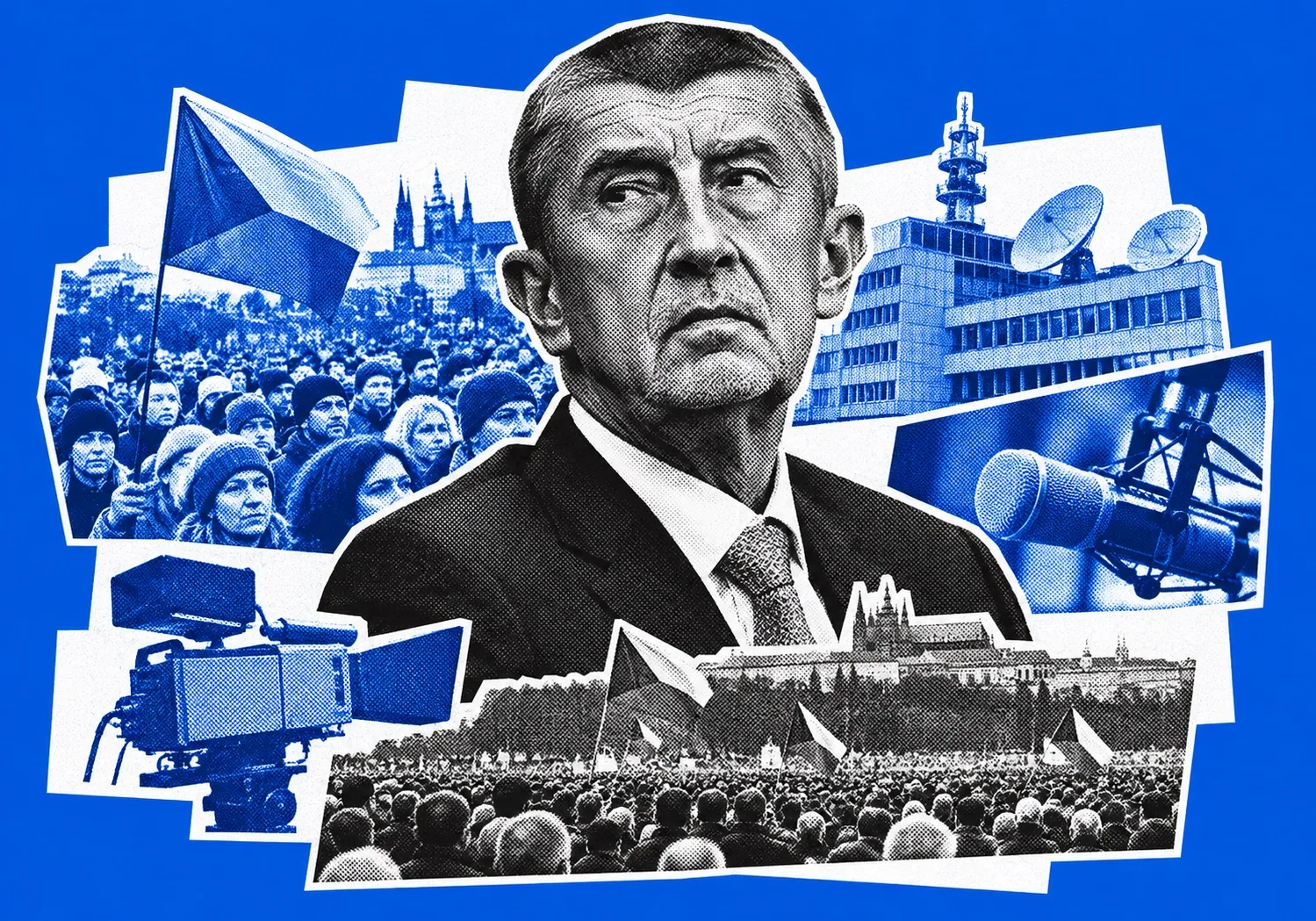
Protesters filled Prague’s Letná Park on 15 November to oppose Prime Minister Andrej Babiš’s plan to abolish household broadcasting fees and fund Czech Television and Czech Radio directly from the state budget. The reform, which includes a 15% funding cut, has sparked warnings across Europe over political interference and press freedom.
The demonstration, organised by the civic movement Million Moments for Democracy, came two days before the anniversary of the 1989 Velvet Revolution, which ended communist rule in Czechoslovakia. Organisers estimated attendance at between 350,000 and 400,000, although international news agencies reported varying figures, ranging from tens of thousands to several hundred thousand.
Protesters carried signs declaring “Hands off the media” and “Let politicians do politics”. Among those attending were students, military personnel and former Charter 77 dissidents, whose opposition to communist rule gave the gathering particular historical resonance.

At the centre of the dispute is a question extending beyond the cost of television and radio services: whether public broadcasters can retain meaningful editorial independence when their financing depends directly on the governments they are expected to scrutinise.
Why the funding model has become politically contentious
Prime Minister Andrej Babiš's governing coalition, which includes the far-right Freedom and Direct Democracy party (SPD) and the eurosceptic Motorists, wants to eliminate the mandatory monthly household broadcasting fee of 205 Czech korunas, approximately $9.26.
Under the proposal, Czech Television (ČT) and Czech Radio (ČRo) would instead receive funding from the national budget. Their combined resources would also be reduced by approximately 1.4 billion korunas, equivalent to a 15% cut.
The government presents the changes as a way to ease financial pressure on households and modernise an outdated financing system. Ministers maintain that the reform fulfils an electoral commitment and deny that it is intended to interfere with journalistic independence.
That argument has an important European precedent. Norway and France have moved away from traditional broadcasting licence fees without automatically dismantling the independence of their public media organisations.
The distinction lies in how replacement funding is allocated, protected and maintained.
A system financed through taxation can preserve editorial autonomy if public broadcasters receive sufficient resources under transparent, predictable arrangements that limit political discretion. Conversely, funding that depends on recurring government decisions can expose media organisations to pressure even without explicit instructions about editorial content.
Critics argue that the Czech proposal creates precisely that vulnerability by combining direct budgetary dependence with substantial immediate reductions.

The financial changes would also arrive as the broadcasters continue to fulfil statutory responsibilities to provide independent, balanced and comprehensive public-service programming.
For opponents of the legislation, the concern is therefore institutional rather than simply financial. A broadcaster can remain formally independent while becoming increasingly constrained by the political authorities controlling its resources.
What a 15% reduction would mean for Czech journalism
The projected financial consequences are substantial.
According to assessments by broadcaster management, Czech Television's 2027 budget would fall by approximately 1 billion korunas, or €41 million, to around €237 million. In nominal terms, that would return its funding to levels last recorded in 2008.
Czech Radio faces a reduction of approximately 400 million korunas, equivalent to €16 million, bringing its annual resources to around €85 million, comparable with its nominal funding in 2005.
These comparisons do not account for subsequent inflation or changes in operating costs, making the return to earlier nominal budgets particularly significant for institutions maintaining nationwide services.
Management projections indicate that between 450 and 700 positions could disappear across the two broadcasters. Czech Television could lose 300 to 500 employees, while Czech Radio could shed another 150 to 200.
The consequences would extend beyond staffing figures.
Investigative reporting requires experienced journalists, editorial oversight, legal support and sufficient time to pursue stories that may not produce immediate results. Regional news operations depend on permanent reporting networks, while original television production involves financial commitments that cannot easily be reduced without affecting output.
Both broadcasters have warned that these activities would face significant cuts.
Specialised services are also at risk, including Czech Radio's Radiožurnál Sport station and its symphony orchestra.
For audiences outside Prague, reduced regional broadcasting could mean fewer reports on local government, public services and issues receiving limited attention from national newsrooms.
The proposed reductions have not yet taken effect, and the precise distribution of any cuts remains uncertain. Nevertheless, the broadcasters' projections provide a concrete indication of what the proposed financial settlement could require.
The European dimension of Prague's media dispute
The controversy has attracted criticism from several major international press freedom organisations.
The European Broadcasting Union, European Federation of Journalists, Reporters Without Borders and International Press Institute have warned that the proposed combination of state financing and reduced resources could undermine the autonomy of Czech public media.
Their objections concern the structural conditions under which journalism operates, rather than evidence that the government has already imposed direct editorial censorship through the legislation.
 European Commissioner for Justice Michael McGrath has also emphasised that public-service broadcasting must be financed according to transparent and objective criteria, with funding that remains sufficient, stable and predictable.
His intervention places the Czech dispute within a wider European debate about safeguards for independent journalism.
Public broadcasters occupy an unusual institutional position. They are expected to serve the public interest, provide politically balanced information and scrutinise elected authorities, yet their financial arrangements are ultimately established through political decisions.
The challenge is to prevent that necessary relationship with the state from becoming a mechanism of editorial influence.
Experiences in Hungary, Poland, Slovakia and Serbia have already raised concerns about political pressure on public media and the durability of institutional protections. Their circumstances differ, however, and the Czech proposal cannot automatically be equated with the outcomes observed elsewhere.
Nor does direct budget financing necessarily produce government control. The examples of Norway and France demonstrate that the method of collecting public broadcasting revenue is only one part of the institutional framework.
What matters is whether funding arrangements provide meaningful protection against arbitrary reductions and political bargaining.
The available briefing does not establish what specific safeguards would remain in the final Czech legislation, or whether parliamentary amendments could strengthen them.
That uncertainty is central to assessing the reform's eventual consequences.
A parliamentary dispute shaped by the Velvet Revolution
The legislative process has intensified opposition to the government's plans.
The proposal passed its first reading in the Chamber of Deputies at 4:36 a.m. in late October, prompting criticism over the circumstances and speed of parliamentary consideration.
The timing has contributed to suspicions among opponents that a consequential institutional reform is being advanced without sufficient scrutiny.
The government rejects accusations that its objective is political control, although the available evidence does not establish a detailed response from the administration specifically addressing criticism of the overnight parliamentary proceedings.
The November demonstration also drew strength from the historical significance of Letná Park.
The site is closely associated with the mass mobilisation that accompanied the Velvet Revolution in 1989. Holding a major protest there immediately before the revolution's anniversary connected contemporary concerns about media independence with the country's experience of authoritarian information control.
Participants wearing newspaper hats inspired by classic Czech children's television programming added another dimension to the gathering, linking the political dispute to the cultural role of public broadcasting.
Yet the historical parallels have limits. The Czech Republic remains a parliamentary democracy in which the proposal is subject to further legislative consideration, public opposition and institutional scrutiny.
The bill's final provisions remain unsettled. It is not yet clear whether subsequent parliamentary stages, including possible Senate consideration, will produce meaningful changes.
Nor is there confirmation that European Commission scrutiny will result in formal infringement proceedings.
Those unresolved decisions will determine whether the proposed funding system contains enforceable protections for editorial autonomy or leaves Czech Television and Czech Radio dependent on future budget negotiations with the political authorities whose decisions they must continue to investigate.