
Czech Media Reform: Babiš Plan to Abolish TV Licence Fees Sparks Backlash

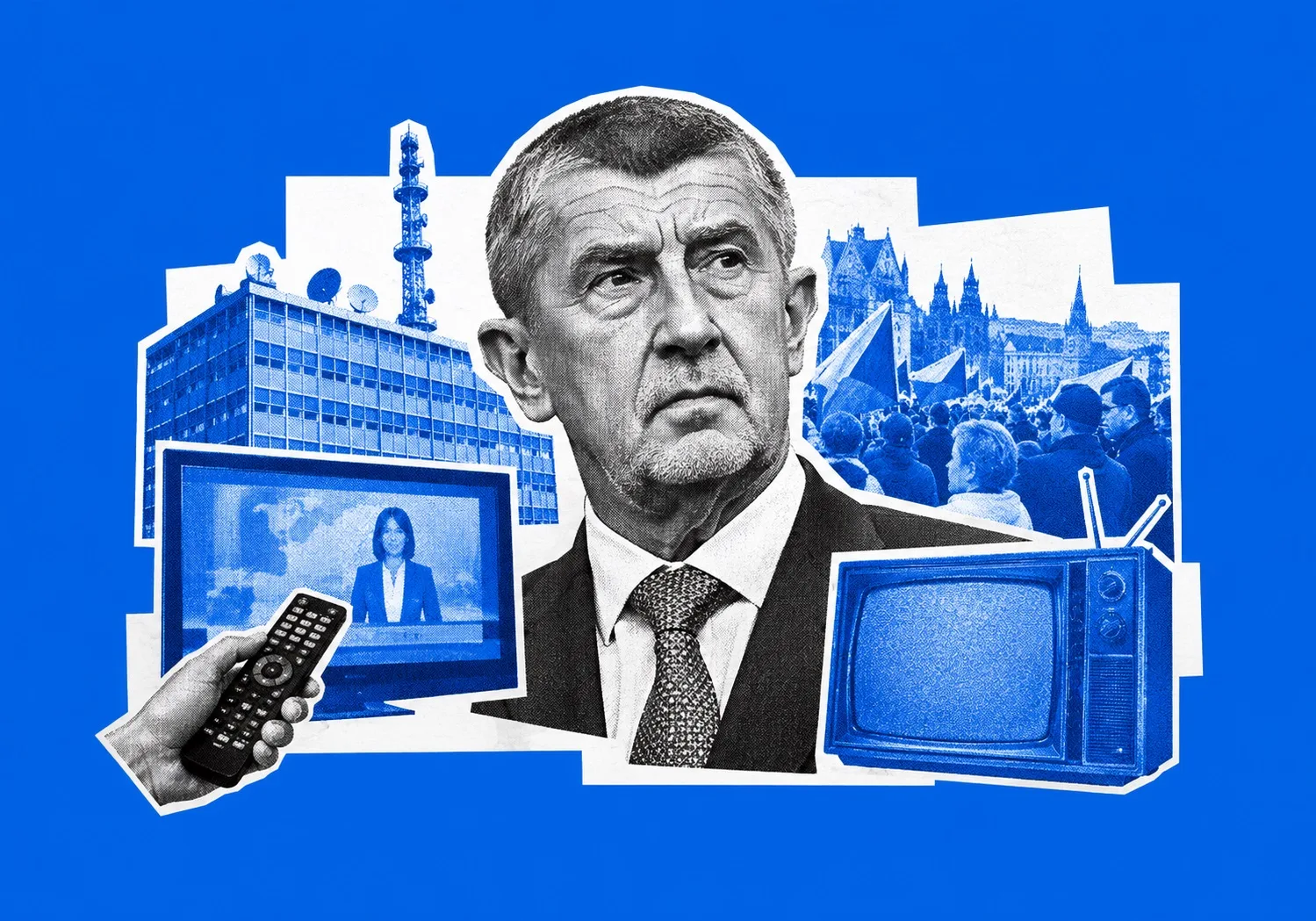
A controversial proposal by Czech Prime Minister Andrej Babiš to replace public broadcasting licence fees with state budget funding has triggered mass protests across the country. Opponents warn the legislation could cut funding for Czech Television (ČT) and Czech Radio (ČRo) by 15% and place independent media under political control. On Sunday, October 25, thousands gathered in Prague’s Old Town Square, alongside demonstrations in Brno, Liberec, and České Budějovice, as parliament accelerated the law's approval.
The disagreement is about more than the size of a budget. It concerns who gets to determine that budget, how often the decision can be revisited and what happens when journalism becomes inconvenient for those holding the purse strings.
The Power Behind the Budget
The existing Czech system gives public broadcasters a revenue stream that does not depend directly on annual government spending decisions. Households with equipment capable of receiving broadcasts pay 150 koruna a month for television and 55 koruna for radio, equivalent to 2,460 koruna a year.
It is not an especially popular arrangement. Payments are compulsory, and non-payment can lead to penalties and court collection proceedings. Babiš’s government has therefore identified a genuine political argument for reform: the funding mechanism is outdated and places a recurring financial obligation on households.
Ministers insist that replacing these fees with direct public expenditure need not compromise independence. They propose making broadcaster allocations mandatory items in the state budget, with expenditure guarantees established in law.
Yet statutory protection and institutional autonomy are not necessarily the same thing.
A broadcaster funded through dedicated household contributions has a degree of separation from the government’s immediate spending priorities. Once that funding becomes part of the state budget, politicians acquire a more direct role in determining the resources available to the institution.
Even where allocations are legally guaranteed, the legislation establishing those guarantees can itself become a political battleground. Funding formulas may be revised, spending priorities reconsidered and future budgets subjected to pressure.
That distinction matters particularly for organisations whose responsibility includes scrutinising the people making those decisions.
Financial influence need not take the form of explicit censorship. A newsroom facing sustained uncertainty over staffing, production costs and future funding may find its editorial choices constrained by circumstances rather than instructions.
The government denies that its proposals would affect news coverage. The concern raised by media workers and international press freedom organisations is that the proposed structure would make such interference easier, regardless of the current government's stated intentions.
A Smaller Broadcaster, a Weaker Watchdog?
The proposed reduction is not merely a change in accounting arrangements.
Czech Television’s general manager has warned that a cut of approximately 1 billion koruna from the broadcaster’s budget could require between 300 and 500 redundancies. With a workforce of roughly 2,900, that would represent a considerable contraction.
The effects would extend beyond the employees directly affected.

Television journalism relies on substantial infrastructure: reporters, editors, technical crews, regional coverage, production teams and the capacity to sustain investigations that may take months without producing immediate results.
A broadcaster operating with significantly fewer staff would have to make choices about what it could continue to cover. Some programmes might become harder to sustain, while expensive or labour-intensive reporting could face greater pressure.
The briefing does not establish which departments or programmes would be cut. Nor is there evidence that particular investigations have been targeted. But the scale of the proposed reduction makes operational consequences difficult to dismiss.
Czech Television and Czech Radio employees have announced a one-day strike for November 3. Their decision places the broadcasters themselves at the centre of a dispute that the government has presented principally as an administrative and financial reform.
There is also a question of public confidence.
General trust in the Czech media stands at approximately 30–33%, according to the figures provided in the editorial briefing. In such an environment, public broadcasters occupy an important position as comparatively trusted sources of information.
Their credibility depends partly on audiences believing that political leaders cannot easily punish unfavourable reporting.
If that perception weakens, even without demonstrable editorial interference, the damage could be difficult to reverse. Trust is not something a future budget increase can automatically restore.
Why the Parliamentary Rush Matters
The speed of the legislative process has intensified suspicions surrounding the reform.
The Chamber of Deputies advanced the proposal during an accelerated session that continued into the early hours of October 24. The coalition's decision to pursue this route has become almost as contentious as the funding model itself.
There is an important distinction between a government possessing the parliamentary numbers to change legislation and using those numbers to limit the time available for scrutiny.
Public broadcasting reform raises questions about institutional safeguards, financial accountability and the relationship between elected officials and independent media. These are matters in which detailed parliamentary examination is particularly relevant.
An accelerated procedure reduces the opportunity for opponents to test the government's assurances, challenge the financial assumptions and examine possible protections against future political intervention.
The government’s precise reasoning for choosing the overnight timetable is not established in the briefing. It would therefore be premature to attribute a specific tactical motive to the coalition.
Its political effect, however, is clear: the reform has moved forward while the opposition and civil society are still contesting its underlying principles.
President Petr Pavel has criticised the haste and warned against irreversible decisions affecting public service media, which he regards as a fundamental pillar of democracy.

His intervention gives the dispute an institutional dimension beyond the familiar confrontation between government and opposition.
Pavel's criticism does not itself determine the legislation's fate. The extent to which he could delay or influence the process will depend on the bill's subsequent parliamentary passage and the constitutional mechanisms available at that stage.
For now, his objections reinforce the argument that the issue deserves more extensive deliberation than the coalition has allowed.
Central Europe’s Familiar Question
The Czech dispute also carries significance beyond its borders.
Hungary provides a regional example of how political influence over media institutions can become entrenched through changes to their governance and financial arrangements.
The comparison should not be stretched too far. The Czech proposal has not established direct editorial control, and its eventual implementation remains contested. Different legal systems and institutional safeguards can produce different outcomes.
Nevertheless, the underlying question is recognisable: how much practical independence can a publicly funded institution retain when the government gains greater control over its financial circumstances?
Public broadcasters across Europe operate under different financing arrangements. State-budget support is not, by itself, proof of political interference, just as licence fees cannot guarantee editorial independence under every circumstance.
The decisive issue is the design of the safeguards.
Predictable funding, protection from arbitrary reductions and credible limits on political discretion matter more than the administrative label attached to the revenue.
In the Czech case, the proposed 15% cut makes the change especially contentious. The government is not simply transferring an existing funding obligation from households to the state. It is proposing a new financial relationship while simultaneously reducing the resources available to the broadcasters.
That combination creates a sharper risk than a funding reform that preserves existing capacity.
The European Broadcasting Union, European Federation of Journalists, Reporters Without Borders and International Press Institute have raised concerns about the implications for media independence.
Their objections place the Czech legislation within a wider European debate over the resilience of public service journalism against political and financial pressure.
The organisations' involvement does not establish that political interference has already occurred. It does indicate that the proposed safeguards have failed to reassure important parts of the European broadcasting and press freedom community.
The Opposition Moves Towards the Courts
The parliamentary opposition, including the Pirate Party, has promised to challenge the legislation before the Constitutional Court.
That prospect opens another front in the dispute, although the precise legal grounds of the anticipated challenge have not yet been established in the briefing.
The accelerated parliamentary procedure could become an important area of scrutiny, alongside questions about the institutional protections available to public broadcasters. Whether either argument would succeed is a separate matter.
The political confrontation is also moving outside parliament.
Sunday's demonstrations were organised by Million Moments for Democracy, a civic initiative with a history of mobilising opposition to Babiš.
The movement organised major protests in 2017 and 2019 amid allegations of corruption and conflicts of interest involving the politician. His return to power in 2025 has brought an established protest network back into confrontation with his government.
Another, larger demonstration is planned in Prague for November 15.
The sequence of parliamentary action, employee strike plans, presidential criticism and renewed street protests reveals how quickly a dispute over broadcasting finance can spread across the country's institutions.
For Babiš, the challenge is no longer confined to persuading voters that compulsory licence fees should disappear. His coalition must also defend why the replacement system should give politicians a more direct role in financing organisations tasked with holding them accountable.
The tension is likely to persist even if the government succeeds in passing the legislation.
A future administration could inherit the same financial powers, with different political priorities and different attitudes towards critical journalism. The question facing Czech lawmakers is therefore not only whether the present government intends to interfere with public broadcasting, but whether the funding system it creates would allow a subsequent government to do so.
For Czech Television and Czech Radio, that distinction could determine how independently they operate long after the current parliamentary confrontation has ended.
Sources: AFP, Reuters, CT24, Inquirer.net