
How Ukraine’s Drones And Robots Supply Troops And Rescue the Wounded

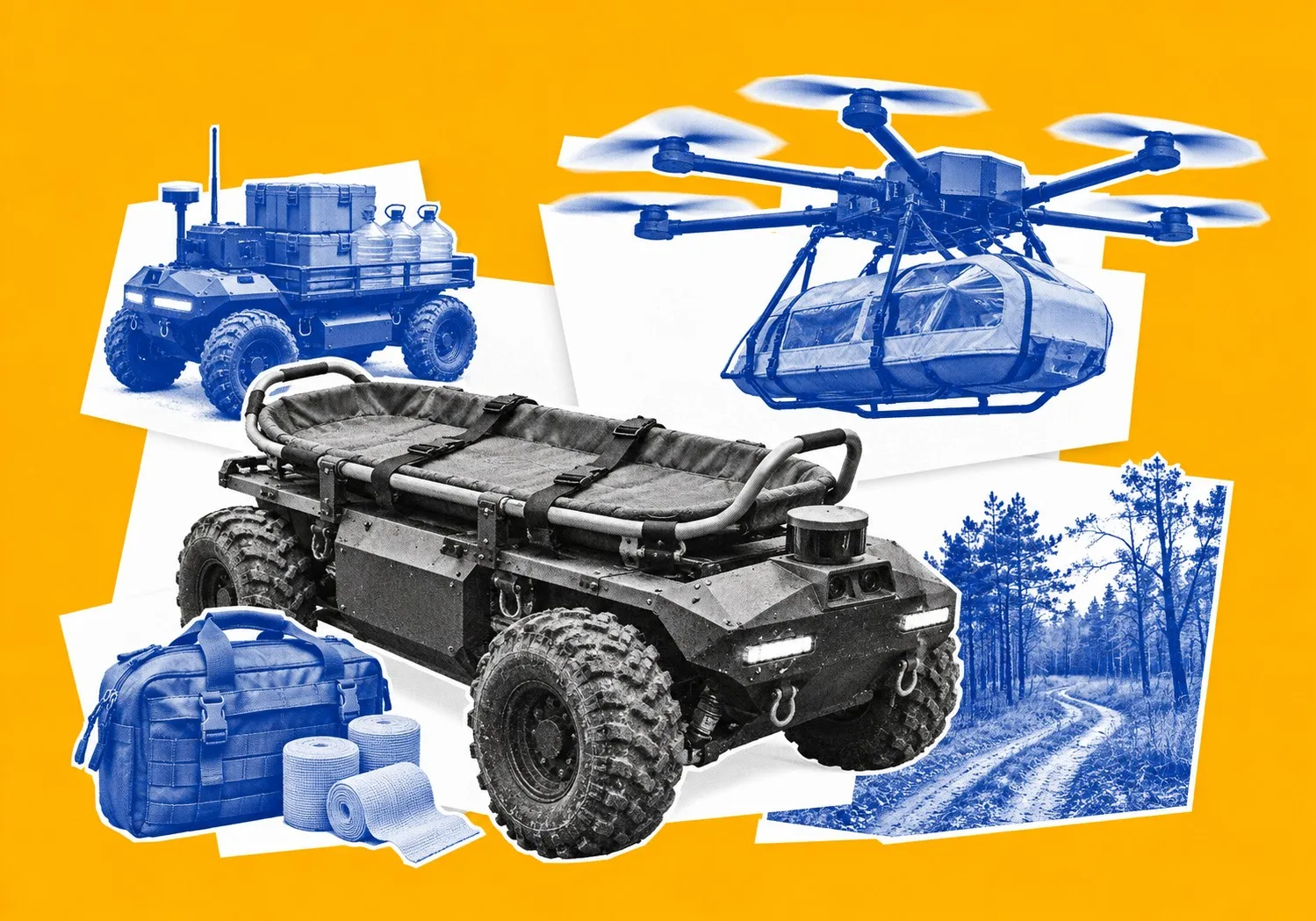
Ukraine’s National Guard has used drones and ground robots to transport nearly 6,200 tonnes of supplies since Russia’s full-scale invasion began in 2022, its commander says. The same systems have evacuated 499 military personnel, including the recovery of those killed in action. Across Ukraine’s armed forces, unmanned vehicles are also rescuing wounded soldiers and delivering aid to civilians cut off by the fighting.

When the only way out is by air
In October, Ukrainian forces carried out what they described as the world’s first medical evacuation of a wounded soldier from the battlefield using a heavy aerial drone.
The rescued infantryman, Kostiantyn Vlasenko, known by the call sign Magura, had spent 491 days at a position on the Kupiansk front in the Kharkiv region.
A member of the 30th Mechanised Brigade, he had arrived on the eastern bank of the Oskil River in June 2025. His fellow soldier was later killed, leaving him isolated in an area watched by Russian drones.
On 14 February 2026, a Russian drone dropped an explosive that severely injured both his legs. One foot was lost, and Vlasenko was forced to amputate the other himself to survive.
Attempts to reach him by land failed. Russian forces destroyed a ground robot sent to collect him, while mines, Russian infantry and constant drone surveillance prevented rescue teams from approaching.
For months, his comrades kept him supplied by drone, dropping food and other essentials every four or five days. They maintained contact by radio.
Eventually, soldiers developed a plan to lift him out by air.
 Working with the Ukrainian manufacturer Gurzuf Defence, they adapted a Heavy Shot Ayudag-6 drone, capable of carrying up to 130kg. The operation took months to prepare and involved personnel from several brigades.
The aircraft was fitted with a winch to lift the wounded soldier. Before the rescue, another drone delivered a climbing harness and a telephone with video instructions showing Vlasenko how to attach himself to the lifting equipment.
On 4 October, he secured himself to the cable and was lifted into the air.
Other Ukrainian drones flew diversionary missions to distract Russian interceptors. The aircraft had to make battery stops during the journey, while ground teams stood ready in case something went wrong.
After being carried approximately 16km by air, Vlasenko was transferred to a ground robot, which took him another 8km through difficult terrain. He was then driven to a medical stabilisation point for emergency treatment.
The mission succeeded.
After more than 16 months at the frontline position, Vlasenko had finally been brought to safety.
Later that month, another seriously wounded soldier was rescued using a different aircraft, the StarGate evacuation drone.
Artem Lytvyn, 25, had spent eight days stranded near the Russian border after stepping on a mine that severely injured his right leg. Attempts to reach him using ground robots and a stretcher team had failed.

On 21 October, a StarGate operated by the 475th Separate Assault Regiment landed near his hiding place. Unlike the aircraft used for Vlasenko, it carried an enclosed capsule.
Lytvyn dragged himself inside, shut the hatch and was flown roughly 29km to safety in about 20 minutes. Other Ukrainian drones provided cover during the flight.
He survived, although surgeons subsequently amputated his injured leg.

He feared the drone might be shot down but felt relieved to have escaped, Lytvyn told the Guardian.
Both rescues relied on technology originally developed for other purposes. Ukraine is now developing dedicated aerial evacuation teams, although such missions remain difficult and dangerous. Heavy rescue drones require careful planning, protection from Russian aircraft and safe places to collect casualties.
Under fire, without a driver
A ground robot belonging to Ukraine’s 14th National Guard Brigade, Chervona Kalyna, was carrying supplies to frontline troops when Russian FPV drones attacked it. Twice, its operators steered the vehicle away from the incoming drones. The cargo reached its destination.
The brigade released footage of the mission on 11 November. It was one of many deliveries now being made without drivers on roads watched by Russian reconnaissance drones and exposed to artillery fire.
National Guard commander Oleksandr Pivnenko said ground robots had transported about 70% of the nearly 6,200 tonnes of cargo delivered by his units since February 2022. Heavy aerial drones carried the remaining 30%. The volume moved in 2026 was almost four times higher than the previous year.
 The cargo includes ammunition, food, water and equipment needed by troops holding positions that conventional vehicles can no longer safely approach. Losing a robot can be costly, but it does not put a driver’s life at risk.
The National Guard also uses these machines to evacuate casualties.
In February, the Guard described the work of an officer known by the call sign Dozor, whose ground-robot unit operates with its 4th Brigade, Rubizh, near Pokrovsk. His company had completed around 30 successful evacuations over several months, including wounded soldiers from neighbouring army units.
North of Kharkiv, the Guard’s 13th Brigade, Khartiia, reported sending a robot along a 12km route to collect an injured serviceman in May 2025. Another operation involved four wounded soldiers travelling on a single robotic platform at night.
Most of these vehicles were designed for cargo rather than people. Soldiers have adapted them with mattresses, blankets and radios, although journeys over damaged ground can be painful for seriously injured passengers.
According to Pivnenko, two-thirds of the National Guard’s evacuation missions using unmanned systems took place in 2026.
Food and six cats across the Dnipro
National Guard drones have also helped deliver humanitarian aid to Russian-occupied Oleshky, across the Dnipro from Kherson.
Residents faced severe shortages of food, medicine and other essentials. With conventional aid deliveries unable to reach the town safely, Ukrainian forces used heavy drones to fly supplies across the river.
In late September, aircraft delivered around four tonnes of food to 100 locations. Another operation followed overnight on 3–4 October, when troops from the National Guard’s 11th Brigade and 34th Kherson Regiment worked alongside Ukrainian marines and border guards.
Together, they delivered almost 400 packages weighing close to four tonnes, containing food, medicines and supplies for children.
The October operation also included an unusual rescue.
Members of the National Guard’s Bolharychi drone unit, part of the 11th Brigade, arranged to evacuate a mother cat and her five kittens stranded in Oleshky.
Local residents helped place the animals in a specially prepared cage. A heavy drone then carried them more than 10km across the river to Ukrainian-controlled territory.
The soldiers called the mission Operation Tigers.
All six animals survived.
 The flights provided a way to reach people in occupied territory without sending rescue teams across the Dnipro. Their limited carrying capacity, however, meant repeated journeys were needed.
Later in October, a temporary local ceasefire allowed a separate humanitarian evacuation by bus. Some residents were subsequently able to return to Ukrainian-controlled territory after travelling through Russia and Belarus.
Robots across Ukraine’s army
The National Guard’s figures cover its own operations, but unmanned logistics have spread across Ukraine’s wider Defence Forces.
According to the Ministry of Defence, participating military units carried out more than 171,000 logistics and evacuation missions using ground robots between January and October 2026. October alone accounted for 31,398 missions, compared with 7,511 in January.
These figures count missions rather than tonnes transported or people rescued and are separate from the National Guard totals.
In May, the 1st Separate Medical Battalion and the 425th Assault Regiment, Skelia, used a ground robot to evacuate a wounded soldier from a partially surrounded position.
On its return journey, the vehicle struck two anti-personnel mines but continued moving. The soldier suffered no further injuries. The operation covered 36.5km and lasted two hours and 13 minutes.
Other units have used the machines to reach civilians trapped by fighting.
In April, operators from the 60th Mechanised Brigade spotted a 77-year-old woman walking along a shell-damaged road in the Lyman district of Donetsk region. She fell while trying to escape an area exposed to Russian fire.

The soldiers sent a ground robot towards her, covered with a blanket bearing the message: “Grandma, get on.”
The woman, whose home of 53 years had been destroyed, was brought to safety. Aerial drones also guided three other civilians towards an evacuation point, where soldiers collected them in an armoured vehicle.
In September, the 20th Separate Unmanned Systems Brigade, known as K-2, reported using a ground robot to rescue civilians injured when a Russian FPV drone struck their home.
Ground robots can reach places too dangerous for ambulances, but they are slow and vulnerable to mines, mud and communication failures. For badly wounded soldiers, the delay can be critical.
Sources: National Guard of Ukraine, Ministry of Defence of Ukraine, The Guardian, Reuters