
Paraguay President Peña Impeached and Placed Under House Arrest Following Ueno Bank Collapse

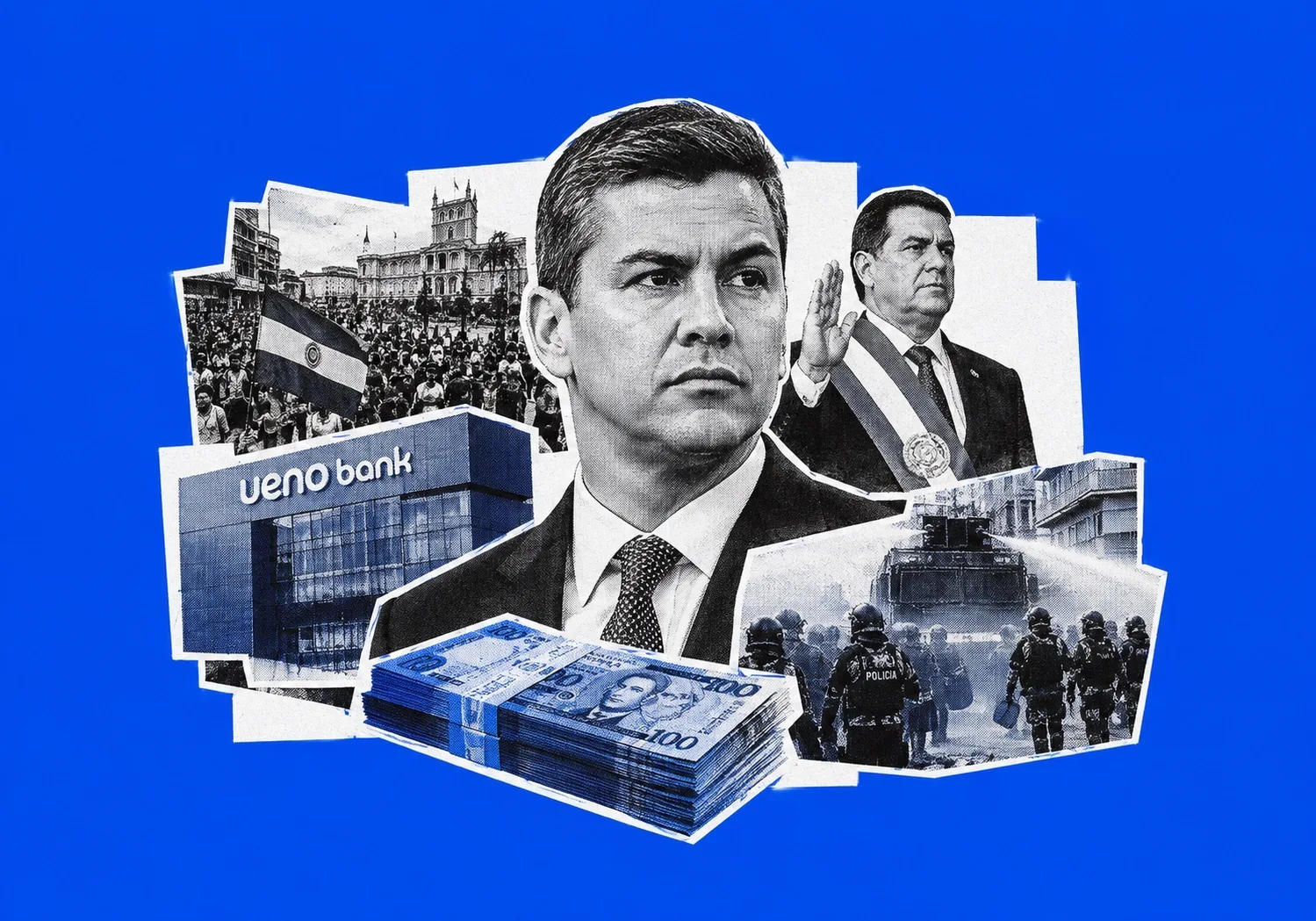
Paraguay’s Senate has removed President Santiago Peña from office and placed him under house arrest following the systemic collapse of Ueno Bank, which froze over $800 million in public funds and pensions. While Vice President Pedro Alliana assumes power, the swift impeachment exposes how Paraguay's ruling Colorado Party sacrificed its own president to protect its decades-long grip on power.
The crisis began on 3 November, when Paraguay's Central Bank intervened in Ueno Bank after its solvency ratio fell below half the statutory minimum. The intervention froze operations at an institution serving approximately three million customers, equivalent to around 60 per cent of the country's adult population.
Ueno was not simply another commercial bank experiencing financial difficulties. Owned by Grupo Vázquez, a major Paraguayan conglomerate, it had become an important destination for public-sector funds, including pension assets. Approximately $800mn to $850mn in public and private money was caught in the freeze.
For ordinary customers, the consequences were immediate. Pensioners lost access to savings, small businesses struggled with blocked accounts, and retail activity suffered. Thousands of people protested in Asunción and other cities, with demonstrations escalating into clashes involving police tear gas and water cannons.

The financial repercussions extended beyond Ueno's customers. The guarani depreciated by roughly 5 per cent, while Paraguayan sovereign bonds fell as investors assessed the implications of the crisis for public finances and political stability.
The Central Bank's intervention may have been necessary to contain an insolvent lender. Yet it also raised a more uncomfortable question: how had a bank with such extensive exposure to public funds reached this condition before decisive regulatory action?
Ueno's expansion had been remarkably rapid. Grupo Vázquez acquired Financiera El Comercio in 2021 and transformed it into a digital banking operation the following year. Within a few years, the lender had accumulated millions of accounts and substantial public-sector deposits.
That growth created a concentration of financial exposure which became apparent only when the institution failed.
The precise arrangements governing the placement of state and pension funds at Ueno remain a central unresolved issue. The available information does not establish whether particular regulatory exemptions, procurement decisions or failures of supervision enabled the bank's expansion. Those distinctions will matter as investigators examine how public money became exposed to a politically connected financial group.
Why the Colorado Party Abandoned Peña
Peña's vulnerability was not confined to his government's handling of the banking system.
The former economist had previously held shares in companies affiliated with Grupo Vázquez, maintaining business ties until early 2025. Although those connections did not establish criminal responsibility, they complicated his position once the bank's financial problems became a national political emergency.
On 4 November, opposition lawmakers submitted impeachment requests against Peña and Vice-President Alliana, citing conflicts of interest, financial misconduct and failures of oversight.
Peña responded by signing an emergency decree promising payments to depositors. But the announcement did little to resolve the immediate political danger.
The decisive development came from within the Colorado Party.

Horacio Cartes, the former president who remains the dominant figure in the governing party, withdrew his support for Peña on 5 November. The decision effectively deprived the president of the political protection on which his administration had depended.
Peña had won the 2023 election as the Colorado Party's candidate, defeating a centre-left coalition. His presidency was closely associated with Cartes and the party organisation that had helped secure his victory.
Once the banking crisis threatened that organisation's wider position, however, Peña became politically expendable.
The calculation was straightforward, even if its longer-term consequences remain uncertain. Defending a president associated with a financial scandal affecting millions of voters risked tying the entire party to the collapse. Replacing him offered a way to acknowledge public anger without surrendering control of the government.
Alliana's succession made that option particularly attractive. A veteran Colorado politician and close Cartes ally, he represented continuity within the party rather than a transfer of power to its opponents.
The presidency changed hands. The ruling network remained in place.
Congress Chose Impeachment Over Resignation
Peña's removal also revealed the extent to which Paraguay's legislature could determine the outcome of an executive crisis.
Under the constitution, Congress must approve a presidential resignation. When Peña offered to step down, both chambers rejected the proposal, keeping open the possibility of formal impeachment proceedings.
The Chamber of Deputies subsequently voted 78–0 to advance impeachment. On 6 November, the Senate removed Peña by 44 votes to one.
The decision to pursue impeachment rather than accept resignation was politically significant.
A resignation might have allowed Peña to leave office without a formal congressional judgment on his conduct. Impeachment instead established an institutional finding of improper performance of duties, giving lawmakers a more explicit role in assigning political responsibility.
For opposition politicians, the process offered an opportunity to turn public dissatisfaction into a concrete exercise of parliamentary authority.
For the Colorado Party, it provided a mechanism to separate the departing president from the organisation that had sustained his administration.
These interests converged despite the broader rivalry between government and opposition. The near-unanimous votes illustrated how completely Peña's political position had deteriorated.
They also exposed an unusual feature of the crisis. Congress acted forcefully against the president, but the outcome did not fundamentally alter the governing party's control over the executive.

Alliana inherited the presidency with the Colorado Party's legislative position intact. Whether his administration can restore confidence without confronting the financial relationships underlying the scandal is a different question.
The Problem With Politically Connected Finance
Ueno's collapse has brought renewed attention to a model of financial expansion that combines digital banking, large corporate groups and substantial public-sector deposits.
Digital lenders can acquire customers quickly, but rapid expansion does not eliminate conventional banking risks. Capital adequacy, concentration of deposits and the quality of regulatory supervision remain decisive, regardless of how customers access their money.
Ueno's scale made those risks unusually consequential.
The freezing of accounts held by such a large share of Paraguay's adult population transformed a banking problem into an immediate challenge to the government's legitimacy. The involvement of pension funds made the consequences especially sensitive.
The political connections surrounding Grupo Vázquez added another layer of concern. When senior officials have past commercial relationships with financial institutions holding public money, regulators face questions not only about the quality of their supervision but also about their independence.
There is not yet sufficient evidence to establish precisely how political influence affected Ueno's operations or regulatory treatment. Nevertheless, the combination of Peña's former shareholding, the bank's public-sector exposure and its severe solvency deterioration has made those relationships central to the investigation.
The Attorney General's office has opened three criminal inquiries involving alleged mismanagement of corporate and state funds. Twenty-seven individuals associated with Grupo Vázquez have been indicted, while Peña has been placed under pretrial house arrest on allegations of breach of trust.
His removal from office does not establish criminal guilt. Nor does the investigation's current scope determine whether responsibility extends to other senior figures in Paraguay's political establishment.
That uncertainty is likely to complicate Alliana's attempt to stabilise the government.
Financial Confidence Beyond Paraguay
The immediate international implications are more limited than the domestic political shock, but foreign creditors also have reason to follow the investigation.
Ueno had approximately $510mn in foreign financing as of September. Its corporate structures included minor indirect connections to European financial groups, including Hungary's OTP Bank.
The available figures do not establish the extent of potential losses for individual foreign lenders, and there is no confirmed evidence of wider contagion across European banking markets.
For Paraguay, however, the deterioration in its currency and sovereign bond prices creates a more direct concern.
A banking failure involving substantial public funds can raise questions about whether the state will need to assume additional financial obligations. Peña's emergency decree promised depositor payments, but the precise timetable, funding arrangements and extent of reimbursement remain unclear.
Those details will be important for determining whether the initial market reaction develops into a more persistent problem for sovereign financing.
Paraguay's Mercosur partners are monitoring developments, although neighbouring governments have so far adopted a cautious approach.
The immediate challenge for Alliana is therefore both financial and institutional. Restoring access to deposits will require more than replacing the political leadership. Confidence in the management of public money will depend on whether regulators and investigators can establish how the exposure accumulated and who authorised it.
Cartes and the Colorado Party have demonstrated their ability to survive a presidential collapse by transferring power within their own ranks. Yet the same political continuity that made Alliana's succession possible could complicate scrutiny of the relationships between government, business and financial supervision.
The criminal proceedings may establish responsibility for particular decisions at Ueno and within Grupo Vázquez. A more difficult test awaits Paraguay's institutions: whether an investigation conducted under a government controlled by the same ruling party can examine the political and financial arrangements that preceded the bank's failure without protecting the networks still exercising power.