
Germany Elections: Merz Faces Deep Crisis After CDU Collapse, AfD Surge in East

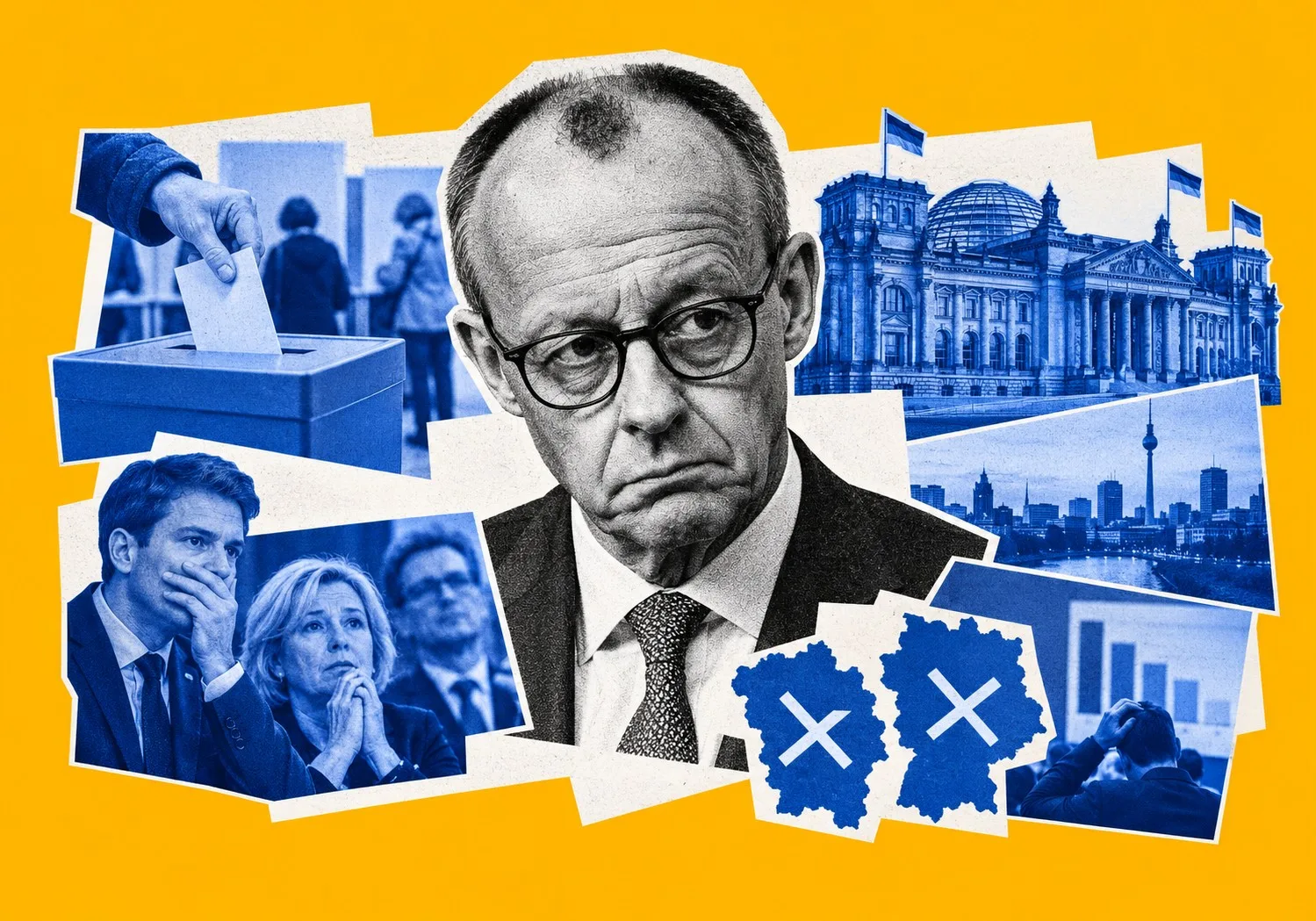
Chancellor Friedrich Merz faces an escalating political crisis after his Christian Democratic Union crashed out of the Mecklenburg-Western Pomerania state parliament with just 4.9% of the vote. Sunday's regional elections delivered a severe double shock to Berlin: while the far-right Alternative for Germany surged to 38.2% in the northeast, Berlin voters handed the Left Party a sweeping 25.3% victory. For an embattled federal administration grappling with industrial stagnation and public discontent, the ballots served as an unsparing verdict on national governance.
Merz rejected calls for his resignation during an emergency party meeting in Berlin. Pale and visibly strained, he told senior officials that stepping down would accelerate federal collapse rather than prevent it.
"We need backbone, not surrender," Merz told reporters outside party headquarters.

Party barons in Bavaria and North Rhine-Westphalia spent the morning reviewing internal polling numbers. Several regional leaders warned that the Chancellor's economic program has alienated rural voters beyond recovery. Merz insists his structural reforms will pass the Bundestag by November.
Lawmakers remain skeptical.

The mood inside the federal chancellery shifted from cautious optimism to open alarm before the ballot boxes even closed. Regional party officials had warned Berlin for weeks that local anger over energy costs and municipal infrastructure was boiling over. National party strategists dismissed those warnings as typical eastern discontent. Sunday night proved the strategists wrong. The CDU lost nearly three-quarters of its traditional voter base in the northeast in less than five years. Party analysts point to a sharp exodus of middle-class voters toward minor populist groupings and non-voters.
The Mechanics of the Eastern Rout
Tino Chrupalla arrived at AfD campaign headquarters to loud applause from local organizers. The party's 38.2% share in Mecklenburg-Western Pomerania marks its highest eastern result to date. Party strategists are already drafting coalition demands for upcoming municipal appointments.
Mainstream parties responded by locking down the firewall. The Social Democrats, Greens, and surviving Christian Democrats reiterated that no administrative cooperation with the far-right will be permitted at any level of government.
This creates a deadlock. The AfD holds a plurality in the east, yet every other faction refuses to negotiate. Local governance in the state is effectively frozen. State officials admit they have no mathematical path to a stable coalition without violating party rules.
The Sahra Wagenknecht Alliance missed the legislative threshold by a hair, pulling in 4.8% of the vote. That failure complicated the mathematics even further, leaving the regional parliament stripped of potential buffer parties. Manuela Schwesig managed to keep the state SPD afloat with 35.5%, relying on personal incumbency rather than national tailwinds. Schwesig ran a localized campaign that deliberately distanced itself from Berlin's legislative agenda. That strategy worked for her survival, but it left the broader national coalition completely undefended.
The Urban Contrast in Berlin
While the east lurched rightward, Berlin moved sharply in the opposite direction. The Left Party secured 25.3% of the vote in the capital, capitalizing on housing grievances and public service cuts. The CDU managed 19%, while the AfD pulled 16% and the SPD sank to 12.1%.
Both elections marked the first time 16- and 17-year-olds could vote in state ballots. Exit polls indicate that younger demographics split heavily between the Left Party and the AfD, bypassing traditional moderate parties almost entirely. This generational shift alarms establishment strategists who assumed youth voters would lean toward centrist green or liberal platforms. Instead, younger urban voters favored systemic disruption just as decisively as older rural voters in the east.
Berlin's political landscape now resembles a fractured mosaic where traditional coalition arithmetic no longer applies. City officials spent the night running simulation models that yielded no workable governing majorities without pairing bitter ideological rivals. The capital's municipal administration faces months of paralysis as backroom negotiations crawl forward.
Economic Anxiety and the Federal Backlash
Voters across both regions pointed to persistent inflation, high energy prices, and crumbling public infrastructure as primary drivers for their ballot choices. Germany's industrial sector has stagnated for eight consecutive quarters, hitting manufacturing hubs in the east particularly hard. Federal subsidies have failed to stem factory closures and job losses in rural districts.
Business associations in Frankfurt and Düsseldorf issued cautious statements warning that political instability could deter foreign investment. Manufacturing output fell another 0.4% last month, according to preliminary federal figures. Corporate leaders argue that Berlin's paralysis prevents any meaningful overhaul of the tax code or energy grid.
Merz came to power promising a renaissance for German industry and fiscal discipline. Instead, his cabinet has spent eighteen months locked in internal budgetary disputes. The finance ministry cannot agree on how to fund infrastructure upgrades without breaking the constitutional debt brake. Voters noticed the gridlock. Sunday's ballots served as a direct invoice for unfulfilled promises.
European Implications and Brussels Reactions
Foreign diplomats in Brussels watched the returns with growing concern. Germany provides the primary fiscal anchor for EU defense and trade initiatives. A paralyzed federal government leaves European policy stalled ahead of the autumn budget negotiations.
Merz must now manage an unruly caucus while negotiating pension reform with coalition partners who blame him for the regional wipeout. The political center is running out of room.
European Commission officials fear that a weakened Berlin will stall vital banking union reforms and delay joint defense procurement projects. France is dealing with its own domestic political friction, leaving the Franco-German engine effectively stalled at a time of mounting geopolitical tension. Eastern European member states look to Berlin for leadership on security assistance, yet German policymakers are currently consumed by internal survival tactics.
The institutionalization of the AfD at nearly 40% in eastern regional polls alters the baseline of German foreign policy debate. Even though mainstream parties maintain their firewall, the constant pressure from the far-right forces Berlin into defensive positions on migration quotas and border enforcement. Other European capitals note the shift with unease, recognizing that Germany can no longer project predictable, unified leadership across the continent.
Sources: Der Spiegel, DW, Reuters, Euronews