
Eurozone Inflation Hits 4% as Energy Shock Drives Up Living Costs

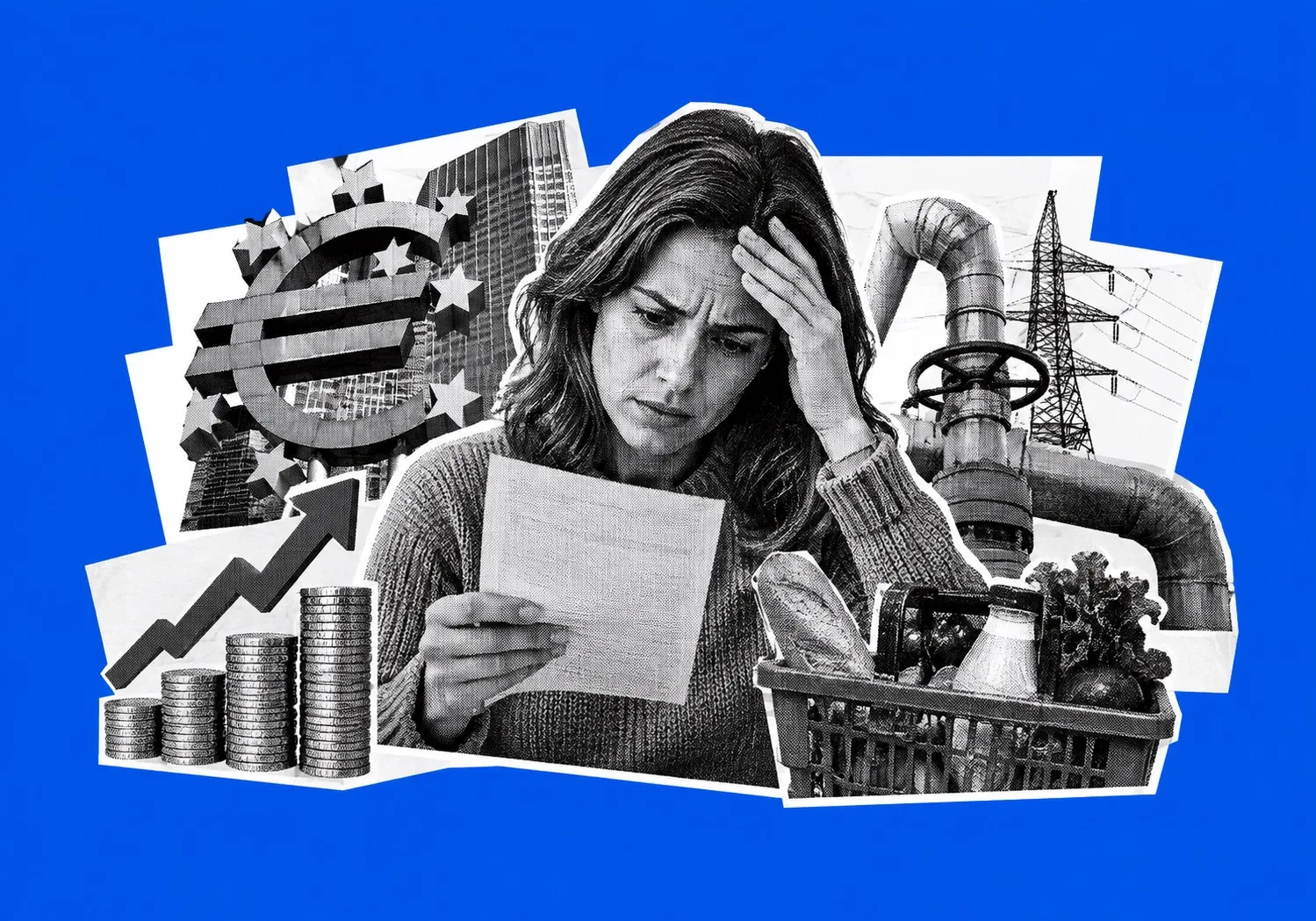
Eurozone inflation climbed to 4.0% in October 2026 - its highest level in over three years- driven by surging oil and gas prices. In its latest economic forecast, the European Commission warns that high energy costs, mounting public debt, and further ECB interest rate hikes could squeeze household budgets well into 2028.
According to the Commission’s Autumn Economic Forecast, published on 17 November, inflation across the broader European Union is projected to average 3.3% in 2026 and 3.2% in 2027, before easing to 2.3% in 2028. Economic growth, meanwhile, is expected to remain modest at 1.4% in both 2026 and 2027, following a September uptick to 3.8% in the euro area.
Behind those forecasts lies a difficult economic equation. Europe must contain renewed price pressures without undermining already fragile growth, while governments with substantial public debt have limited room to protect households and businesses from rising costs.
A New Energy Shock Is Driving European Inflation
The immediate source of Europe’s latest inflation surge lies beyond the continent’s borders.
Nearly eight months into the conflict in the Middle East, disruptions to energy shipments through the Strait of Hormuz continue to affect global oil and gas markets. Damage to regional energy infrastructure has complicated the recovery of supply, while higher shipping and insurance costs have added pressure throughout international energy markets.
According to the European Commission’s November forecast, Brent crude oil exceeded $100 per barrel in October, while European benchmark gas prices rose above €95 per megawatt-hour in late October, more than three times their level in late February.
The effects are already visible in consumer prices.
Eurostat’s preliminary October figures show that energy prices in the eurozone increased by 20.8% year-on-year, compared with 18.9% in September. Energy was by far the fastest-rising major component of the Harmonised Index of Consumer Prices.

The impact of higher wholesale energy prices is not always immediate. Electricity and gas suppliers often purchase energy under contracts agreed months in advance, while household tariffs may be adjusted periodically.
Consequently, even if wholesale prices begin to decline, consumers may continue to face higher bills as earlier increases move through the system.
This delayed transmission creates a particular problem for European policymakers. Energy markets can begin recovering before households experience any meaningful financial relief.
Food Prices Are Adding to the Household Squeeze
Energy is not the only source of pressure.
Eurostat estimates that unprocessed food prices increased by 4.6% in October compared with the same month in 2025, accelerating from 4.0% in September.
The broader category of food, alcohol and tobacco recorded a more moderate annual increase of 1.6%. The difference illustrates how inflation can affect individual household purchases much more sharply than headline food statistics suggest.
Fresh vegetables, fruit, meat and fish are particularly sensitive to changing agricultural and distribution costs. Fuel prices influence transportation, while energy expenses affect irrigation, refrigeration, greenhouse production and food processing.
Fertilizer costs can also respond to natural gas prices, creating another channel through which international energy disruption reaches European agriculture.
Weather-related production losses may compound these pressures, although their contribution varies by country, crop and season.
For lower-income households, the consequences are especially significant. Energy and essential food purchases generally account for a larger proportion of disposable income, leaving less flexibility to absorb sudden price increases.
A household cannot easily reduce its need for winter heating or basic groceries in the same way it can postpone discretionary spending.
The resulting squeeze may weaken consumer demand in other sectors, including retail, hospitality and household services, even when employment and wages remain relatively stable.
Inflation Is Dividing Europe
The inflation shock is not affecting every European country equally.
Eurostat’s October estimates show substantial differences between eurozone members, reflecting variations in energy dependence, national pricing systems, taxation, domestic market conditions and government support measures.

Lithuania recorded estimated annual inflation of 6.1%, while Bulgaria reached 6.0%. Italy and Greece both registered 5.6%, placing them well above the eurozone average.
Belgium, by contrast, recorded inflation of 1.1%, while Germany stood at 2.8% and the Netherlands at 3.3%.
These differences matter because all eurozone countries share a common monetary policy, but their economies respond differently to interest rates and energy prices.
A single European Central Bank decision therefore operates across economies experiencing very different levels of price pressure.
Countries with higher inflation may require tighter financial conditions to contain demand, while economies with more moderate inflation may experience unnecessary pressure on borrowing, investment and consumption.
National governments can attempt to cushion these differences through targeted assistance, taxation or temporary energy measures. Their capacity to do so, however, depends heavily on public finances.
The ECB Faces a Difficult Interest Rate Decision
The European Central Bank has already begun responding to the renewed inflationary pressure.
In June 2026, the ECB raised its key interest rates by 25 basis points. A second increase of the same size followed in September, bringing the deposit facility rate to 2.50%.
The September decision reflected concerns that the Middle East conflict would keep inflation above the ECB’s 2% medium-term target for an extended period.
Higher interest rates are intended to reduce demand by making borrowing more expensive. They can discourage excessive credit growth, moderate consumption and investment, and help prevent temporary price shocks from becoming embedded in longer-term inflation expectations.
But the current inflationary episode presents a complication.
Much of the renewed pressure originates from disrupted energy supplies rather than excessive consumer spending. Higher borrowing costs cannot directly restore oil shipments through the Strait of Hormuz or repair damaged energy infrastructure.
Instead, monetary tightening seeks to prevent those initial increases from spreading into wages, services and other prices.
This creates a risk of weakening economic activity without immediately resolving the underlying supply disruption.
Businesses facing higher energy bills may also encounter more expensive financing. Households with variable-rate loans can experience additional pressure on disposable income, while prospective homebuyers face less affordable mortgages.
The ECB must therefore balance the danger of allowing inflation expectations to rise against the possibility of slowing an economy already expanding at a modest pace.
Its September projections anticipated eurozone inflation averaging 3.0% in 2026, 2.5% in 2027 and 2.1% in 2028. The European Commission’s newer November forecast presents a somewhat more persistent inflation outlook, projecting eurozone rates of 3.2%, 3.1% and 2.1% respectively.
These differences underline the uncertainty surrounding the energy market and the path of inflation.
Further interest-rate increases remain possible, but their timing and scale will depend on incoming economic data and subsequent ECB decisions.
High Public Debt Leaves Governments With Less Room to Respond
The inflation shock is also exposing another longstanding weakness in the European economy: the scale of public borrowing.
According to Eurostat, Greece had the EU’s highest government debt ratio in the second quarter of 2026, at 140.8% of GDP. Italy followed at 139.9%, France at 119.1%, Belgium at 110.2% and Spain at 101.4%.
These figures matter because higher interest rates can gradually increase the cost of refinancing government debt.
Although existing fixed-rate bonds do not immediately become more expensive, governments must continually issue new securities to replace maturing obligations and finance ongoing deficits.
When investors demand higher yields, future interest expenditure rises, potentially leaving less money available for public services, infrastructure and household assistance.
France is particularly exposed to this combination of challenges. Its substantial debt burden coincides with rising bond yields and pressure on public finances.
Italy faces a similar structural constraint, with one of the highest debt ratios in the European Union and inflation significantly above the eurozone average.
The European Commission expects the EU’s aggregate government deficit to increase to 3.6% of GDP in 2026 and reach 3.8% by 2028.
Across the bloc, interest expenditure is projected to rise from 1.9% of GDP in 2025 to 2.4% in 2028.
Governments therefore face competing demands: supporting households through another energy shock, maintaining investment in economic competitiveness, increasing defence expenditure and keeping public finances sustainable.
The EU’s fiscal framework adds another constraint. Its reference values of 3% of GDP for annual deficits and 60% for government debt remain important benchmarks, although the reformed fiscal rules allow country-specific adjustment paths.
For heavily indebted countries, broad energy subsidies or permanent tax reductions may prove difficult to finance without increasing fiscal risks.
Targeted assistance to vulnerable households may offer a more affordable alternative, but it cannot eliminate the underlying rise in energy costs.
Europe Is Growing, but Its Recovery Remains Fragile
Despite the inflation resurgence, the European Commission does not forecast an EU-wide recession.
Its November outlook projects economic growth of 1.4% in both 2026 and 2027, followed by a modest acceleration to 1.5% in 2028.
The eurozone is expected to expand more slowly, at 1.2% in 2026 and 2027, and 1.3% in 2028.
These figures suggest resilience, but not a particularly strong recovery.
Higher energy costs reduce the purchasing power of households and raise production expenses for businesses. Higher interest rates can simultaneously discourage investment in housing, industrial equipment and new projects.
The Commission expects private consumption growth to slow to 1.1% in 2027, while overall investment growth is projected to remain subdued.
There is also a longer-term competitiveness issue.
European manufacturers compete with producers operating under different energy pricing structures. When energy remains persistently expensive, industries such as chemicals, metals, fertilizers and other energy-intensive manufacturing activities face pressure on operating margins.
Companies may respond by raising prices, reducing investment or reconsidering the location of future production.
The energy transition could help address part of this vulnerability by reducing dependence on imported fossil fuels. However, developing new electricity generation, upgrading grids and expanding storage capacity require substantial investment.
Europe is therefore attempting to reduce its exposure to external energy shocks while simultaneously managing the economic consequences of the latest one.
What Happens to European Inflation in 2027?
The next stage of Europe’s inflation trajectory will depend heavily on developments in global energy markets.
The Commission expects headline EU inflation to peak above 4% around the end of 2026 and beginning of 2027, before gradually declining.
Its central forecast assumes that energy pressures will moderate as fuel prices ease. Household gas and electricity costs, however, may continue rising temporarily because wholesale increases take time to reach retail tariffs.
Food inflation could also remain elevated as agricultural producers and manufacturers pass higher input costs through supply chains.
Financial markets, at the cut-off date of the Commission’s forecast, expected three to four additional ECB interest-rate increases, potentially taking the deposit facility rate to approximately 3.4% by mid-2027.
Those expectations are not commitments by the central bank. They reflect how investors assessed the inflation outlook at a particular point in time and may change as new data emerge.
A sustained decline in oil and gas prices would improve the prospects for lower inflation and stronger household spending. Renewed geopolitical disruption, extreme weather or further increases in borrowing costs could instead prolong the adjustment.
For European households, the distinction between falling inflation and falling prices will remain crucial.
Even if inflation declines to the Commission’s projected 2.3% in 2028, that would generally mean prices are rising more slowly, not returning to their earlier levels.
After several years of successive cost increases, purchasing power will depend on whether wages and incomes can recover sufficiently to offset the accumulated rise in living expenses.
Europe’s immediate challenge is to navigate another winter of elevated energy costs. Its longer-term challenge is to build an economy less vulnerable to imported fuel disruptions, while preserving the investment and fiscal capacity needed to sustain growth.
Sources: [European Commission forecast,](https://economy-finance.ec.europa.eu/economic-forecast-and-surveys/economic-forecasts/autumn-2026-economic-forecast-shows-continued-growth-amid-higher-inflation_en ) [Eurostat inflation release,](https://ec.europa.eu/eurostat/web/products-euro-indicators/w/2-04112026-ap ) [Eurostat inflation analysis,](https://ec.europa.eu/eurostat/statistics-explained/index.php ) [Eurostat government debt statistics,](https://ec.europa.eu/eurostat/en/web/products-euro-indicators/w/2-21102026-bp )
[ECB June monetary policy decision,](https://www.ecb.europa.eu/press/pr/date/2026/html/ecb.mp260611~4d41bd5e83.en.html ) [ECB September monetary policy decision,](https://www.ecb.europa.eu/press/pr/date/2026/html/ecb.mp260910~314e508016.en.html ) [ECB interest-rate statistics](https://www.ecb.europa.eu/stats/policy_and_exchange_rates/key_ecb_interest_rates/html/index.en.html )