
EU and Canada Move to Build a Strategic Alliance Beyond Trade

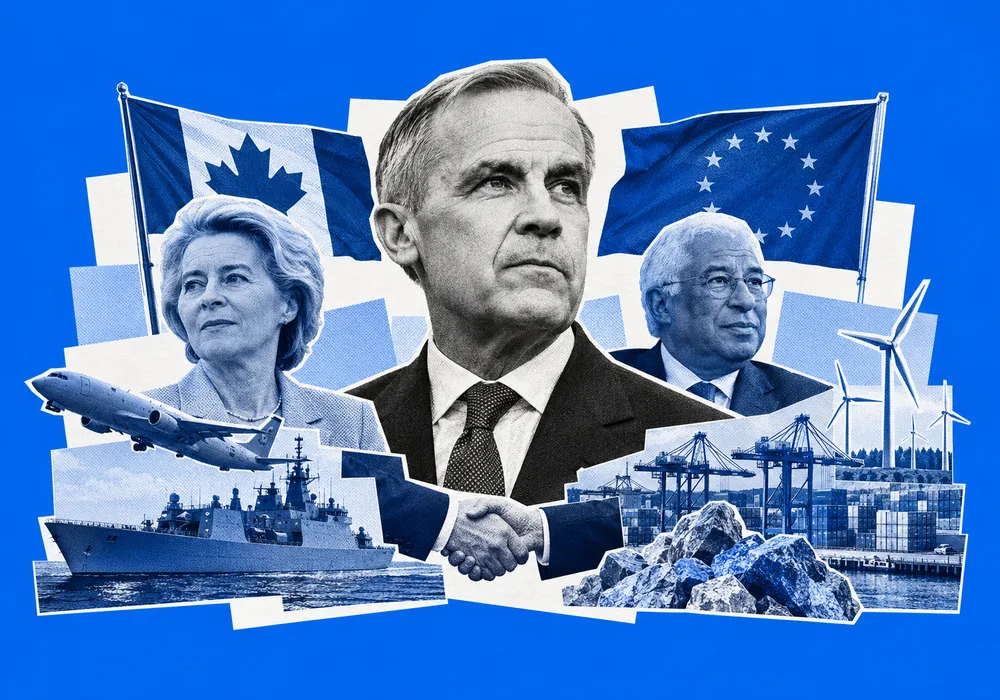
The European Union and Canada are preparing to launch an Alliance for the Future at their 29–30 October summit in Montreal, expanding cooperation across trade, technology, critical minerals and defence. The initiative reflects a broader effort to reduce strategic dependencies, strengthen economic resilience and coordinate responses to an increasingly uncertain international environment.
The European Union and Canada are preparing to establish a more integrated partnership that extends beyond their existing trade agreements, with leaders expected to launch an Alliance for the Future at a summit in Montreal on 29–30 October. European Council President António Costa, European Commission President Ursula von der Leyen and Canadian Prime Minister Mark Carney are expected to use the meeting to define a framework for closer cooperation across economic policy, technology, defence, energy and security. The initiative would give greater institutional weight to a relationship that has developed over decades but is acquiring new strategic importance as both sides reassess their exposure to external economic and geopolitical pressures.
The proposed alliance builds on the EU–Canada Strategic Partnership Agreement, the Comprehensive Economic and Trade Agreement (CETA) and the security and defence partnership signed in June 2025. CETA has progressively reduced trade barriers, with the vast majority of tariff lines already liberalised, while cooperation has expanded into research, digital policy and climate action. The new framework is intended to connect these existing arrangements more closely, turning separate areas of cooperation into a broader strategy for economic security and political coordination.
The timing reflects growing uncertainty over the reliability of established international partnerships and the risks associated with concentrated supply chains. For the EU, closer engagement with Canada offers an opportunity to diversify economic relationships while strengthening ties with a democratic partner that possesses substantial natural resources, advanced research capabilities and an established industrial base. Canada, meanwhile, is seeking stronger economic and security links with Europe while retaining its independence outside the EU's formal membership structure.
Critical Minerals and Economic Security
Access to critical raw materials is expected to be one of the central elements of the proposed alliance. Minerals used in batteries, renewable energy systems, electronics, advanced manufacturing and defence production have become increasingly important to industrial policy on both sides of the Atlantic. European efforts to expand domestic production and diversify imports have been constrained by the concentration of processing and supply capacity in a limited number of countries. Cooperation with Canada could help reduce some of these vulnerabilities by encouraging investment, supporting alternative supply chains and improving coordination between industrial strategies.
Canada brings substantial mineral resources and established expertise in energy and resource development, while the EU provides a large industrial market, technological capabilities and significant investment capacity. Closer coordination could help companies develop projects that might otherwise face financing, infrastructure or market-access barriers. It could also create opportunities to link raw-material extraction with processing and manufacturing in Europe and Canada, allowing both sides to capture a greater share of the value generated by strategic industries.
However, diversifying supply will require more than political commitments. Mining projects can take years to develop, and new production depends on permitting, infrastructure, environmental assessments, investment and processing capacity. The practical value of the alliance will therefore depend on whether its political framework produces identifiable projects and reliable commercial arrangements rather than simply adding another layer of strategic dialogue.
The broader objective is to make economic interdependence less vulnerable to geopolitical pressure. For European policymakers, supply-chain resilience increasingly forms part of national and collective security, particularly where access to materials can affect defence production, energy infrastructure and advanced technologies. A closer relationship with Canada could support this objective without requiring the EU to rely exclusively on domestic production, which would be difficult to achieve for many strategically important resources.
Defence Industry and Transatlantic Security
Defence cooperation is another significant pillar of the emerging relationship. Canada became the first non-European country to participate in the EU's Security Action for Europe (SAFE) initiative in 2026, creating opportunities for Canadian defence companies to participate in procurement linked to European rearmament. SAFE provides up to €150 billion in loans to support defence investment by EU member states, including through joint procurement. Canada's participation establishes a practical link between European demand for military equipment and Canadian industrial capacity.
The arrangement could help strengthen production networks across the Atlantic, particularly as European governments seek to replenish stocks, expand manufacturing capacity and address capability gaps exposed by Russia's war against Ukraine. Canadian companies may gain access to new markets, while European defence manufacturers could benefit from a wider network of suppliers and industrial partners. Cooperation could also improve the coordination of equipment production, technology development and procurement standards.
Nevertheless, deeper industrial integration will require decisions on production capacity, intellectual property, procurement conditions and the distribution of economic benefits. European governments are under pressure to ensure that increased defence spending strengthens the continent's own industrial base, while Canada will seek tangible returns for its companies and workers. The alliance will need to reconcile these interests if it is to produce a durable defence-industrial relationship.
The strategic significance extends beyond procurement. A closer EU–Canada partnership could support coordination on sanctions, export controls and the protection of critical infrastructure, while strengthening the political relationship between European capitals and Ottawa. It would not replace NATO or existing bilateral defence arrangements, but could complement them by addressing the economic and industrial foundations of security.
Technology, Energy and Digital Trade
Technology cooperation is expected to broaden the alliance beyond traditional trade and defence. The EU and Canada already cooperate through their digital partnership, launched in 2023, covering areas including artificial intelligence, cybersecurity, digital skills and secure connectivity. Canada is also associated with Horizon Europe, the EU's research and innovation programme, providing a foundation for continued scientific collaboration. The proposed framework could bring these activities into closer alignment, particularly in sectors where technological capacity has direct implications for economic competitiveness and security.
Artificial intelligence, quantum technologies and space capabilities are among Canada's areas of strength, while the EU offers a substantial research base, advanced manufacturing and a large internal market. Greater coordination could help companies and research institutions expand cross-border projects, improve access to expertise and develop technologies with applications in civilian and strategic sectors. Negotiations on digital trade could also help address regulatory and administrative barriers affecting businesses operating across the two markets.
Energy is another area where complementary interests could support closer ties. Canada is a major producer of oil, natural gas, hydroelectricity and renewable energy, while the EU continues to seek a more diversified and secure energy supply. Cooperation could cover energy security, clean technologies and supply chains for low-carbon infrastructure, although the commercial viability of individual projects will depend on costs, infrastructure and market conditions. The alliance's broader value would lie in connecting energy policy with industrial development and long-term economic resilience.
For businesses, the immediate test will be whether the new framework translates into more predictable market access, stronger investment flows and lower barriers to cross-border activity. The existing CETA agreement provides a foundation, but differences in regulation, standards and domestic market conditions continue to shape how easily companies can operate on both sides of the Atlantic.
The Question of a New European Partnership Model
The initiative also raises the question of how the EU can deepen relations with strategically important countries that are not seeking full membership. Von der Leyen has invited Canada to explore becoming the bloc's first associate member, a proposal that could provide a more structured role in European cooperation without granting the rights or obligations associated with EU membership. The precise institutional form remains to be established, making the Montreal summit an important step in determining how ambitious the arrangement will become.
For Brussels, a closer association with Canada could offer a model for cooperation with partners that share core political principles and economic interests but remain outside the Union. Such a framework could make it easier to coordinate policy across trade, technology, security and industrial development while preserving the EU's existing decision-making structures. It would also allow the bloc to strengthen its international network without relying exclusively on enlargement as a means of building closer political relationships.
The model's credibility will depend on its practical substance. Regular political consultations, defined commitments, access to cooperation programmes and mechanisms for implementing joint initiatives would give the partnership greater durability. Without clear institutional arrangements, the concept of associate membership risks remaining a political label rather than a meaningful new instrument of European external policy.
The relationship may also attract attention in the United Kingdom, where policymakers have been exploring ways to rebuild ties with Brussels following Brexit. A closer EU–Canada framework would not automatically establish a template available to other countries, since the legal and political circumstances differ. It could nevertheless demonstrate how the EU can develop differentiated partnerships with countries seeking closer integration in selected areas without joining the bloc.
Implications for Ukraine
Ukraine is an important part of the wider strategic context. The EU and Canada have both supported Kyiv since Russia's full-scale invasion and cooperate with other G7 partners on sanctions and international assistance. Their existing relationship provides channels for coordinating political support, economic measures and security cooperation. The proposed alliance could strengthen this coordination by bringing defence industrial capacity, critical supply chains and broader economic resilience into a more integrated framework.
Closer cooperation between European and Canadian defence industries could be relevant to Ukraine's longer-term needs, particularly if it contributes to expanded production, more reliable supply chains and sustained European military-industrial capacity. However, the launch of the alliance should not be interpreted as confirmation of a new, specific military aid package for Kyiv. The scale and form of any additional support will depend on the decisions made by both sides and the initiatives ultimately agreed at the summit.
The partnership could also create opportunities in reconstruction and industrial development. Ukraine's future recovery will require investment in energy infrastructure, transport, digital systems and manufacturing, alongside continued security assistance. Greater EU–Canada coordination on technology, energy and strategic materials could eventually support projects relevant to Ukraine, although concrete benefits would require dedicated programmes and financing.
For Kyiv, the broader question is whether closer transatlantic cooperation can translate into sustained political commitment and practical support over time. An alliance that strengthens Europe's industrial resilience and Canada's engagement with European security could contribute to that objective, but its impact will be determined by implementation rather than declarations.
From Political Ambition to Concrete Commitments
The Montreal summit represents an effort to adapt EU–Canada relations to a period in which trade, technology, industrial capacity and security are increasingly interconnected. Both sides have incentives to reduce vulnerabilities, widen access to strategic resources and strengthen cooperation with partners whose economic interests and political priorities broadly align. The proposed Alliance for the Future would give these objectives a common framework, potentially making the relationship more coordinated and strategically consequential.
The main challenge will be converting that framework into measurable results. Critical-mineral investments, defence-industrial projects, digital trade arrangements and research partnerships require funding, clear responsibilities and sustained political attention. Differences in regulation and national industrial priorities will also need to be managed, particularly where both sides want to protect domestic capabilities while benefiting from deeper integration.
The summit is therefore less about creating a partnership from scratch than about deciding how far an established relationship can evolve into a more coherent strategic arrangement. If the EU and Canada agree on concrete mechanisms and follow them with implementation, the alliance could strengthen economic security and transatlantic cooperation at a time of growing uncertainty. If commitments remain broad and voluntary, its immediate effects will be more limited, even as the political signal of closer alignment remains significant.
Sources: European Council, European Commission, Government of Canada