
EU Designates 46 Critical Mineral Projects, but Face a €21B Funding Gap

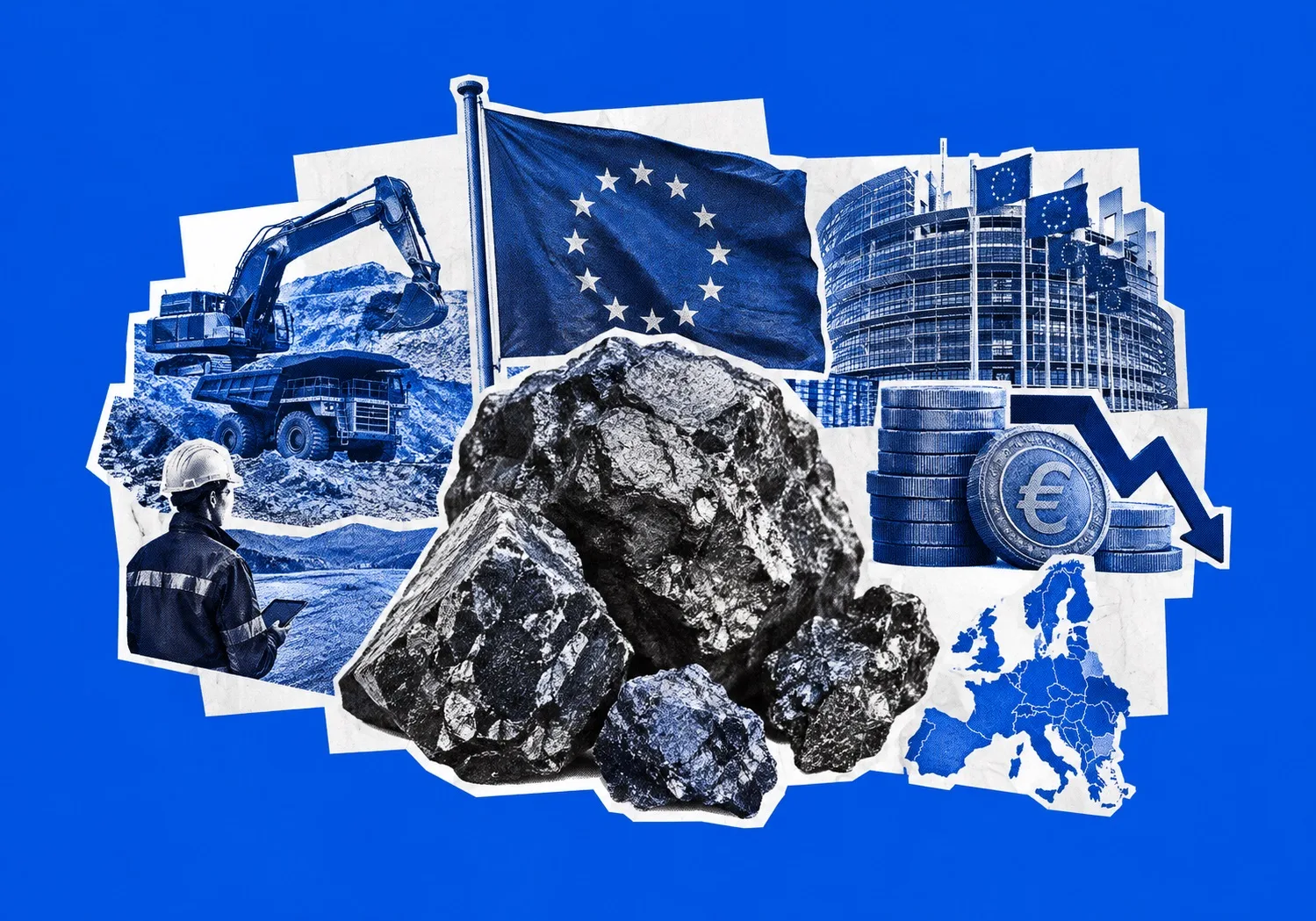
On 9 October, the European Commission designated 46 Strategic Projects across 16 member states to secure critical raw materials and reduce reliance on foreign suppliers like China. While the decision accelerates permitting under the Critical Raw Materials Act, it reveals a fundamental flaw in Europe's industrial strategy: fast-track approvals cannot bridge the €21.1 billion funding gap facing these projects in volatile global markets.
At stake are the core inputs needed for Europe’s electric vehicles, renewable energy, electronics, and defence sectors. Achieving resource autonomy now depends on a difficult proposition: persuading investors to commit billions to projects that serve a strategic purpose for the continent without offering sufficiently attractive market returns.
Permits are no longer the only obstacle
The Critical Raw Materials Act was designed to reduce the EU’s exposure to concentrated supply chains. Its 2030 benchmarks require the bloc to extract 10% of its annual consumption of strategic raw materials domestically, process 40% within the EU and recycle 25%.
Strategic Project status is intended to remove one of the obstacles to achieving those targets. National authorities must respect maximum permitting periods of 27 months for extraction projects and 15 months for processing and recycling. The designation also gives developers a route towards potential financing through the European Investment Bank and commercial lenders, with the Commission’s RESourceEU platform intended to connect projects with capital providers and buyers.
These are useful measures. Mining and industrial processing projects can be held back by lengthy approvals, fragmented administrative procedures and uncertainty over whether they will reach production before market conditions change. Reducing that uncertainty can improve a project's investment case.
But a shorter permitting process does not necessarily produce a better investment case.
A mine with a permit but insufficient construction funding remains a mine that cannot be built. A processing plant may receive regulatory priority and still struggle to secure financing if the expected selling price of its output no longer covers its costs. The new designation addresses the time required to obtain approval, not the risk that a project will never generate an adequate return.
There is also a timing problem. Applications for the second cohort closed nearly nine months before the Commission announced its decision. For companies already facing volatile commodity markets, administrative acceleration that takes months to arrive offers only limited relief.
The distinction matters because the EU is not starting from scratch. Its first cohort, designated in 2025, contained 60 projects, including 13 outside the Union. More than €2 billion in public funding was mobilised for that group, yet only about a quarter of the projects remained on schedule. At least a third of extraction and processing projects were delayed, halted or exposed to a high risk of failure, with capital shortages, administrative bottlenecks and local environmental opposition among the obstacles.
The new list therefore arrives before the previous one has demonstrated that strategic designation can reliably translate into industrial capacity.
A market moving in the wrong direction
The commercial environment has become less favourable since Europe began turning critical minerals into a formal industrial policy priority.
According to the International Energy Agency, global investment in critical minerals fell by 9% in 2025, while exploration spending declined by more than 10%. The contraction was particularly pronounced in sectors central to the energy transition: lithium specialists cut capital expenditure by about 40%, while battery-material companies reduced it by 20%. Copper-focused companies moved in the opposite direction, increasing spending by 8%.
Investors are not responding to European legislation alone. They are responding to expected demand, commodity prices, project costs and the prospect of earning a return over the long development cycles typical of the sector.
Rare earths offer a clear example of the problem. The average price of neodymium-praseodymium oxide, used in permanent magnets, fell from $124 per kilogram in 2022 to $69 in 2025, a decline of 44%.
Projects built around earlier price assumptions may no longer offer the margins on which their original financial models depended. Lower expected revenues weaken the ability to service debt, make equity investment harder to justify and increase the risk that construction costs will not be recovered.
The same pressure can affect the wider chain. Even where European manufacturers want to diversify away from concentrated foreign supply, their willingness to pay more for domestically processed materials has limits. Strategic value does not automatically translate into a commercial premium large enough to make an uncompetitive project viable.
That leaves European developers caught between two sets of expectations. Policymakers want them to build capacity that reduces geopolitical exposure. Investors want evidence that the capacity will generate sustainable returns.
Permitting reform can narrow that divide, but it cannot eliminate it.
The projects most likely to survive
The composition of the new cohort offers clues about how Brussels intends to manage the problem. Of the 46 projects, eight focus on extraction, 11 on processing, 19 on recycling and eight on multiple stages of the value chain.
The emphasis on recycling is particularly significant. Rather than relying exclusively on new mines, the EU is seeking to recover more material from batteries, industrial waste and existing products. Secondary raw materials can help reduce dependence on geological resources that are unevenly distributed across the world, while creating another source of supply within Europe.
Recycling is not immune to financing problems, and it cannot replace every primary mineral input. Its strategic appeal lies in offering an additional route to supply that is less dependent on opening new deposits. Processing capacity matters for the same reason: access to raw materials is of limited value if Europe cannot refine them into materials its manufacturers can use.
Yet the distinction between a strategically useful project and a financeable one remains decisive.
Established industrial groups with existing operations, access to capital and relationships with customers are better positioned to exploit the new rules. Companies such as Belgium’s Umicore, Poland’s KGHM and Mitsubishi Materials Europe can potentially combine regulatory priority with existing industrial capabilities. Their ability to finance development, however, will still depend on the economics of individual projects.
Smaller developers face a different calculation. Without committed construction capital or a strong corporate balance sheet behind them, a faster route through permitting may not be enough to attract lenders. Strategic designation can improve their visibility, but visibility is not a financing commitment.
This creates the risk of a two-tier industrial landscape. Well-capitalised companies could use the new rules to advance projects while smaller developers, including those pursuing deposits important to Europe’s future supply, remain stuck between approval and investment.
The consequences extend beyond the mining sector. Automotive manufacturers, renewable energy companies and defence contractors need reliable supplies of specialised materials. If domestic projects fail to progress, those industries will remain exposed to external disruptions even as the EU expands its list of strategically important investments.
China remains the benchmark Europe must confront
The urgency is not simply about producing more minerals within European borders. It is about reducing the vulnerability that comes from relying heavily on a limited number of suppliers for materials that are difficult to substitute.
In 2025, China accounted for 92% of the EU’s magnesium imports, 77% of its gallium imports and 43% of its natural graphite imports. Rare earths represented another significant exposure, with China accounting for 40% of EU imports by value.
These dependencies give the raw materials agenda a security dimension that conventional market calculations do not fully capture. A supply chain can be efficient under normal commercial conditions yet leave manufacturers vulnerable when access to a material becomes uncertain.
Europe’s response is a shift away from treating critical minerals as ordinary industrial inputs towards a more security-conscious model of supply. International Energy Agency Executive Director Fatih Birol has described the additional strategic value attached to secure supplies as a “mineral security premium”.
The difficulty is determining who should pay for that premium.
If European production is more expensive than competing imports, private investors may hesitate to finance it. Manufacturers may prefer cheaper supplies unless they have a strong reason to accept higher costs. Governments, meanwhile, want greater resilience but have not attached automatic grants to Strategic Project status.
Competitors operating with substantial state support can potentially absorb risks that private investors in Europe are reluctant to take. The EU’s regulatory-first approach leaves more of the financing burden with developers, lenders and industrial buyers.
The RESourceEU platform may help bring those parties together. The European Investment Bank can also provide a route towards potential co-financing. But connecting a developer with a lender is not the same as persuading the lender to accept risks it would otherwise reject. Nor does identifying a potential buyer guarantee an agreement on price, volume or duration.
Long-term purchasing commitments and mechanisms that reduce the risks of early investment could help close the gap. Without sufficient support of that kind, Europe’s strategic objectives will continue to compete with the immediate commercial incentives shaping investment decisions.
The next test is capital, not designation
The geographical spread of the new cohort shows that the effort is intended to reach across the Union rather than concentrate on a single industrial centre. Germany accounts for eight projects, while Finland has five. Seven projects are located in member states bordering Ukraine: three in Poland, two in Romania and two in Slovakia.
The Polish, Romanian and Slovak projects span activities including copper, battery recycling, magnesium, gallium and primary aluminium. Their significance lies in the range of industrial capabilities the EU is trying to develop, not merely in the number of projects assigned to each country.
But the aggregate requirement of €21.1 billion remains the more revealing figure. The Commission has identified the projects it considers strategically important and established a framework intended to move them through administrative procedures more quickly. It has yet to ensure that the necessary capital will follow.
Expanding the list despite the difficulties facing the first cohort is not necessarily a mistake. Large industrial projects take time, and a strategy aimed at reshaping supply chains cannot be judged on a single year's progress. A broader pipeline also gives Europe more opportunities to develop processing and recycling capacity rather than depending on a handful of mines.
The danger is that designation becomes a substitute for execution. If the next cohort encounters the same financing constraints as its predecessor, the EU could accumulate approved projects without producing the volumes required to meet its 2030 benchmarks.
That would leave European industry facing the costs of continued dependence without the protection promised by domestic capacity. It would also expose a limit to Brussels’ preferred method of industrial intervention: regulation can make a project easier to build, but it cannot compel private capital to believe in its economics.
The decisive question is whether Europe is prepared to share the financial risk of strategic supply chains when global markets make them unattractive. Until that question is answered, the 46 new designations will remain a test not of how quickly the EU can issue permits, but of how much industrial security it is willing to pay for.
Sources: Crux Investor, European Union, Critical Raw Materials Act, Politico