
EU Sanctions: How France Is Targeting Russia’s New Influence Network in Africa

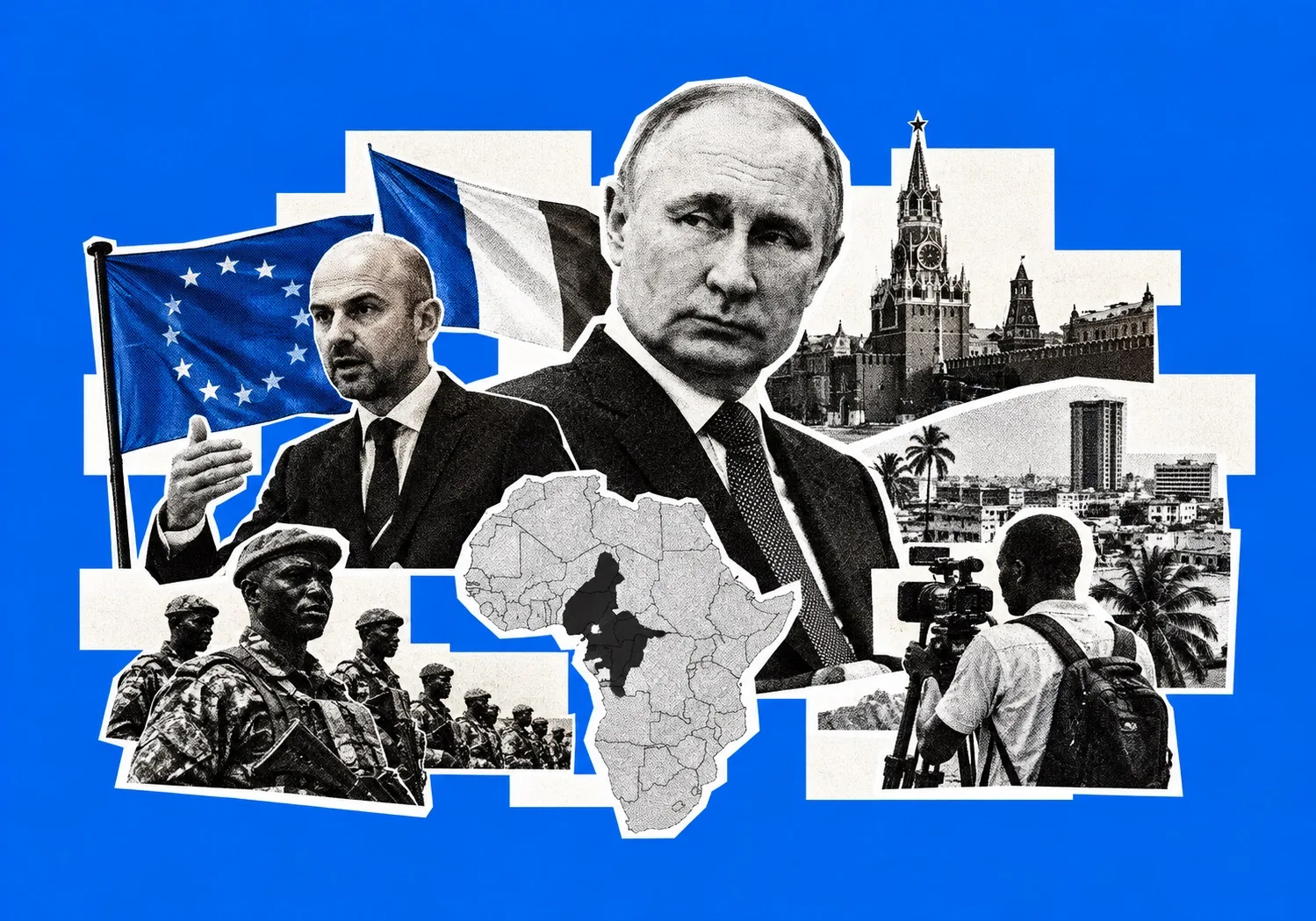
France is urging the European Union to impose sanctions on Globus - a Russian influence network active in Cameroon and the Republic of the Congo. Based on a technical investigation by the French intelligence agency VIGINUM, Paris reveals how Kremlin disinformation tactics have evolved beyond Wagner, shifting from mercenaries to local African media, civil society, and political proxy groups.
The significance extends beyond another confrontation over disinformation: Moscow’s African influence machinery appears to have survived the collapse of its most notorious private military patron by moving deeper into local political organisations, media, and educational initiatives.
For European governments, that presents a different problem from the one posed by Wagner. Military deployments and security agreements are relatively visible. A television debate, journalism course or youth association can be considerably harder to distinguish from legitimate domestic political activity.
The Network That Outlived Prigozhin
Prigozhin’s death in August 2023 did not end the Russian influence operations built around his business and security empire. Instead, the organisations that supported his activities were dismantled, absorbed into state structures or reorganised under new management.
Globus illustrates that transition.
Founded around the beginning of Russia’s full-scale invasion of Ukraine, the organisation describes itself as an international club of experts. Its leadership, however, has substantial experience in the political operations associated with Prigozhin.
Co-founder Yulia Berg, previously known as Afanasyeva, worked within his network and helped manage the Association for Free Research and International Cooperation, or AFRIC. The organisation had been involved in election-related influence activities across several African countries, including operations involving purported election observers.
Berg has been under American sanctions since 2021 over disinformation and malign influence activities in Africa and Europe.

Her fellow co-founder, Andrey Gromov, has a background in government relations and connections to Russian political institutions. Both are linked through earlier activities to networks associated with Project Lakhta, while VIGINUM identifies relationships extending towards the State Duma and Russia’s Foreign Intelligence Service.
The important change is organisational. The old Prigozhin apparatus brought together mercenaries, political consultants and media operators under a prominent private patron. Its successors operate through a more dispersed collection of entities whose connections to Russian state interests are less immediately apparent.
The military component has also been reorganised, with the Africa Corps operating under Russian military intelligence. Information operations, meanwhile, have developed their own networks of political consultants and ostensibly independent organisations.
Such an arrangement gives Moscow access to specialist expertise without requiring every campaign to carry an explicit government signature.
It also complicates accountability.
How Russian Narratives Acquire Local Voices
Cameroon provides a detailed example of the approach identified by French investigators.
Rather than simply publishing Russian government messages, Globus has supported television programmes, documentaries and political discussions carried by established pan-African media platforms.
Among them are Afrique Média TV, For You Média Africa and Panafrican Média TV. Their programming has promoted narratives critical of France, Ukraine and Western governments, often presenting the war in Ukraine through arguments aligned with Moscow’s official position.
One documentary, The Realities of Donbass, formed part of this wider media activity.
The mechanism is more consequential than the distribution of individual programmes. By placing material within locally produced broadcasting, the network allows foreign political messaging to acquire the appearance of independent African commentary.
Viewers encounter familiar presenters, regional political figures and domestic media brands rather than a Russian state broadcaster.
For You Média Africa was founded by Cameroonian politician Serge Espoir Matomba, who also incorporated pro-Russian narratives into his political campaigning. Panafrican Média TV is associated with Mohamed Bachir Ladan, a journalist and regional representative of the BRICS International Alliance.
Local journalists and bloggers, including Charly Kengne and Jonathan Batenguene, have also appeared within the amplification networks identified in the briefing.
Their involvement matters because the credibility of an influence operation depends partly on who delivers its message.
A criticism of French policy voiced by a Cameroonian commentator carries different political implications from the same criticism issued by a Russian official. Local grievances can be genuine even when outside actors seek to exploit them.
This distinction creates an enduring difficulty for European responses. Countering covert foreign sponsorship requires identifying the networks behind a message without treating African criticism of Western governments as inherently illegitimate.
From Television Studios to Political Organisation
In the Republic of the Congo, Globus moved beyond media distribution into activities involving young people, training programmes and public events ahead of the March 2026 presidential election.
The network established a 120-hour Media School in Brazzaville, designed to train local digital communicators. It also organised photographic exhibitions promoting Russia, conducted socio-economic surveys and supported the creation of a youth movement called Avenir du Congo.
Young participants wearing Globus and GR-Group branding were deployed in survey activities. GR-Group, managed by Olga Ustinova, formed part of the organisational structures associated with the campaign.
Martial arts competitions, organised alongside the Russian-backed African Initiative network, extended the operation into recreational and community settings.
None of these activities is inherently evidence of political interference. Journalism training, surveys and sporting events are ordinary features of civic life.
Their significance in this case lies in the relationships identified by VIGINUM and the broader political purpose attributed to the organisations directing them.
The technical evidence was particularly revealing.
Infrastructure supporting Avenir du Congo, including its avenir.cg website and gaming platforms connected to the AFree social network, was developed, hosted and maintained in Russia. Investigators identified Russian cloud services and tools configured in Cyrillic.
The findings exposed a discrepancy between the local identity presented by the initiative and the foreign infrastructure supporting it.
For political consultants, such projects can serve several purposes simultaneously. Training programmes develop sympathetic communicators. Surveys provide insight into public concerns. Youth associations create networks capable of sustaining political activity beyond a single media campaign.
They also establish relationships that may persist after an election.
The concern is therefore not confined to whether particular online messages change voting intentions. It concerns the gradual construction of organisations and personal networks through which outside interests can participate in domestic political debate.
Young recruits may not fully understand the foreign connections or strategic objectives behind the programmes they join. The wider Russian recruitment ecosystem also raises concerns about the possibility of vulnerable participants being drawn towards activities associated with Moscow’s war in Ukraine, although the briefing does not establish that Globus’s media trainees were deployed to the battlefield.
Why Brussels Is Being Asked to Target Individuals
France’s proposed sanctions focus on the people directing Globus rather than relying exclusively on restrictions against the organisation.
There is a practical rationale for that choice.
Front organisations can change names, dissolve or reappear under different legal structures. Experienced political consultants retain their contacts, methods and relationships even when the institutions employing them disappear.
The history of AFRIC and Project Lakhta illustrates precisely that continuity.
Targeting individual operators could make it more difficult to reproduce the same activities through successor organisations. It would also extend European restrictions towards personnel already implicated in earlier influence operations, including Berg, who has faced American sanctions for several years.
Whether the EU can translate the French initiative into effective restrictions remains a separate question. Sanctions cannot automatically dismantle relationships with local broadcasters, politicians or civil organisations.
Nor can they remove the political grievances that make anti-Western narratives attractive to some audiences.
The French initiative nevertheless indicates a change in how European governments are approaching Russian interference. The focus is shifting from identifying misleading content to examining the professional infrastructure that produces, finances and distributes it.
The Commercial Interests Behind the Political Campaign
The activities of Globus also sit alongside commercial lobbying structures, including IBAC and the African-Russian Energy Association.
These connections introduce an economic dimension to what might otherwise appear to be an exclusively political operation.
Russia has interests in African hydrocarbons, mining and civilian nuclear technology. Access to those sectors can provide commercial opportunities and help Moscow develop alternatives to relationships constrained by Western sanctions.
Political influence and business promotion need not operate separately. A network capable of cultivating journalists, political figures and civic organisations can also help create favourable conditions for Russian companies seeking contracts or regulatory support.
The distinction matters when assessing Moscow’s economic claims.
At the Russia - Africa Forum in Moscow, Vladimir Putin addressed representatives from 48 African countries and pledged to double bilateral trade to more than $50 billion.
The available trade figures present a more limited picture. Africa accounts for less than 4 per cent of Russia’s external trade, while bilateral trade had contracted by 2.4 per cent before the summit.
Trade with China, India and the European Union remains considerably larger.
The disparity does not mean Russia lacks economic ambitions in Africa. It indicates that political engagement is operating on a scale not yet matched by commercial integration.
Influence networks can help narrow that gap by cultivating relationships with decision-makers and creating opportunities in strategically valuable sectors. Their political usefulness, however, does not depend entirely on delivering substantial trade growth.
Even modest commercial relationships may support diplomatic access, sector-specific contracts or channels that reduce Moscow’s isolation.
For European policymakers, this makes the boundary between legitimate Russian commercial activity and covert political interference increasingly difficult to police.
The same intermediaries may appear in business associations, media partnerships and political initiatives. Restricting one organisation does not necessarily interrupt the wider network.
France’s challenge is therefore larger than Globus itself. The structures that emerged from Prigozhin’s former operations are becoming embedded in local institutions, where their Russian connections may be technically identifiable. Still, they exercise political influence through African participants.
An EU sanctions decision could constrain the individuals responsible for building those structures. It would leave Brussels confronting a more difficult question: how to challenge covert foreign control over political networks without undermining the independence of the very civil society it seeks to protect.
Sources: SGDSN, RFI, Dossier, DiGi24, International