
EU Moves to Pull Syria Closer as Russia Seeks to Preserve Its Military Foothold

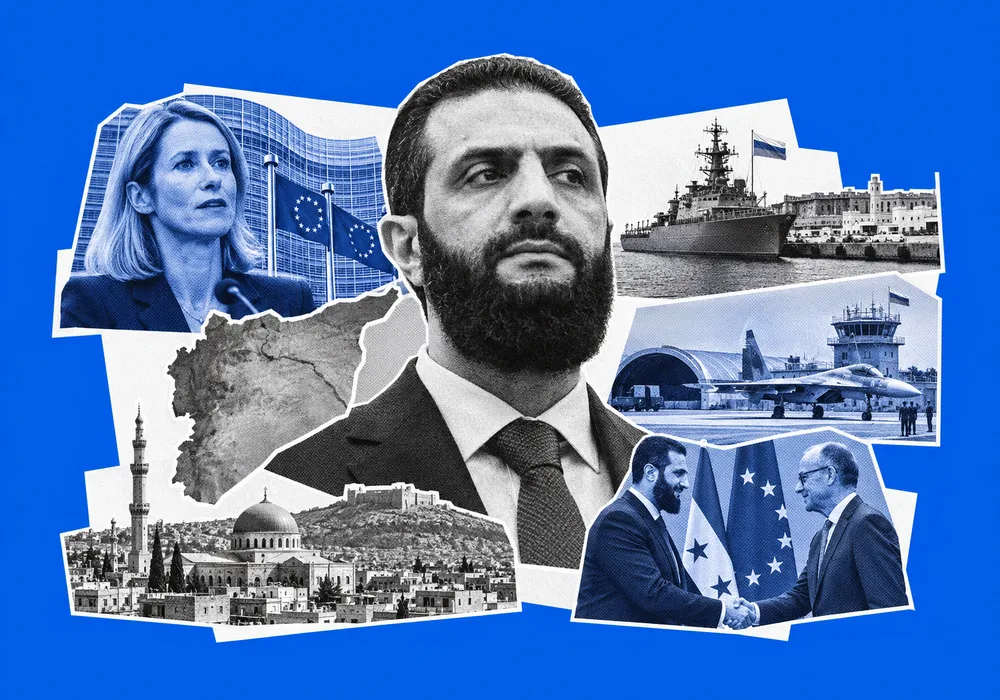
The European Union is considering a major expansion of political, economic and security cooperation with Syria, seeking to accelerate the country's recovery while limiting Moscow's remaining influence. Plans include reviving a long-frozen trade agreement, attracting European investment and supporting security-sector reforms, as Brussels competes with Russia for strategic influence in the eastern Mediterranean.
The European Union is preparing to deepen its engagement with Syria in one of its most significant attempts yet to reshape relations with Damascus following the overthrow of Bashar al-Assad in December 2024. A diplomatic discussion paper prepared ahead of the EU foreign ministers' meeting on 16 November outlines a broader partnership covering political dialogue, economic reconstruction, investment and security cooperation. The initiative reflects Brussels' ambition to bring Syria closer to European institutions and reduce the influence of external powers, particularly Russia, which continues to maintain important military and economic interests in the country.
The European diplomatic service considers Syria's political transition to be progressing, but warns that substantial challenges remain. Accelerating economic recovery, advancing national reconciliation and facilitating the return or reintegration of displaced people and refugees are among the priorities identified by Brussels. The EU also wants the transitional authorities to demonstrate tangible progress towards political stability and inclusive governance, recognising that the country's long-term recovery will depend on more than the removal of the previous regime.
The proposed expansion builds on steps already taken to restore diplomatic relations. In May 2026, Brussels held its first high-level political dialogue with the Syrian transitional authorities, while the EU restored the full application of its cooperation agreement with Syria. In September, the bloc re-established ambassadorial-level representation in Damascus for the first time since 2012. These developments indicate that European engagement is moving beyond humanitarian assistance towards a more structured political and economic relationship.
Russia's Military Presence Remains a European Concern
Countering Moscow's continued influence is an important dimension of the proposed partnership. Russia intervened militarily in the Syrian civil war to support Assad's government and established a strategic presence that gave the Kremlin considerable influence across the eastern Mediterranean and the wider Middle East. Although Assad's removal weakened Moscow's position, Russia has continued negotiations with Syria's new authorities in an effort to preserve access to its military facilities.
The Tartous naval facility and Hmeimim air base remain particularly important to Russian strategic interests. Tartous provides Moscow with a naval logistics and maintenance facility in the Mediterranean, while Hmeimim has served as a major hub for Russian air operations and military deployments in the region. Retaining access to both installations would allow the Kremlin to preserve part of the infrastructure supporting its operations beyond its immediate neighbourhood.
For Brussels, the continued Russian presence represents a strategic complication in the process of stabilising Syria. The EU discussion paper explicitly identifies limiting the harmful influence of Russia and other external actors as an objective of deeper engagement. Rather than relying exclusively on diplomatic pressure, the bloc appears to be considering economic assistance, institutional cooperation and security-sector reform as instruments for reducing Damascus's dependence on Moscow.
The competition also has implications beyond Syria itself. Russian access to Mediterranean infrastructure has historically supported its wider military and diplomatic positioning in the Middle East and North Africa. A stronger European partnership with Damascus could gradually change the balance of external influence in the region, although the extent of that shift will depend on the Syrian authorities' willingness to diversify their international relationships.
Reviving Trade Relations and Opening the Door to European Investment
Economic reconstruction is another central element of the proposed strategy. Nearly 14 years of civil war have devastated Syria's infrastructure, weakened public institutions and severely damaged its productive capacity. The transitional authorities need substantial external financing and expertise to rebuild essential services, restore transport networks and revive economic activity. The EU sees this need as an opportunity to establish a lasting economic presence in a country that remained largely isolated from European markets under Assad.
One of the most significant proposals concerns the revival of an EU-Syria Association Agreement, initially agreed in 2008 but never formally concluded. The framework would provide a basis for broader political dialogue, trade liberalisation and economic cooperation. European diplomats are expected to seek a new negotiating mandate from member states, potentially allowing the existing text to be adapted to the current political circumstances.
Brussels is also looking to reconnect Syria with Euro-Mediterranean cooperation frameworks and international trade networks. Transport, energy and digital connectivity have been identified as areas where European expertise and investment could contribute to reconstruction. These sectors are strategically important because they would help restore Syria's links with neighbouring markets while creating opportunities for European companies and investors.
Financial institutions could play a particularly important role. The EU is encouraging the European Investment Bank to resume engagement with Syria and supporting Damascus's efforts to become a shareholder in the European Bank for Reconstruction and Development. Greater access to these institutions could help mobilise financing for infrastructure projects and private-sector development, although actual investment will depend on political stability, institutional capacity and the availability of viable projects.
Security Cooperation Extends the European Role
The proposed partnership also goes beyond economic assistance. The EU wants to support reform of Syria's security sector, including cooperation with Jordan on training recruits for the Syrian police. This trilateral initiative could help strengthen domestic security institutions and improve their ability to maintain public order during the transition.
Security-sector reform is particularly important given the fragmentation of armed structures and the challenges facing the transitional authorities as they seek to establish effective central institutions. A functioning police service and accountable security institutions would be necessary for protecting civilians, restoring confidence in public administration and creating conditions for economic recovery.
For the EU, supporting these reforms would also provide a practical means of building long-term institutional relationships with Damascus. Cooperation with Jordan offers an additional regional dimension, allowing European involvement to be developed through an established neighbouring partner rather than exclusively through direct engagement with Syrian authorities.
However, the process carries significant political and operational risks. The effectiveness of security assistance will depend on the extent to which new institutions become accountable, inclusive and capable of operating across Syria's diverse communities. Without meaningful institutional safeguards, external support could strengthen existing power structures without addressing the underlying causes of instability.
Brussels Prepares a Longer-Term Economic Commitment
The next phase of engagement is expected to focus on attracting private investment. An EU-led coordination forum scheduled for 17 November in Damascus will bring together stakeholders to discuss investment opportunities and private-sector involvement. The meeting is intended to lay the groundwork for a possible EU-Syria investment conference in 2027.
The EU has already committed €620 million in support for Syria in 2026 and 2027, covering humanitarian assistance and socio-economic recovery. The proposed initiatives would build on this financial commitment by creating opportunities for longer-term economic cooperation rather than limiting European involvement to emergency assistance.
Nevertheless, Brussels faces a difficult balance between pursuing strategic interests and ensuring that reconstruction benefits the Syrian population. The country's economic recovery will require substantial international participation, while unresolved questions surrounding governance, reconciliation, accountability and security could complicate the mobilisation of private capital.
The proposed expansion of relations therefore represents more than a diplomatic normalisation. By combining trade, investment, security cooperation and institutional support, the EU is attempting to establish itself as a major partner in Syria's post-Assad reconstruction while limiting the space available to Russia and other external powers. Whether this strategy can translate into lasting influence will depend on the transitional government's ability to deliver political stability and on Europe's willingness to sustain its engagement beyond the initial reconstruction phase.
Sources: Reuters, European External Action Service