
Canada and Europe Move Towards a Strategic Alliance

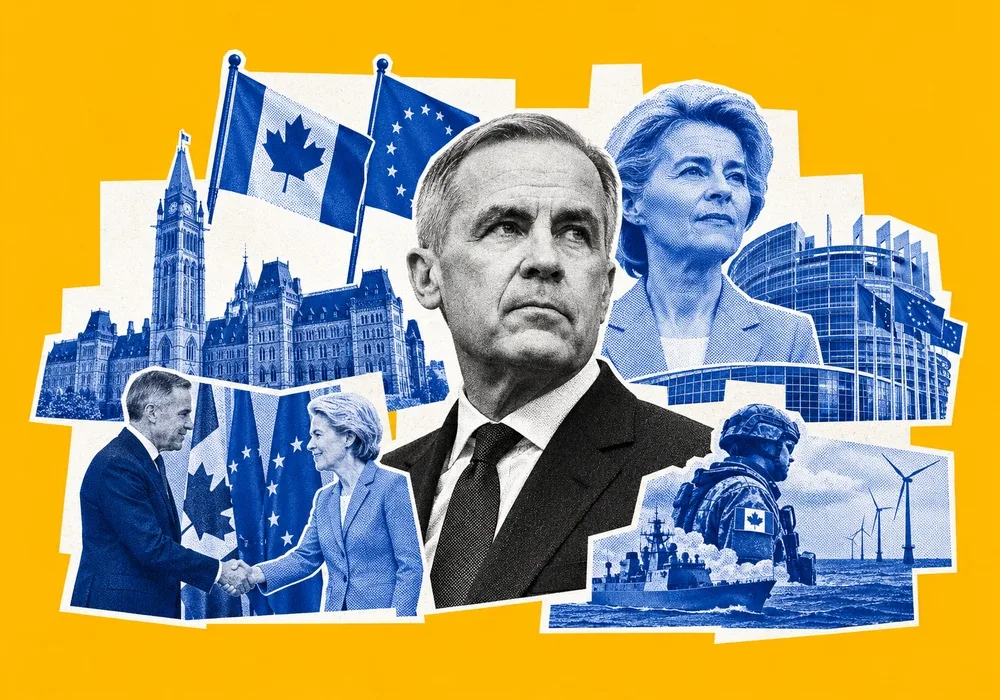
Canada is pushing for a new strategic relationship with the European Union covering defence, critical minerals, AI, energy, trade and financial infrastructure, after Brussels proposed making Canada the bloc's first associate member.
Canadian Prime Minister Mark Carney has called for a broad strategic alliance with the European Union, arguing that Canada and Europe need to deepen cooperation across defence, critical minerals, artificial intelligence, energy, trade and financial infrastructure as geopolitical and economic pressures reshape the international system.
Speaking to the European Parliament in Strasbourg on 17 September, Carney welcomed European Commission President Ursula von der Leyen’s proposal to explore making Canada the EU’s first associate member. The concept, introduced by von der Leyen in her State of the Union address a day earlier, would go beyond the existing Canada-EU Comprehensive Economic and Trade Agreement (CETA), although the precise institutional framework has yet to be defined.
Carney presented the initiative as a response to a wider shift in the global environment rather than as an attempt to create another geopolitical bloc. He argued that the traditional balance between economic openness and national sovereignty has become harder to maintain as trade, technology and access to strategic resources are increasingly exposed to geopolitical pressure.
From CETA to a broader political relationship
Canada and the EU already have a comprehensive trade relationship through CETA, but Carney's proposal points towards a much wider form of integration. He argued that the next stage should focus not only on reducing trade barriers but on building common capacity in areas that increasingly determine economic and political resilience.
The proposed cooperation would cover critical minerals, defence-industrial capacity, artificial intelligence and computing, energy security, space, financial services and payment systems. Canada and the EU would also seek to advance digital trade in non-agricultural goods and services, potentially creating a more integrated transatlantic economic space.
The Canadian government has described the relationship as an effort to strengthen strategic autonomy through complementary capabilities. Ottawa and Brussels discussed the same areas during Carney's meetings with von der Leyen and European Parliament President Roberta Metsola in Strasbourg. Both sides also reaffirmed their commitment to transatlantic security and support for Ukraine.
Carney also proposed expanding people-to-people links. His vision includes greater opportunities for young Europeans and Canadians to live, study and work on the other side of the Atlantic, as well as closer Canadian participation in European programmes such as Erasmus+ and Horizon Europe.
Strategic autonomy without a new bloc
Carney framed sovereignty increasingly as a question of resilience rather than self-sufficiency. In his argument, a state cannot be fully sovereign if it lacks secure access to critical technologies, minerals, energy, payment systems or communications infrastructure.
That approach closely mirrors the EU's own growing focus on strategic autonomy and economic security. For Brussels, reducing vulnerabilities in critical supply chains has become an increasingly important part of economic and foreign policy, while Canada has substantial reserves of critical minerals, energy resources and technological capabilities that could complement European capacity.
Carney also stressed that the proposed partnership should not be interpreted as an attempt to establish a third geopolitical bloc. Instead, he presented closer Canada-EU cooperation as a way of increasing the ability of democratic states to withstand external pressure while remaining open to international trade.
"Canada and Europe are each strong. Europe and Canada are even stronger together," Carney told MEPs, presenting the relationship as a partnership based on shared political values rather than opposition to another power.
The distinction is significant because Canada's economic relationship with the United States remains central to its economy. Carney's argument is therefore not that Ottawa should replace Washington with Brussels, but that Canada should have a broader network of economic and strategic partnerships.
Energy could become a major pillar
Energy is one of the areas where Canada could offer Europe a particularly tangible contribution. Carney said Canada could provide LNG and hydrogen at scale to support European energy security, while developing port infrastructure on Canada's eastern coast and in the High North.
For the EU, this would add another potential source of energy supply as member states continue to reduce their exposure to Russian energy and seek more diversified imports. For Canada, closer integration with European energy markets could provide additional demand and infrastructure opportunities.
The proposal also reflects the broader shift in how energy security is being treated in Europe. Energy is no longer viewed only as a commercial issue but increasingly as part of strategic resilience, alongside defence, technology and critical infrastructure.
Critical minerals and industrial capacity
Critical minerals are another potential foundation for a deeper Canada-EU relationship. Europe is seeking to reduce dependence on concentrated foreign supply chains for minerals needed in batteries, renewable energy, electronics, defence systems and other strategic industries.
Canada, with significant natural resources and an established industrial base, could become a more important partner in this effort. Carney's proposal would link access to raw materials with broader cooperation on processing, manufacturing and technological capacity rather than treating mineral supplies as a standalone trade issue.
The same logic applies to defence. Carney proposed deeper cooperation in defence-industrial capacity, potentially allowing Canada and European countries to coordinate more closely on procurement, production and strategic capabilities.
Defence and security move closer to the centre
The security dimension gives the proposed relationship a significance beyond conventional economic integration. Canada is already a NATO member and has long participated in European security arrangements, while Ottawa and Brussels have increasingly sought closer cooperation in response to the deterioration of the wider security environment.
Carney's emphasis on defence-industrial capacity suggests that future Canada-EU cooperation could increasingly focus on the ability to produce and sustain military capabilities rather than solely on political coordination.
This could become particularly relevant as European governments increase defence spending and seek to expand domestic production. Canadian participation could add industrial capacity while giving Ottawa a more direct role in Europe's evolving defence ecosystem.
Canada and the EU have already been moving in this direction. Their discussions in Strasbourg placed defence alongside critical minerals, AI, energy, space and financial infrastructure as elements of a broader strategic relationship.
AI, payments and technology become strategic infrastructure
Carney also placed artificial intelligence and computing alongside more traditional areas of national security. His argument was that technological infrastructure increasingly affects the ability of governments to govern, economies to function and societies to remain resilient.
That extends the proposed partnership into areas where the EU has been attempting to strengthen its own technological sovereignty. Cooperation with Canada could provide another channel for research, computing capacity, investment and regulation.
Financial infrastructure is also part of the proposal. Carney specifically identified payments as an area for strategic cooperation, reflecting growing concerns among governments about dependence on external financial and technological systems.
The underlying principle is that sovereignty increasingly depends on access to infrastructure that did not traditionally fall under the definition of national security.
A new form of EU association
The biggest political question remains what "associate membership" would actually mean. The EU does not currently have a standard status matching the model suggested by von der Leyen, meaning that Canada and the EU would have to define the framework themselves.
Carney made clear that Canada is not seeking full EU membership. Instead, he described a separate arrangement designed for a country outside Europe that nevertheless shares deep economic, political and security links with the bloc. The exact institutional structure, rights and obligations of such a status would therefore need to be negotiated.
The proposal could ultimately produce a relationship somewhere between a conventional free-trade agreement and political membership. It could include participation in selected European programmes and mechanisms without requiring Canada to adopt the full body of EU law or surrender national sovereignty.
That makes the initiative potentially relevant beyond Canada itself. If implemented, it could create a new model for how the EU works with closely aligned democracies that are not candidates for membership.
The US factor remains unavoidable
The proposed Canada-EU alliance is also unfolding against a deteriorating relationship between Ottawa and Washington. The United States remains Canada's overwhelmingly important economic partner, but tariffs and broader disputes over trade and sovereignty have encouraged Ottawa to diversify its external relationships.
US President Donald Trump has criticised the emerging EU-Canada arrangement and threatened additional tariffs if it develops into what Washington considers a hostile initiative. The dispute adds a geopolitical dimension to what Ottawa and Brussels are presenting as a resilience and diversification strategy.
Carney has nevertheless insisted that stronger ties with Europe are not designed to replace Canada's relationship with the United States. In his formulation, a more resilient and diversified Canada would also be in a stronger position to maintain constructive relations with Washington.
This creates a delicate balance for both sides. Canada wants greater room for manoeuvre without severing its most important economic relationship, while the EU has an interest in closer ties with Ottawa without turning the partnership into a direct confrontation with Washington.
From political signal to concrete agreements
The next stage will be to translate the political ambition into specific programmes and agreements. Canada and the EU are already discussing areas including digital trade, research, youth mobility, energy, defence and critical minerals.
The two sides are expected to continue negotiations ahead of a Canada-EU summit in Montreal later this year, where several elements of the emerging partnership could be advanced. Any major agreement would still require the appropriate domestic approval processes in Canada and the EU.
For now, Carney's Strasbourg speech has established the political direction: Ottawa wants a relationship with Europe that is substantially deeper than CETA and extends into the strategic infrastructure of modern economies.
The significance of the proposal lies less in the terminology of "associate membership" than in the areas it is intended to cover. Trade, defence, energy, critical minerals, AI, payments, research and mobility are increasingly interconnected parts of economic and national security. A Canada-EU partnership built around them would therefore represent a qualitatively different relationship from a conventional trade agreement.