
Deported Ukrainian Children Now Fight for Russia’s Army

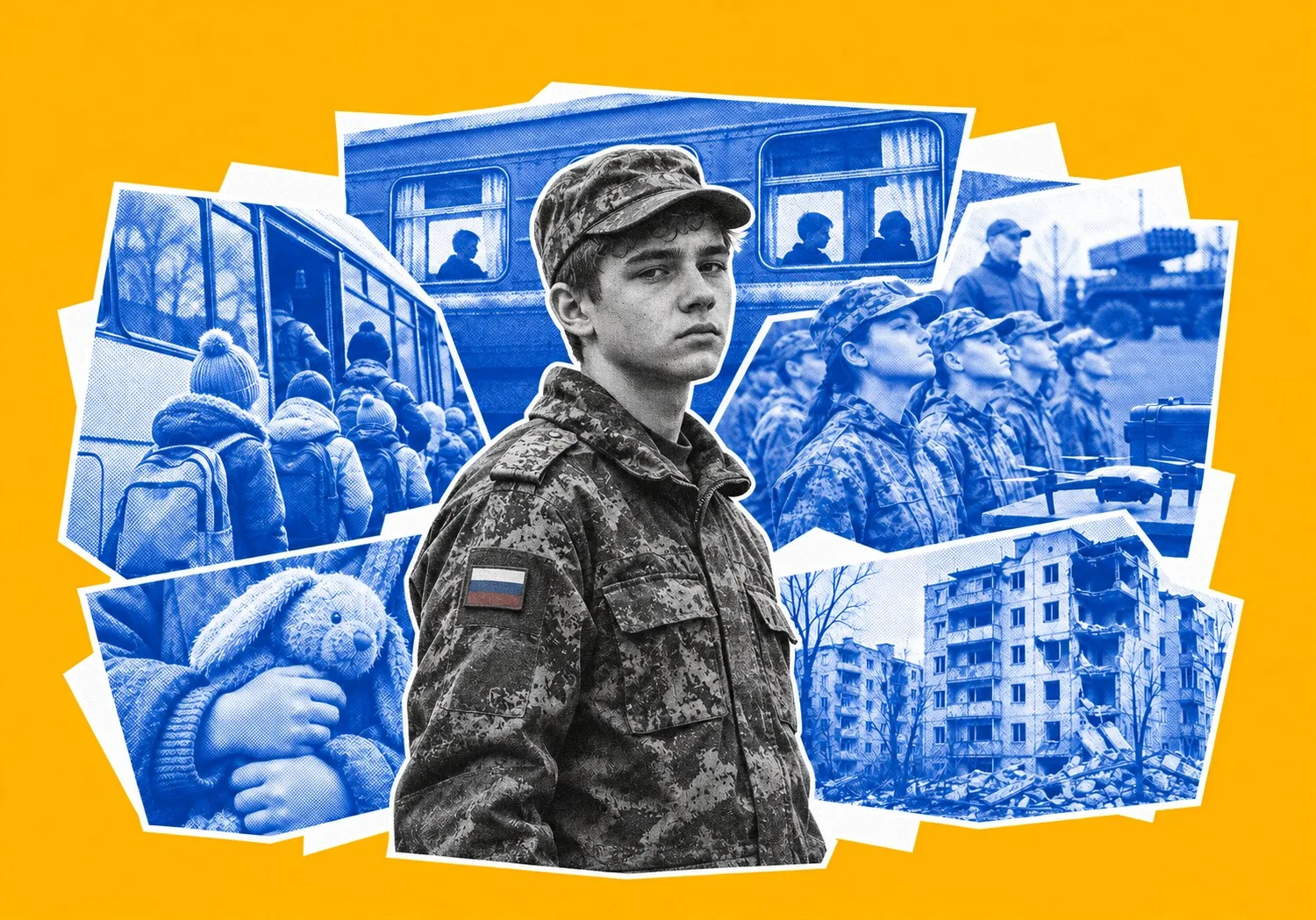
At least five Ukrainian boys taken to Russia before the February 2022 invasion later joined its army as adults, an investigation has found. Removed from institutions in occupied Donetsk region, they returned to Ukraine to fight for the invading force.The independent Russian outlets IStories and Vyorstka documented their cases in an investigation published on 16 November. Some had suffered serious wounds; one was reported missing. The boys were among hundreds of children transported from residential institutions in Donetsk, Amvrosiivka and surrounding areas days before the full-scale invasion. Russian and proxy authorities called the operation a “humanitarian evacuation”, sending children to Russia on buses and trains. Moscow presented their removal as a rescue from shelling.
On 19 February, 2022 the Russian-controlled authorities in Donetsk published footage of children leaving the Amvrosiivka boarding school.
The invasion began five days later.
The children were subsequently dispersed among Russian institutions and foster families.
 Pavlo Yeremeyev moved between foster families after being taken to Russia. The family he later joined supported the war: his foster father served in Ukraine, while his foster mother organised collections and sent equipment to Russian troops. Yeremeyev appeared in official publicity and attended a Moscow family forum organised under the Movement of the First, a state-backed youth organisation.
By September 2024, he and Andrii Zhelnov, whom he had known at the Amvrosiivka boarding school, had signed military contracts. Yeremeyev had recently turned 18; Zhelnov was 19. Both had finished college three months earlier. Yeremeyev told the investigators that he had considered military service since he was 16 or 17, describing it as offering “status, prospects, a future”.
After a month’s training, they went on their first combat mission together. Zhelnov stepped on a mine and lost part of a leg. He told the reporters that he did not regret enlisting. Yeremeyev remained at the front and said he had become a drone pilot.
For another former institutional resident, identified as Kirill P., enlistment followed shortly after college. He had appeared in a Russian child-placement database in October 2022; four years later, photographs showed him in a trench with a rifle. He said he signed his contract two months after turning 18 and was subsequently wounded.
The investigation changed some names for safety. It documented contracts signed after the young men reached adulthood and did not establish that they had been ordered to enlist. Their accounts described different motives and attitudes towards service, rather than a single explanation for why they joined.
The Scale of the Removals
The departures from Donetsk and Amvrosiivka formed part of a wider programme.
Ukraine has identified roughly 20,000 children as deported or forcibly displaced. The full number remains unknown because Ukrainian investigators and international monitors lack unrestricted access to Russia and occupied territory.
A separate investigation by the UN Independent International Commission of Inquiry on Ukraine verified the unlawful deportation or transfer of 1,205 children. Its March 2026 findings included 995 removed from 11 institutions in occupied Donetsk and Luhansk regions in operations beginning before the invasion. These were individually documented cases, not an estimate of the total number taken.
 and the Commissioner for Children's Rights, Maria Lvova-Belova. Photo: Radio Liberty") Children in the commission’s cases were placed across 21 Russian regions. More than 80 per cent had not returned. Investigators found that Russian authorities had prioritised long-term placement over establishing a system for repatriation.
Many children described as orphans have surviving parents, siblings or other relatives. Residential care can reflect a parent’s illness or inability to look after a child; it does not establish that there is no family to trace. UNICEF’s guidance calls for preserving identity documents, preventing sibling separation and locating relatives before decisions about long-term care.
Russian citizenship and adoption procedures have further complicated those ties. In December 2024, Yale’s Humanitarian Research Lab identified 314 Ukrainian children in an investigation into coerced adoption and fostering. Researchers traced interconnected databases presenting children from Ukraine as Russian orphans.
The laboratory’s director, Nathaniel Raymond, told the UN Security Council that 208 of the children had been placed with Russian citizens through adoption or forms of guardianship, and 67 had been naturalised. Presidential decrees and legal changes facilitated citizenship procedures and placement under Russian adoption law. Researchers also identified sibling separation. They corroborated children’s identities using photographs, travel records, official documents and other personal details, and passed their dossiers to Ukrainian authorities and the office of the International Criminal Court’s prosecutor.
Military Lessons Under Occupation
Children who remained in occupied Ukraine also encountered military education.
Russian authorities imposed their school curriculum, restricted Ukrainian-language teaching and introduced lessons justifying the invasion. Patriotic and military instruction was intended to prepare children for service in Russian military or civilian institutions, the UN Human Rights Monitoring Mission in Ukraine found.
 Refusing that education carried risks. Children and parents faced threats or punishment for speaking Ukrainian or continuing Ukrainian schooling online. Teachers who resisted the Russian curriculum faced threats, detention and abuse, according to Human Rights Watch. Parents were threatened with fines, detention or losing custody if they refused to enrol their children in Russian-controlled schools.
Military training became part of the curriculum. Secondary schools were also required to provide the names of students aged 18 and over whom Russian authorities considered eligible for conscription, Human Rights Watch reported.
The network extended beyond classrooms. In a separate study published in September 2025, Yale researchers identified at least 210 facilities in Russia and occupied Ukrainian territory to which Ukrainian children had been taken. They found re-education at 62.9 per cent of the locations and militarisation at approximately 18 per cent.
Activities included combat training, drills, drone assembly and military history instruction. More than half the facilities were managed by Russian government bodies. The percentages measure locations, rather than the proportion of children receiving training, and the study did not establish how many would later enlist.
Finding a Way Home
For relatives seeking a child’s return, the first obstacle is often finding them. Russian authorities failed to disclose children’s whereabouts, leaving families to organise searches and negotiate repatriation, the UN commission found. Some remained separated for years.
Returns have relied on Ukrainian agencies, organisations including Save Ukraine, and international mediation. Qatar has maintained a channel between Ukrainian and Russian officials. In September 2026, its foreign ministry said more than 14 humanitarian operations, coordinated with the International Committee of the Red Cross, had helped reunite 87 Ukrainian children with their families.
On 17 November, Ukraine’s National Information Bureau reported that 118 children had returned in October through Bring Kids Back UA, taking the initiative’s cumulative total to 2,775. The figure includes children leaving occupied territory as well as those brought back from Russia, so it cannot be directly compared with the deportation register.
Assistance continues after return. Ukraine’s 18-month reintegration plan provides for restoring documents, temporary housing, work with families or placement in family-based care, and psychological and social support. The Ministry of Social Policy has said that a one-off grant of 50,000 hryvnias also applies to returnees aged 18–23 who were deported as minors.
Deportation, Recruitment and the Law
The removals and subsequent recruitment engage several provisions of international humanitarian law. Article 49 of the Fourth Geneva Convention prohibits forcible transfers and deportations from occupied territory. Evacuations are permitted only under strict conditions and must not become permanent resettlement.
Article 50 requires an occupying power to help establish children’s identities and parentage and prohibits changing their personal status.
Article 51 prohibits compelling protected persons to serve in the occupying power’s armed or auxiliary forces. It also bans pressure or propaganda designed to secure voluntary enlistment. A signed contract therefore does not, by itself, establish that recruitment was lawful: the circumstances in which it was obtained must also be examined.

The UN commission concluded in March 2026 that Russian authorities had committed crimes against humanity through deportation, forcible transfer and enforced disappearance of children. It also identified war crimes, including unlawful deportation and unjustifiable delay in repatriation. The Genocide Convention separately provides that forcibly transferring children between national groups can constitute genocide when accompanied by intent to destroy a protected group, wholly or partly; establishing that intent requires a further legal assessment.
The International Criminal Court issued arrest warrants for Vladimir Putin and children’s rights commissioner Maria Lvova-Belova in March 2023 over alleged war crimes involving the unlawful deportation and transfer of children.
An estimated 1.6 million children, including around 600,000 of school age, remain in Russian-occupied Ukrainian territory, according to Human Rights Watch. There, occupation authorities impose Russian schooling, exclude Ukrainian-language instruction and channel boys towards Russian military registration and conscription.
Sources: IStories / Vyorstka: investigation, 16 November 2026,Human Rights Watch, UN Commission of Inquiry, Yale Humanitarian Research Lab, Yale: re-education and militarisation research, OHCHR, Ukraine's National Information Bureau