
Russia Is Turning Abducted Ukrainian Children Into Future Soldiers

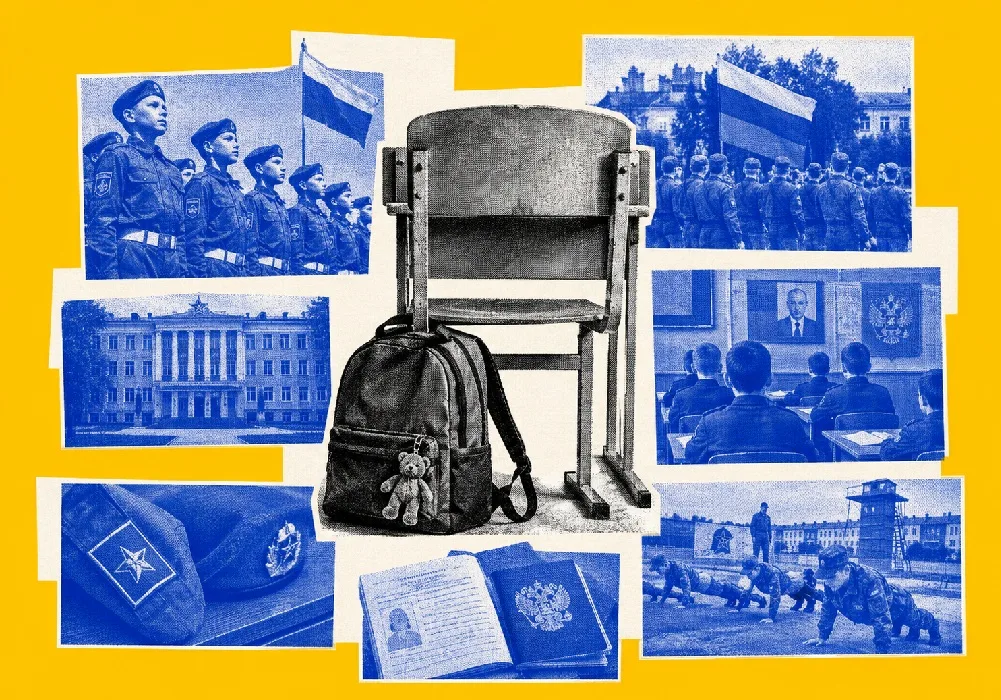
Russia’s abduction of Ukrainian children is evolving into a broader system of forced assimilation. Children are separated from their families, given new identities, placed into Russian education and adoption systems, and exposed to increasingly intensive military training. As Russian authorities prepare children in occupied territories for military service, the line between deportation, indoctrination and recruitment is becoming harder to ignore. The result is a system designed not only to remove Ukrainian children from their homes, but to reshape their identity and potentially turn them into future soldiers of the state that occupies their homeland.
For thousands of Ukrainian children taken by Russia, the disappearance does not end with deportation. It can become the beginning of a much longer process in which a child’s identity is gradually dismantled, rewritten and replaced with a Russian one — before the same state that took the child begins preparing them for military service.
This system is becoming increasingly visible. In July 2026, an OSCE expert mission concluded that Russia’s militarisation and indoctrination of Ukrainian children is not a collection of isolated initiatives but part of a coordinated policy. The report documented the forced integration of Ukrainian children into the Russian education system, the removal of Ukrainian language and history from schooling, propaganda portraying Ukrainian identity as a threat, and the expansion of military-patriotic education. Children are being exposed to weapons handling, drone operation, tactical medicine and other forms of military preparation.
The scale of the wider child-removal operation is equally significant. The European Commission says more than 20,500 Ukrainian children have been unlawfully deported or forcibly transferred to Russia or Russian-occupied territories since the beginning of the full-scale invasion. More than 2,100 have been returned, leaving the fate of tens of thousands unresolved. The EU says some children have been forced to change their identities, placed for adoption and given Russian citizenship.
The result is a process that goes far beyond physical displacement. Russia is attempting to make it progressively harder for a Ukrainian child to return to the family, community and country from which they were taken.
First the child disappears. Then the identity does
For parents searching for children taken into Russia or occupied territory, one of the greatest obstacles is that the child may no longer officially exist under the same identity.
Russian authorities have used citizenship procedures, new documents, changes to personal information and adoption mechanisms to integrate Ukrainian children into Russian society. Investigations have previously identified Ukrainian children on Russian adoption platforms under altered Russian identities. A Financial Times investigation matched Ukrainian children taken from occupied territories with profiles on Russian government-linked adoption websites, finding cases in which children had been assigned new Russian identities.

The problem is not simply that a child has been moved hundreds or thousands of kilometres away. Once names, documents, citizenship and family information are altered, the search itself becomes harder.
Ukraine has repeatedly warned that Russian adoption and guardianship procedures create additional barriers for families attempting to locate their children. Ukrainian officials have described cases in which children taken from occupied territories are placed with Russian families or institutions, making the original family connection increasingly difficult to establish.
The European Union now explicitly identifies forced identity changes and unlawful adoption as part of the broader system surrounding the deportation of Ukrainian children. In May 2026, the EU sanctioned individuals and organisations it said were involved in the unlawful deportation, forced transfer, forced assimilation, militarised education and unlawful adoption of Ukrainian minors.
This creates a particularly dangerous contradiction. A parent may still be searching for a missing child while the Russian state is simultaneously constructing a new legal and social identity for that child — one that can eventually make the original family appear foreign to them.
From Russian schoolbooks to military training
The second stage is ideological.
Children who remain in occupied Ukrainian territory face a Russian-controlled education system in which Ukrainian language and identity are systematically marginalised. Human Rights Watch reported in July 2026 that Russian authorities were forcing children into a school system based on the Russian curriculum, restricting Ukrainian-language education and using anti-Ukrainian propaganda and militarised lessons. Boys are increasingly channelled towards Russian military registration and conscription.

The OSCE investigation reached a similar conclusion. Its July report documented military-patriotic lessons, cadet programmes, youth movements, camps and paramilitary organisations. Children were exposed to weapons handling, drone operation, tactical medicine and other activities designed to familiarise them with military service. The mission concluded that the practices may constitute serious violations of international law and could amount to crimes against humanity.
The progression matters.
A child does not have to be handed a rifle on the first day for militarisation to begin. It can start with a classroom lesson, continue through a patriotic camp, move into drone training and military competitions, and eventually lead to formal registration for service.

UN human rights monitors have documented this trajectory as well. Children from occupied Ukrainian territories have participated in Russian military-patriotic programmes involving weapons, drones, tactical medicine, obstacle courses and simulated combat. In occupied Sevastopol, children were trained to operate aerial, ground and naval drones at a facility connected to the Russian Ministry of Defence.
The system therefore treats childhood not as a protected period outside the war, but as preparation for the next stage of the war.
The occupation is preparing children for the army that occupies their homeland
The most disturbing element is where this education is designed to lead.
The Ukrainian Foreign Ministry, citing the OSCE report, said Russian authorities were preparing Ukrainian boys in occupied territories for conscription into combat or supporting units of the occupying power. Human Rights Watch has separately reported that some Ukrainian children received Russian conscription notices before reaching the normal age of military service, prompting families to flee occupied territory.
This is why the distinction between “indoctrination” and “recruitment” is becoming increasingly artificial.
The Russian system is creating the ideological conditions for a child to perceive Russian military service as normal, prestigious or obligatory. The Ukrainian Ombudsman's office has documented the promotion of Russian military service among children in occupied territories, including narratives presenting sacrifice for Russia as a form of heroism.
Recent reporting has gone further, citing Ukrainian officials who say hundreds of Ukrainian minors who grew up under occupation were eventually drawn into Russian military structures, with some reportedly killed on the battlefield. These claims are difficult to independently verify in full because Russia does not provide transparent access to military and personnel records, but they illustrate the end point feared by Ukrainian and international investigators: children subjected to years of Russian control can ultimately be turned into personnel for the same military that occupies their homeland.
The critical issue is therefore not whether Russia is simply “recruiting children”. It is whether Russia is deliberately constructing a pipeline in which a Ukrainian child is first separated from their national identity and family, then socially and ideologically integrated into Russia, and finally prepared to serve the Russian state.
The evidence increasingly points in that direction.
Adoption can become another layer of disappearance
The adoption system adds another dimension to the problem.
For a Ukrainian parent, losing a child to deportation is already an enforced separation. But when that child is subsequently assigned Russian documents, placed in a Russian family and potentially given a new name, the separation becomes institutionalised.
Investigations have shown that Ukrainian children removed from occupied territories appeared in Russian adoption systems under identities that obscured their Ukrainian origins. The Financial Times identified several such cases through image recognition and public records, demonstrating that children taken from Ukrainian institutions could subsequently appear as Russian children available for adoption.
This is why the issue cannot be reduced to the question of where the children physically are.
A child can be alive, housed and attending school — and still be effectively missing from their Ukrainian family.
The European Commission has explicitly warned that some children have been forced to change their identity, granted Russian citizenship and placed for adoption. It also notes that the fate of many thousands remains unknown.
For families, this creates a race against time. Every additional administrative step — a new birth certificate, a Russian passport, an adoption decision, a new surname, a transfer to another region — can make tracing the child more difficult.

And once a child has spent years inside the Russian education and social system, the challenge is no longer only locating them. It is also reconstructing the connection between the child and the family from which they were separated.
Russia is building a system that can outlast the war
The significance of the policy is therefore demographic and strategic as much as humanitarian.
Russia is not merely removing children from territory it occupies. It is attempting to determine what those children will believe about themselves when they grow up.
The OSCE report describes a system designed to erase Ukrainian identity and impose loyalty to the occupying power. UN monitoring has documented Russian citizenship requirements, Russian curricula, restrictions on Ukrainian-language education and military-patriotic training. Human Rights Watch has described the same combination of education, propaganda, surveillance and military preparation.
Taken together, these policies create a continuum.
Removal separates the child from the family.\ Adoption and documentation can obscure the child's identity.\ Russian schooling replaces the child's national narrative.\ Militarisation normalises the use of force and service to Russia.\ Conscription can eventually turn that child into an instrument of the occupying state.
That continuum is what makes the child deportation issue different from a conventional wartime displacement crisis.
The objective is not simply to move children away from danger. If that were the purpose, children could be returned once the immediate danger passed, their Ukrainian documents and identities could be preserved, and their families could remain connected to them.
Instead, international investigators are documenting a system in which separation, assimilation and militarisation reinforce one another.
The longer the process continues, the more difficult return becomes.
For Ukraine, recovering these children therefore means recovering more than physical custody. It means restoring identities that may have been altered, reconstructing family links that Russian authorities have deliberately obscured, reversing years of imposed education and propaganda, and ensuring that children who were taken from Ukraine do not eventually become soldiers fighting against the country they came from.
That is the strategic danger behind Russia's child policy: the Kremlin is not only trying to remove Ukrainian children from the present. It is attempting to shape who they will become in the future.
Sources: OSCE / ODIHR, European Commission, Council of the EU, Human Rights Watch, Financial Times, European Commission