
Albania’s Anti-Government Protests Escalate as Calls for Rama’s Resignation Grow

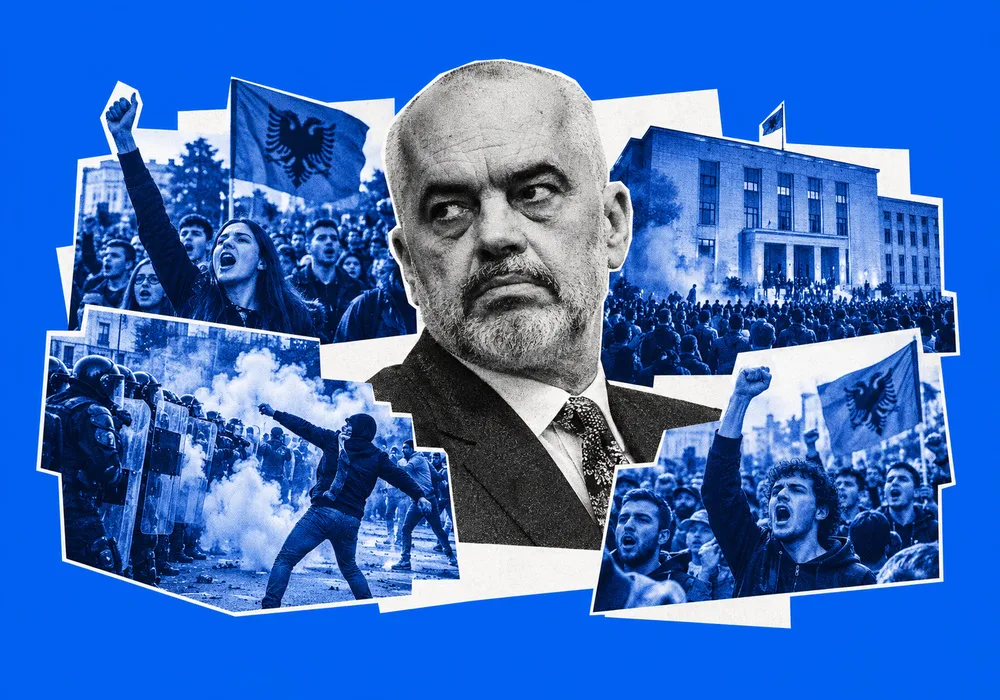
Violent clashes in Tirana have intensified a political crisis fuelled by allegations of corruption, dissatisfaction with education and employment prospects, and opposition to controversial tourism development. The unrest presents a growing challenge to Prime Minister Edi Rama as Albania continues its pursuit of EU membership.
Albania’s anti-government demonstrations escalated on 24 October as protesters in the capital, Tirana, launched fireworks, stones and petrol bombs at police, while security forces responded with tear gas, water cannons and rubber bullets. The clashes spread from the Ministry of Education to Skanderbeg Square, the prime minister’s office and other parts of the city, with demonstrators targeting public buildings and private property. Fires were reported at the entrances to several government institutions, including the ministries of Agriculture and Environment and Tirana Municipality. Rubbish bins were set alight, paving stones were pulled up and used as projectiles, and burning barricades disrupted traffic in the city centre. The scale of the confrontation marks a further deterioration in a protest movement that has increasingly challenged the authority of Prime Minister Edi Rama’s government.
The demonstrations initially centred on students’ concerns about education costs, inadequate university facilities and limited employment opportunities. However, the movement has broadened into a wider expression of dissatisfaction with the government, with demonstrators accusing the administration of corruption and demanding Rama’s resignation. The participation of university professors, artists, opposition supporters and other groups has extended the protests beyond their original student base. For many participants, the dispute is no longer confined to education policy but reflects deeper concerns about public accountability, economic prospects and the ability of political institutions to respond to social grievances.
Economic Frustration and Controversial Development Projects
The current unrest follows months of demonstrations against a proposed luxury tourism development on Albania’s southern coast linked to an investment firm founded by Jared Kushner, the son-in-law of US President Donald Trump. What began as opposition to a specific development project has contributed to a broader debate about how Albania manages investment, protects its environment and distributes the benefits of economic growth. The controversy has become politically significant because it connects questions about the country's development model with wider suspicions about the relationship between political power and private interests.
Education and employment have added another dimension to the discontent. Young Albanians face concerns about the quality of public services and the availability of opportunities that would allow them to build their futures at home. The country has experienced substantial emigration since the collapse of communism in the 1990s, leaving persistent concerns about its demographic future and the loss of skilled workers. For students and younger demonstrators, better educational conditions are therefore closely connected to broader questions about economic security and whether Albania can offer a credible long-term future to its citizens.
These grievances have created common ground between groups that might otherwise have different priorities. Environmental activists, students and anti-government demonstrators do not necessarily share a single political programme, but their mobilisation reflects overlapping concerns about transparency, public services and the direction of the country. This broad coalition increases pressure on the government while making the movement harder to resolve through concessions on any single issue.
Police Response Raises Questions About Public Order
The latest clashes have intensified scrutiny of the authorities’ handling of the demonstrations. Police used tear gas, water cannons and rubber bullets to disperse crowds, while some protesters attacked officers with incendiary devices and other projectiles. Albanian public broadcaster RTSH reported that one officer caught fire during the confrontation before colleagues intervened. Fires and damage to public infrastructure also raised concerns about the safety of residents, journalists, demonstrators and emergency personnel operating in central Tirana.
The violence follows nearly two weeks of confrontations and arrests. Figures reported earlier in October indicated that hundreds of people had been detained, while police and protesters had sustained injuries. The authorities had also suspended seven police officers pending investigations into alleged misconduct during earlier demonstrations. These developments place pressure on the government to address both public safety and concerns about the proportionality of law enforcement measures.
The distinction between peaceful protest and violence against people or institutions will be central to the government's response. Authorities have a responsibility to protect public order, but the handling of demonstrations also affects public confidence in law enforcement and the right to political expression. If the response is perceived as indiscriminate or excessively forceful, it could reinforce the protesters’ claims that institutions are failing to respond to legitimate grievances. Conversely, attacks on police and public buildings risk alienating sections of the population that support demands for accountability but oppose violent escalation.
The number of people injured in the latest clashes remains subject to differing reports. Albanian authorities reported more than 300 injuries among police and protesters in the wider wave of unrest, while the Ministry of Health reported that 13 people required medical attention following the 24 October demonstration, including protesters, police officers and journalists. These figures cover different reporting periods and should not be treated as directly comparable.
Rama Rejects Calls to Resign
Rama, who has led Albania since 2013 and secured a fourth term in the 2025 parliamentary election, has rejected demands to leave office. His government faces pressure not only from demonstrators but also from an opposition seeking to turn public dissatisfaction into a challenge to the governing Socialist Party. Opposition supporters have participated in the rallies, although demonstrators have also criticised the wider political establishment rather than endorsing a single alternative.
The prime minister has called for dialogue while blaming political opponents for encouraging violence. He has also alleged that foreign actors, including Russia and Iran, are contributing to online misinformation surrounding the unrest. Such claims add an external dimension to the crisis, but they do not resolve the domestic grievances driving the demonstrations. The government's ability to regain public confidence will depend on how it responds to concerns about corruption, education, employment and accountability, rather than solely on its efforts to restore order.
A symbolic invitation to dialogue outside the government headquarters failed to ease tensions during Saturday's rally. Cushions placed around an improvised table were intended to signal an opening for talks, but protesters rejected the gesture and set the cushions on fire. The episode illustrated the widening gap between the government's stated willingness to engage and demonstrators' demands for more substantial political change.
The protests also expose a challenge for the opposition. Although the government's critics have mobilised around a shared demand for accountability, the movement's broader rejection of established political figures complicates efforts to convert street pressure into a unified political alternative. The discontent is therefore directed not only at Rama's administration but also at a political system that some demonstrators regard as insufficiently responsive to public concerns.
EU Membership Adds to the Stakes
Albania's political stability carries implications beyond its domestic institutions. The country is pursuing membership of the European Union, making the credibility of its democratic institutions, rule of law and public accountability important to its European ambitions. The protests do not, by themselves, determine the course of accession negotiations, but the government's response will influence perceptions of its ability to manage political conflict while upholding democratic standards.
For the EU, the situation presents a familiar challenge in enlargement policy: maintaining support for a candidate country's European integration while insisting on credible institutional safeguards. Allegations of corruption, questions about police conduct and attacks on public institutions all reinforce the importance of transparent investigations and effective accountability. A sustained political confrontation could also divert government attention from reforms and weaken public confidence in the accession process.
The crisis is unfolding at a time when Albania's European future depends not only on formal negotiations but also on the perceived quality of its governance. If citizens believe that economic development benefits a narrow circle while education, employment and public services remain inadequate, support for European integration may become harder to translate into confidence in domestic institutions. Addressing those concerns will require more than policing the streets or calling for dialogue: it will require credible responses to the grievances that have brought different groups into the same protest movement.
The immediate question is whether the government and demonstrators can prevent further escalation. Rama has shown no intention of resigning, while protesters continue to demand political accountability and changes in leadership. Without credible engagement and progress on the underlying concerns, the confrontation risks becoming a prolonged test of public trust in Albania's political system, with consequences for domestic stability and the country's European trajectory.
Sources: Albanian State Police, Euronews Albania