
Car Bomb Kills Russian Colonel in St Petersburg in Latest Attack on Senior Officers

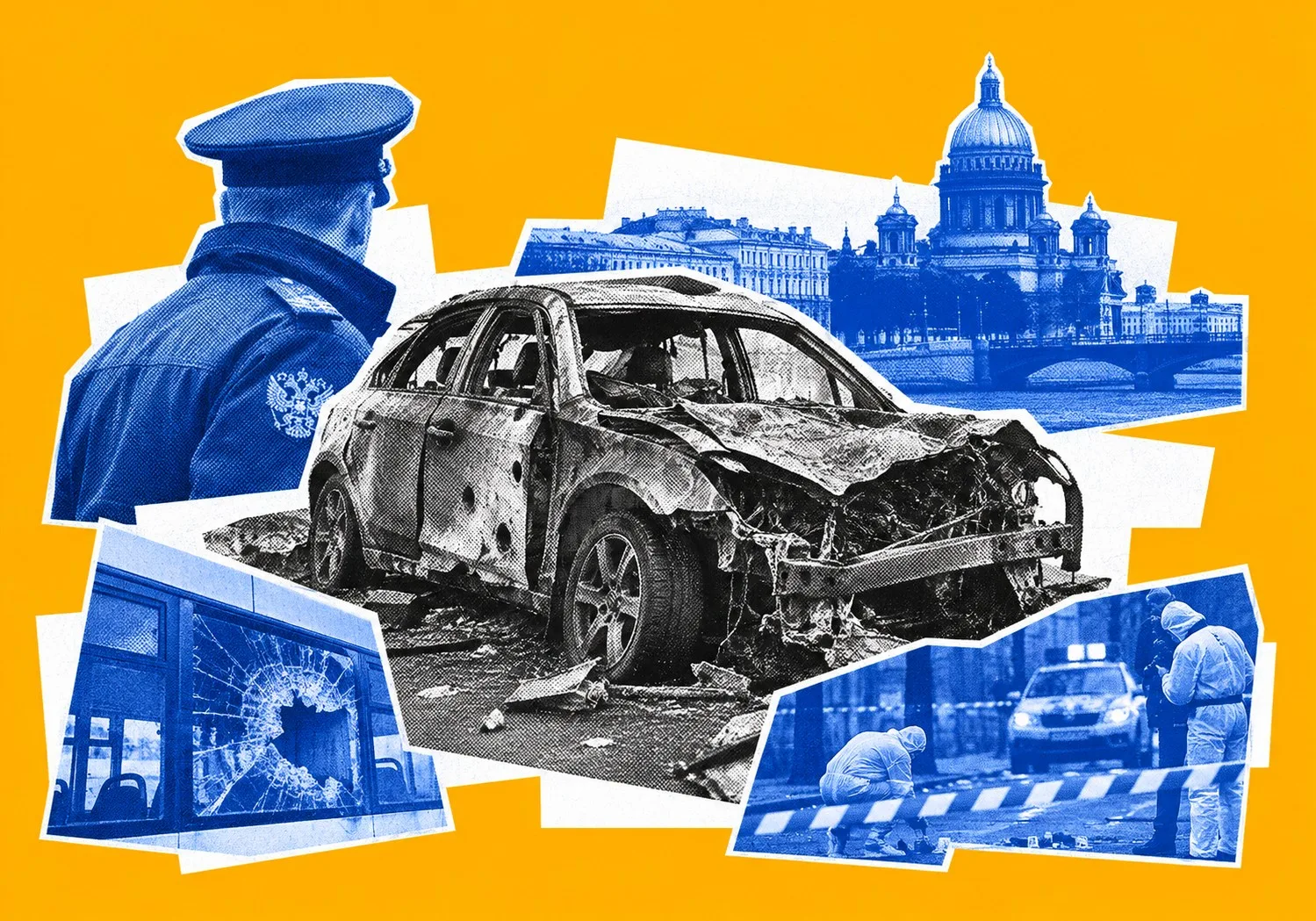
A Russian military officer, identified by local media as a colonel serving in the Russian Aerospace Forces’ 6th Guards Air and Air Defense Forces Army, was killed by a car bomb in St Petersburg on Thursday morning. It was the second fatal bombing involving a military officer on the same road in less than three months, amid a series of attacks on senior commanders and officials connected to Russia's war in Ukraine.Russia's Investigative Committee confirmed the serviceman's death and opened a murder investigation but did not disclose his name or rank. No one has claimed responsibility for the killing.

A second bomb on the same road
The explosion occurred shortly after 7am on Kolpinskoye Highway in Shushary, on the southern outskirts of St Petersburg.
According to Fontanka, a device attached beneath the officer's car detonated as he pulled out of a residential courtyard. He died at the scene. The blast damaged the windows of a passing bus, and police closed part of the highway while investigators examined the wreckage.
Initial reports suggested that a relative had been injured in the explosion. Fontanka later corrected the account after examining security camera footage, which showed that the officer had been travelling alone.
The road had been the scene of another fatal bombing on 27 August. That morning, an explosion killed a Russian officer travelling with his wife, who survived with injuries.
Independent journalists subsequently identified him as Sergei Sechkov, a member of the 332nd Guards Helicopter Regiment. His father confirmed his death to the investigative outlet Agentstvo.
 Ukraine's military intelligence agency has accused personnel from the regiment of carrying out strikes against civilians in the Kharkiv region. Nothing has been established publicly to connect those allegations to Sechkov's killing.
Fontanka reported that investigators suspected a 24-year-old Russian woman of planting the August bomb. She reportedly left Russia shortly afterwards. The authorities have not announced an arrest or provided a public account of the investigation's progress.
Both officers were killed while using their private vehicles near residential buildings, away from military installations. Similar circumstances have featured in several attacks on Russian commanders since 2025.
The generals killed far from the front
One of the most senior victims was Lieutenant General Yaroslav Moskalik, deputy head of the Russian General Staff's Main Operations Directorate.
A car bomb killed him outside his home in Balashikha, near Moscow, on 25 April 2025. The explosion came hours before President Vladimir Putin met US envoy Steve Witkoff for talks about the war in Ukraine.
Russian security services arrested Ignat Kuzin, accusing him of acting on behalf of Ukrainian intelligence. A court subsequently sentenced him to life imprisonment. Kyiv did not claim responsibility.
Moskalik had taken part in military planning at the General Staff and previously represented Russia in international discussions concerning the conflict in eastern Ukraine.
Another General Staff officer, Lieutenant General Fanil Sarvarov, was killed in southern Moscow on 22 December 2025. A bomb placed beneath his car exploded as he left home. Sarvarov headed the military's Operational Training Directorate, responsible for preparing Russian forces.
Investigators examined possible Ukrainian involvement but did not publicly establish who ordered his killing.
The attacks continued into 2026.
Lieutenant General Vladimir Alekseyev, one of the most senior officers in Russia's GRU military intelligence agency, survived being shot several times at his Moscow apartment building on 6 February. He underwent emergency surgery.
Moscow accused Ukrainian intelligence of organising the shooting and announced several arrests. Ukraine denied involvement, and the Russian allegations could not be independently verified.
Four months later, another explosion in Balashikha killed a man identified by independent Russian journalists as Damir Davydov, a senior officer in the Defence Ministry's Main Missile and Artillery Directorate.
His reported responsibilities included supplying ammunition and missiles to Russian forces. The bomb detonated beneath his BMW as he was leaving a residential parking area on 9 June.
Russian investigators confirmed the fatal explosion but did not name the victim. Kremlin spokesman Dmitry Peskov acknowledged the incident while declining to disclose details.
The range of potential targets has extended beyond General Staff officers.
In February 2025, a bomb killed Armen Sarkisyan, founder of the ArBAT battalion, which recruited fighters for Russia's war in Ukraine. The explosion occurred at an upmarket Moscow apartment complex and also killed one of his bodyguards.
Zaur Gurtsiyev, a former military officer involved in Russian operations against Mariupol, was killed in Stavropol in May. By then he had moved into local government. Another man died in the explosion.

Russia's defence industry has also been affected. In April 2025, Ukrainian and Russian media reported the death of electronic warfare engineer Yevgeny Rytikov in a car bombing in Bryansk, although the circumstances were not independently established.
In August 2026, an explosion near Yekaterinburg seriously wounded Vladimir Tkachuk, head of the drone manufacturer Uraldronzavod, and killed his driver. The company produces attack drones used by Russian forces in Ukraine.
Other reported assassination attempts have involved officers linked to operations that Ukrainian authorities have accused of war crimes.
An explosion at a military residential complex in Russia's far east in April killed an officer identified as Kuzmenko. The Guardian, citing sources familiar with the incident, reported that Major General Azatbek Omurbekov, who commanded Russian troops during the occupation of Bucha, had been the intended target.
In September, a senior air force officer was shot near the Engels strategic bomber base in the Saratov region. Russian media named him as Major General Nikolai Varpakhovich, commander of a heavy bomber division.
Ukraine had recently accused Varpakhovich of ordering the July 2024 missile strike on Kyiv's Okhmatdyt children's hospital. Russian investigators confirmed an attempted murder inquiry but did not identify the wounded officer.
The attacks Moscow has barely explained
Some of the most serious incidents have received little explanation from Russian authorities, even when the deaths or explosions themselves were officially acknowledged.
The bombing at Moscow's Balzi Rossi restaurant on 1 August is one example.

The restaurant was preparing to host a birthday celebration for Colonel General Alexander Chaiko, recently appointed commander-in-chief of Russia's Aerospace Forces. A woman carrying an explosive device approached the premises, where security personnel intervened before the bomb detonated.
At least five people were reported killed and around 20 injured. Chaiko was not among the confirmed casualties.
Independent journalists suggested that he may have been the intended target. Russian authorities never publicly established whether the attack was directed at him.
Moscow Mayor Sergei Sobyanin described the explosion as a terrorist attack, but official information about the victims, suspects and possible organisers remained limited. Russian officials and the Russian embassy in Italy accused Ukraine, without presenting publicly verifiable evidence. Kyiv did not claim responsibility.
Other cases reveal a similar reluctance to identify senior military victims.
When Davydov was reportedly killed in June, the Kremlin confirmed the explosion but withheld his identity. Following the August bombing in St Petersburg, investigators initially referred only to a serviceman. Independent journalists identified Sechkov and established his military affiliation.
The September shooting near Engels was likewise acknowledged as an attempted murder without official confirmation that Varpakhovich had been wounded.
In Russian-occupied Sevastopol, Crimea, authorities confirmed that a military officer had been killed by a bomb in August. Unofficial reports identified him as Robert Shageyev, a former Ukrainian naval officer who switched allegiance to Russia in 2014. The FSB announced a woman's arrest and alleged Ukrainian involvement, but did not publicly identify the victim.
The limited official disclosure makes it difficult to determine how many reported attacks involved senior military personnel, which incidents were politically motivated and how many investigations have resulted in prosecutions. It does not, however, establish that the authorities are operating a coordinated policy of concealment.
Security failures reach Putin's inner circle
The protection of senior officers has reportedly become a source of disagreement between Russia's military command and its security agencies.
An intelligence report from an unnamed European Union country, examined by CNN, the Financial Times and independent Russian outlet iStories, described an argument at a Kremlin meeting on 25 December 2025, three days after Sarvarov's assassination.
Chief of the General Staff Valery Gerasimov reportedly criticised FSB director Alexander Bortnikov for failing to anticipate attacks on military commanders.
Bortnikov defended his agency, arguing that such operations were difficult to prevent and that the Defence Ministry lacked its own specialist unit to protect senior officers.
National Guard chief Viktor Zolotov also disputed suggestions that his organisation should assume responsibility for their security.
According to the report, Putin intervened and ordered officials to prepare new protection arrangements. The Federal Protective Service, which normally guards the president and senior state figures, subsequently extended its protection to ten senior military commanders.
The intelligence assessment also described stricter security around Putin himself, including limits on staff communications, travel and access to the president. Some of its claims could not be independently verified.
In February, following the shooting of Alekseyev, Bortnikov promised stronger protection for military personnel.
By August, the Defence Ministry had reportedly distributed written advice urging officers to alter their appearance, vary their travel routes, avoid exposing personal information online and take precautions when using private vehicles.
The guidance, published by political scientist Yekaterina Schulmann and reported by The Insider, was intended for military personnel and their families who had received warnings of possible assassination attempts.
The August bombing at Balzi Rossi also raised questions about the reported protection arrangements. Chaiko was among the generals named in the European intelligence document as having been placed under enhanced security months before the restaurant explosion.
Russian intelligence specialist Andrei Soldatov, commenting on the reported attack against Omurbekov, described it as a serious failure of military counterintelligence given the resources available to protect senior commanders.
Moscow has repeatedly blamed Ukrainian intelligence for assassinations inside Russia. Ukrainian services have acknowledged responsibility for some operations since the full-scale invasion, denied involvement in others and made no public comment on several cases.
In Thursday's St Petersburg bombing, the Investigative Committee has confirmed the serviceman's death but has yet to name the victim, identify a suspect or establish a motive.
*Read more: Explosion at Moscow’s Balzi Rossi Kills Three: Social Media Reports of High-Level Military Banquet. The incident took place on the evening of August 1, at the Balzi Rossi restaurant, an upscale venue situated inside the Stalinist skyscraper on Kudrinskaya Square in central Moscow. At the time of the incident, the restaurant had been completely closed to the public for a private function. Signs posted at the main entrance indicated that access to the premises was restricted due to a private banquet. This strictly closed event independent investigative sources and eyewitnesses identified as a birthday celebration for high-ranking Russian military commanders, central to which was Colonel General Alexander Chaiko.*
Sources: The Moscow Times, Meduza, NV, DW