
Russian General Anton Grunis Killed in Ukrainian Drone Strike After Falsifying Frontline Report to Putin

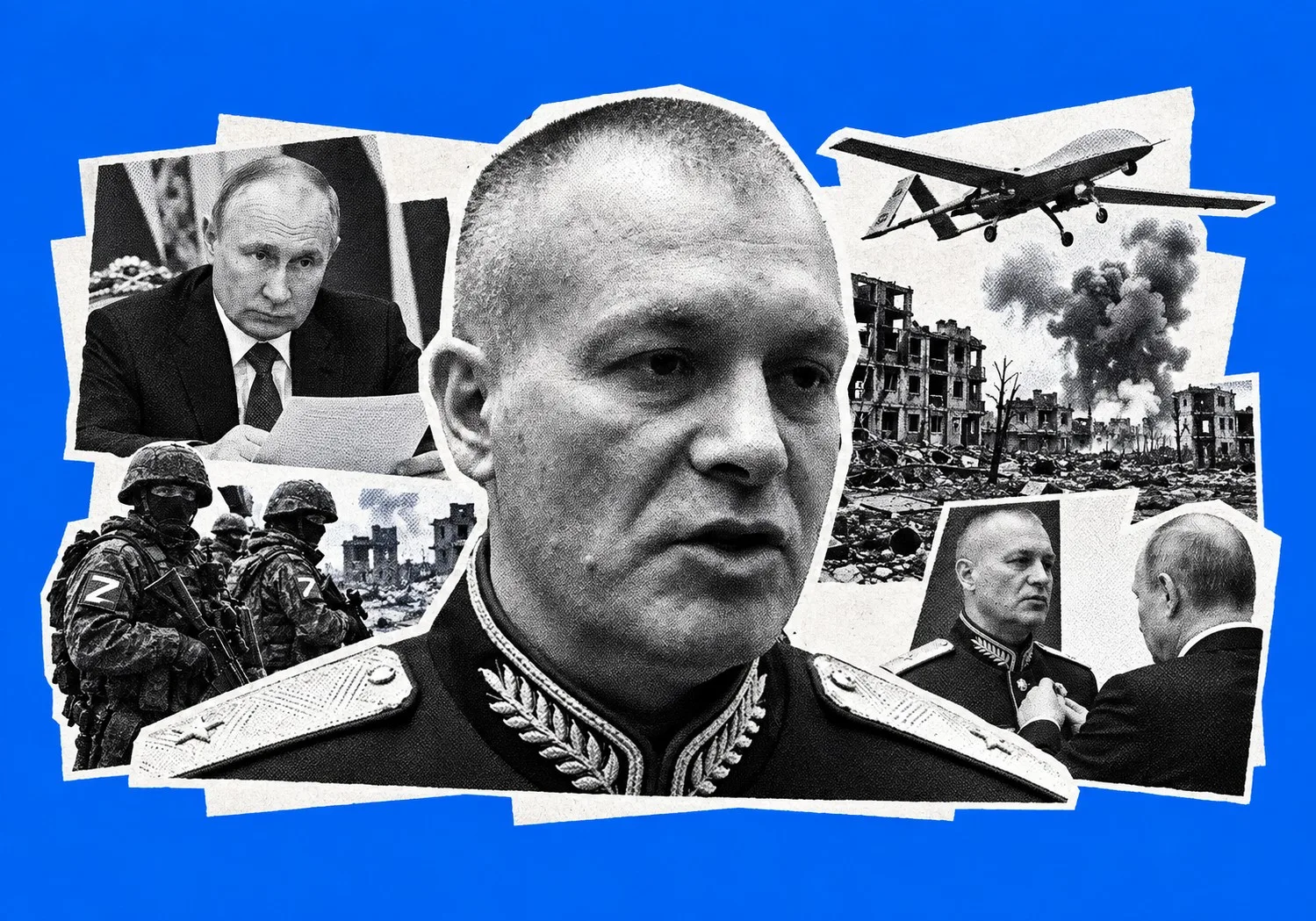
Major General Anton Grunis, commander of Russia’s 4th Motor Rifle Brigade, has been killed in a Ukrainian drone strike in occupied Donetsk. Dubbed "Putin's Ear" for bypassing official channels to report false military victories directly to the Kremlin, Grunis was targeted in Kindratiwka just weeks after receiving Russia's highest military honor.

The origin of Grunis’s fatal trajectory traces to the summer battle for Kostiantynivka. The industrial town functions as the rail-and-road spine protecting the Kramatorsk-Sloviansk urban cluster—the last major Ukrainian stronghold in northern Donetsk Oblast. Russian units had spent months stalled on its outer perimeters, bogged down by heavily fortified industrial zones and a complex network of water reservoirs. Under pressure from Moscow to produce measurable progress before seasonal weather degraded tactical mobility, Grunis skipped his corps-level commanders entirely.
In mid-July, he arranged a direct video call with Vladimir Putin.
Speaking under his callsign "Grosny", Grunis told the Russian president that his 4th Separate Motor Rifle Brigade had completely captured Kostiantynivka. He detailed a swift, aggressive bypass of Ukrainian defensive positions along the local reservoirs, claiming his troops had sliced through line units with minimal friction. Putin accepted the account on state airwaves, praising the Kazan-born general and highlighting his background as proof of multinational cohesion within the ranks. Analysts and intelligence monitors quickly coined the nickname "Putin's Ear" to describe Grunis’s habit of feeding the Kremlin manufactured progress to secure immediate political backing and immunity from military audits.
The claim fell apart within hours. Ukrainian forces held their lines inside the town, operating under firm command-and-control structures despite heavy Russian artillery bombardment. Ukrainian President Volodymyr Zelenskyy openly mocked the assertion, offering Putin a personal tour of Kostiantynivka to inspect the situation himself. Even the Russian Ministry of Defence quietly corrected the record in subsequent combat updates, acknowledging that fighting remained active on the eastern approaches and that no territorial control had been established inside the municipality.
Medal Ceremony Peceded Dron Strike
The public discrepancy did not stop Moscow’s internal award machinery. On 28 August, Defence Minister Andrei Belousov presented Grunis with the Gold Star of the Hero of the Russian Federation inside the Ministry’s headquarters in Moscow.
Fifteen days later, Grunis was dead.
Ukrainian signals intelligence isolated his temporary command post in Kindratiwka, a small village situated behind the immediate front line. Operators from the 427th Separate Battalion "Rarog", working within the Unmanned Systems Forces, launched a coordinated night attack using heavy-payload strike drones. Thermal imaging footage released by Ukrainian commander Robert Brovdi showed multiple direct hits collapsing the facility. Chechen commander Apti Alaudinov confirmed the death on Telegram, omitting the strike location and the weapon used to avoid highlighting frontline vulnerabilities.
From Militia Origins to Flag Tank
Grunis was 47. A graduate of the Suvorov Military School and the Moscow Higher Military Command School, his service record tracked two decades of Russian foreign deployments: Chechnya, Georgia in 2008, Crimea in 2014, and Syria.
He left active duty in 2021 before returning for the 2022 invasion.
His command, the 4th Separate Motor Rifle Brigade, stems from Luhansk proxy militias established in 2014, including remnants of the irregular Prizrak Battalion. Later absorbed into the regular 2nd Army Corps, the brigade saw heavy action at Toshkivka, Hirske, and the siege of Bakhmut before moving toward Chasiv Yar. Grunis took charge during these Donbas operations, receiving his promotion to Major General in May 2024.
Structural Risks in Russian Field Command
At least 15 Russian generals have died in Ukraine since February 2022. The casualty rate exposes a persistent vulnerability in Russian battlefield communication and command structure.
Unlike Western doctrines that delegate tactical decisions to non-commissioned officers and field-grade leadership through Mission Command principles, the Russian military relies on rigid centralization. Field commanders rarely deviate from written orders without senior sign-off due to severe disciplinary sanctions for unapproved tactical retreats. To force stalled offensives forward and enforce compliance, flag officers must physically position themselves close to the forward edge of the battle area.
That physical presence creates high electromagnetic signatures. Ukrainian electronic warfare units routinely trace command hubs through vehicle movements, satellite uplinks, and high-frequency encrypted radio traffic. Once pinpointed, long-range night-strike drones execute the attack cycle before the facility can relocate.
Grunis’s death leaves the 4th Brigade without a commander mid-operation in Donetsk. A replacement will assume control, but the transition creates immediate staff friction and decision-making delays along the Kostiantynivka axis.
Sources: Defence24, The Moscow Times