
Baltic Sea Chemical Weapons: Europe’s 40,000-Tonne Legacy

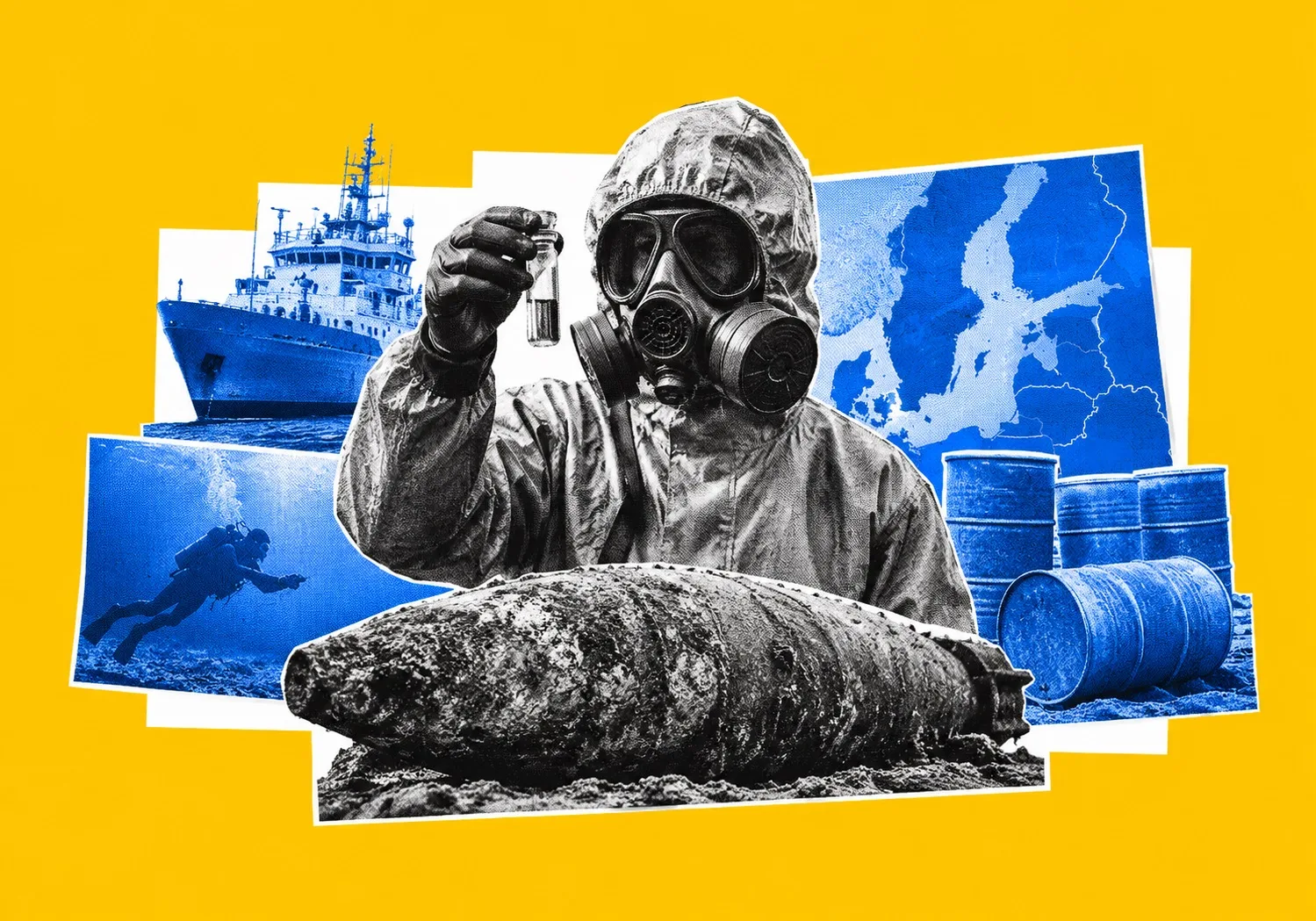
Eight decades after World War II, chemical weapons and unexploded bombs remain scattered across the Baltic seabed. As their metal casings corrode, European governments face an increasingly complicated task: protecting marine ecosystems while building the offshore energy and communications infrastructure on which the continent depends.
In April 2012, two women walking along a beach on Germany’s Baltic island of Usedom reportedly picked up what appeared to be pieces of amber. The objects were not amber. They were fragments of white phosphorus, a highly dangerous incendiary substance left behind by wartime military activity. Both women suffered serious burns and required hospital treatment.
The incident illustrates a problem that has persisted along parts of the Baltic coast for decades. Military materials deposited during World War II and its aftermath have not disappeared. Some remain buried beneath sediment, others lie exposed on the seabed, and certain substances can eventually wash ashore.
Farther offshore, the scale is much greater.
According to the Helsinki Commission, or HELCOM, approximately 40,000 tonnes of chemical munitions were dumped into the Baltic Sea after World War II. They originally contained an estimated 15,000 tonnes of chemical warfare agents, including sulfur mustard and arsenic-based compounds.
Those figures describe the historical quantities deposited, not the amount of active chemical material remaining today. Decades of corrosion, chemical degradation and movement of seabed sediments have altered the condition of the weapons. Their precise locations are not always known.
The challenge is no longer confined to environmental protection. The Baltic is also becoming an increasingly important corridor for offshore wind power, electricity interconnectors, telecommunications cables and other infrastructure. Construction and maintenance activities can bring workers into contact with ammunition that has remained underwater for generations.
European governments are now investing in technologies to locate, recover and dispose of these weapons. Yet the scientific evidence reveals a more complicated picture than the familiar description of a ticking environmental time bomb. Some forms of contamination are already measurable. Others remain poorly understood. And recovering deteriorating munitions can itself introduce environmental and safety risks.
How Europe’s chemical arsenal ended up on the seabed
The dumping operations began as Europe was emerging from the destruction of World War II.
Germany had accumulated large quantities of chemical weapons, including artillery shells, aerial bombs and containers filled with toxic agents. After the country's defeat, the occupying powers faced the enormous task of dismantling its military infrastructure and disposing of weapons that could no longer remain in storage.
Sea disposal offered a relatively straightforward solution. Transport the ammunition to designated locations, take it offshore, and dump it into deep water.
The operation was neither as controlled nor as geographically contained as that description suggests.
According to HELCOM’s historical assessment, chemical munitions were frequently thrown overboard individually rather than transported to a dumping site and deposited together. Ships departing from German ports, including Wolgast and Flensburg, discarded some of their cargo before reaching their intended destinations.
The principal disposal areas included waters east of the Danish island of Bornholm, southeast of Gotland and near the southern entrance to the Little Belt. The Skagerrak, connecting the Baltic region with the North Sea, was another important disposal area.
Depth influenced the choice of location. Some postwar dumping grounds lay more than 70 metres below the surface, where military authorities expected the weapons to remain isolated. But the Little Belt also contained a much shallower disposal site, at approximately 30 metres.
Time, transport capacity and the availability of suitable ships limited how carefully the operations could be conducted. Some ammunition was dumped in wooden containers that could drift away from the original disposal area.
Consequently, the locations marked on nautical charts do not represent the full geographical extent of the problem.
HELCOM has repeatedly acknowledged uncertainties about the quantities, types, and exact positions of the weapons. The historical records provide an overall picture, but they cannot account for every shell or container.

The chemical contents of the arsenal varied considerably.
Sulfur mustard, commonly known as mustard gas, was the most abundant chemical warfare agent. Despite its name, it is not necessarily present as a gas under environmental conditions. It can persist as a liquid or viscous material and cause severe injuries through direct contact.
Other dumped agents included arsenic-containing compounds, such as lewisite and adamsite, as well as different irritants and nerve agents.
Their behaviour in seawater is not uniform. Some degrade relatively rapidly, while others or their breakdown products can persist in sediment. Their toxicity, mobility and environmental effects depend on their chemical properties and the conditions surrounding the dumped ammunition.
The Baltic Sea's physical characteristics add another complication.
It is a relatively shallow, semi-enclosed sea with restricted exchange of water with the North Atlantic. Deep basins can experience limited oxygen availability, while currents and sediment movement vary between regions.
These conditions matter because they influence corrosion, the transport of contaminants and the exposure of organisms living near the seabed.
The original disposal strategy assumed that distance and depth would provide a sufficient barrier between dangerous military materials and human activity. Eight decades later, scientists are still trying to establish how well that assumption has held up.
What scientists have actually found
There is a crucial distinction in the research on underwater ammunition: chemical warfare agents and the explosive compounds contained in conventional weapons are not the same environmental problem.
Both categories are present in the Baltic, but the evidence concerning their movement through the marine environment differs substantially.
HELCOM's assessments have identified contamination of seabed sediments near chemical-munition dumping grounds, including residues associated with arsenic-based warfare agents. Research has also indicated that such contamination can extend beyond designated disposal areas.
However, the commission's 2013 assessment reported that neither the original chemical warfare agents nor their degradation products had been detected in measurable quantities in the water column in the investigations reviewed.
That finding does not establish that the agents are harmless or that no future releases will occur. It does mean that claims of widespread, measurable mustard-agent contamination throughout Baltic waters are not supported by those observations.
The strongest recent quantitative evidence of dissolved contamination comes instead from conventional ammunition.
In February 2025, scientists at the GEOMAR Helmholtz Centre for Ocean Research Kiel published findings from a study of the southwestern Baltic Sea.
The researchers analysed thousands of water samples collected in 2017 and 2018. They detected chemical compounds associated with explosives in almost every sample.
The study, published in Chemosphere under the title Widespread environmental contamination from relic munitions in the southwestern Baltic Sea, estimated that approximately 3,000 kilograms of dissolved toxic munition-related chemicals were present in the investigated region.
The distribution was uneven. The Kiel Bight showed particularly elevated concentrations of TNT-related contamination, while RDX and dinitrobenzene, or DNB, were more prominent in the Lübeck Bight.
These compounds are associated with conventional explosives, not evidence of dissolved sulfur mustard.
The researchers also found that much of the contamination was dissolved in seawater rather than attached to suspended particles. Dissolved substances can move with water masses, potentially extending the affected area beyond the immediate surroundings of a discarded weapon.

GEOMAR reported that the concentrations observed in its water study were generally below relevant drinking-water limits and toxicological thresholds for marine organisms. Some measurements, however, approached levels of concern.
The research also raised a longer-term question. As the metal shells surrounding underwater ammunition continue to deteriorate, additional explosive material may become exposed to seawater.
The resulting contamination could persist or increase for centuries, depending on corrosion rates, chemical degradation and whether ammunition is removed.
That prospect has changed the scientific debate. Researchers are no longer dealing only with the possibility that abandoned ammunition might release harmful substances at some future point. For conventional explosives, they have evidence that releases are already occurring.
The remaining questions concern the rate, geographical distribution and ecological significance of that contamination.
From the seabed to the seafood counter
One of the most sensitive questions surrounding underwater munitions is whether pollutants released into the sea eventually reach food consumed by people.
Marine organisms can absorb contaminants from water, sediment or prey. Mussels are particularly useful for environmental monitoring because they continuously filter surrounding seawater. Bottom-dwelling fish can also provide information about exposure near contaminated sediments.
Researchers have previously detected munition-related compounds in marine organisms. Laboratory studies have shown that certain explosive substances and their degradation products can cause toxic effects.
But detecting a chemical in an organism does not automatically mean that seafood presents a significant risk to consumers.
A study published in Marine Pollution Bulletin in 2026 examined commercially available seafood from the North and Baltic Seas, providing a more direct assessment of potential dietary exposure.
The scientists measured TNT and related compounds, including amino-dinitrotoluene (ADNT), diamino-nitrotoluene (DANT), DNB and RDX.
Their results showed that these substances were present at very low concentrations.

The authors concluded that the concentrations of munition compounds in the seafood they examined posed negligible risk to consumers when compared with established oral reference doses.
For comparison, the study also measured mercury, a better-characterised marine contaminant. Mercury concentrations were higher, although the estimated exposure remained below the European Food Safety Authority's tolerable weekly intake for most seafood consumers.
These findings provide an important counterweight to claims that the Baltic's abandoned arsenal has made its fish broadly unsafe to eat.
The study does not support that conclusion.
It also has limits. The researchers examined commercially available seafood for compounds associated with conventional explosives. Their results do not establish the concentrations of sulfur mustard or other chemical warfare agents in seafood, nor do they resolve every question about long-term ecological exposure near chemical dumping grounds.
A low estimated risk to consumers today is compatible with a continuing environmental problem. Marine organisms may experience exposure that differs from the exposure of people eating seafood, and effects on reproduction, development or local ecosystems require separate assessment.
The scientific task is therefore not simply to determine whether contamination exists. It is to establish where it occurs, how it changes over time and which organisms are most vulnerable.
When the old war interferes with new infrastructure
For decades, the most direct encounters with underwater munitions involved fishermen.
Bottom trawling can disturb ammunition lying on or partly buried beneath the seabed. Nets may bring shells, bombs or chemical containers aboard, exposing crews to explosives or toxic substances.
HELCOM has documented such encounters over many years. Its records show that incidents were particularly frequent during the decades following World War II, although reports continued into the twenty-first century.
A decline in reported encounters does not necessarily mean the weapons have become safer. Fishing activity has changed, some areas are avoided, and reporting practices differ between countries.
The growing use of the seabed has created another category of exposure.
Offshore wind farms require foundations, anchors and electricity connections. Submarine telecommunications cables must be laid along carefully surveyed corridors, sometimes with sections buried beneath the sediment. Ports and shipping channels require dredging, while pipelines and other marine installations involve further seabed disturbance.
Each activity introduces the possibility of encountering an object that was deposited decades earlier and may not appear on existing maps.
The consequences are no longer theoretical.
One example comes from GlobalConnect's major fibre-optic infrastructure project linking northern Sweden with Berlin through the Baltic region.
The project involved a 2,600-kilometre communications connection, including approximately 700 kilometres of subsea cables. Construction required extensive seabed surveys and specialist underwater equipment.
Before the project could be completed, workers had to deal with wartime ammunition.
In a March 2024 announcement, GlobalConnect confirmed that 200 World War II bombs had been cleared during construction.
Its subsequent corporate reporting described the scale of the undertaking: the cable network connected northern Europe through Bornholm and other Baltic locations, while extensive underwater work was needed to prepare the route.
Industry reporting also described delays associated with the discovery of potential munitions. The available evidence supports the fact that clearance became a significant construction requirement, although it does not establish that the final cable route was changed because of the weapons.
The example demonstrates how a conflict that ended more than 80 years ago can still influence the delivery of modern communications infrastructure.
Another, more expensive case occurred in the North Sea.
The Riffgat offshore wind farm, developed off the German coast, faced difficulties connecting to the electricity grid in 2013 after unexploded wartime ammunition complicated work on its export cable.
The wind turbines were ready before the cable connection could be completed. The discovery of underwater explosives contributed to delays and additional clearance costs, leaving a newly built renewable-energy installation unable to deliver electricity as originally scheduled.
Contemporary reporting in Der Spiegel documented the disruption.
Riffgat is not a Baltic Sea project, and its problems concerned conventional unexploded ammunition rather than a demonstrated encounter with dumped chemical weapons. Nevertheless, it illustrates the financial exposure that can arise when offshore infrastructure intersects with historical military material.
For developers, ammunition surveys are becoming an important part of project planning. Identifying suspicious objects can require specialised vessels, divers, remotely operated vehicles and explosive-ordnance disposal teams.
A single discovery may force construction to stop while experts determine whether an object can be avoided, moved or safely destroyed.
The expense depends on the type of ammunition, water depth, seabed conditions and proximity to sensitive infrastructure.
These cases do not establish that wartime munitions are preventing Europe's offshore energy transition. They show something narrower but economically significant: unexploded weapons can impose additional costs, create delays and complicate the construction of individual projects.
And as the number of offshore installations increases, so does the importance of reliable seabed mapping.
Germany’s €100 million experiment
Germany has become one of the principal testing grounds for large-scale underwater ammunition clearance.
The country faces an unusually substantial problem because of the quantity of wartime material lying in its marine waters.
According to the German Federal Environment Ministry, approximately 1.6 million tonnes of unexploded munitions remain in German waters of the North and Baltic Seas.
Of that estimated total, around 1.3 million tonnes are in the North Sea and 300,000 tonnes in the Baltic.
These figures largely concern conventional ammunition, including bombs, mines, grenades and other explosives. They are separate from HELCOM's estimate of chemical munitions dumped across the wider Baltic region.
Germany launched a federal immediate-action programme with €100 million in funding to develop methods for systematically recovering and disposing of submerged ammunition.
The first pilot phase began in 2024 and concluded in autumn 2025.
Work took place at selected locations in the western Baltic, including Haffkrug and Pelzerhaken in the Bay of Lübeck and Boltenhagen in the Bay of Mecklenburg.
These sites were chosen partly because different types of ammunition could be found within relatively limited areas, allowing specialists to compare recovery methods under practical conditions.
The project tested technologies for locating, identifying, recovering and temporarily securing underwater weapons.
Approximately 18 tonnes of ammunition were reported recovered during the pilot phase, with a smaller quantity brought ashore for examination. That figure should be understood as the result of a limited technical demonstration, not as a measure of progress towards removing the Baltic's chemical weapons stockpile.
The federal environment ministry described the technologies tested as highly suitable, while acknowledging that further refinement was necessary.
The challenge is not simply finding a way to lift a bomb from the seabed.
A practical clearance system must work through several stages. First, survey equipment must identify objects that may be ammunition. Specialists then need to classify them and assess their condition. Recovery equipment must handle potentially unstable material, and the ammunition must ultimately be disposed of without creating unacceptable risks for workers or the marine environment.
Germany's next objective is a mobile floating industrial facility capable of treating conventional ammunition at sea.
Such a platform could reduce the need to transport dangerous objects over long distances to land-based disposal facilities. But adapting established destruction methods to a marine environment requires additional engineering, safety testing and environmental safeguards.
The ministry has described systematic removal as a task spanning generations.
That assessment reflects the difference between demonstrating a technology and deploying it across vast areas of seabed containing hundreds of thousands of tonnes of material.
Can underwater robots make clearance safer?
Researchers are working to reduce the amount of direct human contact required during ammunition surveys and recovery.
Autonomous underwater vehicles can map large areas of seabed using acoustic sensors. Remotely operated vehicles provide close-up images and allow operators to examine suspicious objects without sending divers into hazardous locations.
Chemical sampling adds another layer of information, helping scientists determine whether ammunition is already releasing contaminants.
In October 2025, the research vessel ALKOR departed Kiel for a GEOMAR expedition investigating underwater munitions in the southern Baltic.
The mission covered areas near Poland and the Bornholm Basin, the Bay of Lübeck and the Little Belt.
Its objectives included mapping chemical munitions, testing underwater technologies and evaluating environmental conditions following experimental recovery operations.
The research team used autonomous and remotely operated underwater vehicles capable of collecting high-resolution imagery, acoustic data and water samples.
Onboard analytical equipment allowed scientists to examine samples for explosive residues, including TNT and RDX.
A longer-term objective is to develop underwater vehicles that can identify and classify objects more independently, adjusting their survey patterns as new information becomes available.

One important part of the expedition focused on the Bornholm Basin, where chemical weapons were dumped after the war.
Researchers wanted to improve their understanding of how much ammunition remained, what condition it was in and how strongly the surrounding environment had been affected.
Another part of the mission examined sites where Germany had recently conducted pilot recovery operations.
That monitoring addresses a question central to future clearance programmes: what happens to contamination levels after ammunition is removed?
Recovery could eliminate a continuing source of pollutants. But disturbing a corroded container or moving contaminated sediment might also release substances during the operation.
The balance between those risks cannot be determined from the presence of ammunition alone. It requires site-specific information about the condition of the weapons, the surrounding environment and the recovery method.
For chemical weapons, the difficulty is particularly pronounced.
An explosive shell may be dangerous because of its detonation potential. A container holding sulfur mustard or another toxic agent presents an additional hazard if its contents escape during handling.
The same equipment and disposal procedures will not necessarily be appropriate for both.
This is one reason why the development of systems for conventional ammunition does not automatically solve the problem of chemical munitions.
The question Europe cannot avoid
The Baltic's wartime ammunition problem has no simple solution.
Leaving weapons underwater allows corrosion to continue and preserves the possibility of future encounters. Removing them requires expensive operations that can themselves disturb hazardous materials and sensitive habitats.
Some locations may justify priority clearance because ammunition lies close to infrastructure, fishing grounds or areas of substantial human activity. Other sites may require continued monitoring until safer methods become available.
The available science also argues against treating every underwater weapon as an identical environmental threat.
A deteriorating container of sulfur mustard in a deep basin, an unexploded conventional bomb beside a planned cable route and a fragment of white phosphorus washed onto a beach create different hazards.
Their management requires different evidence, technologies and safety procedures.
The 2024 HELCOM assessment of hazardous submerged objects reflects the breadth of the problem. The Baltic contains not only chemical munitions but also naval mines, torpedoes, rockets, bombs and other military material left by both world wars.
Understanding where these objects lie is essential for maritime planning. Yet historical disposal records remain incomplete, and large sections of the seabed have not been examined with the level of detail required for comprehensive clearance.
There is also a financial question.
Germany has committed substantial resources to developing a systematic approach, but the initial €100 million programme is only a starting point. Its pilot operations demonstrated recovery methods on a limited scale. Industrial deployment will require equipment, specialised personnel, disposal capacity and continuing environmental monitoring.
The costs will not necessarily be shared equally across the Baltic region. Different countries have different concentrations of underwater ammunition, different infrastructure plans and different capacities to finance surveys and recovery.
Coordination matters because neither contamination nor marine infrastructure follows a simple national boundary.
The same waters support shipping, fishing, energy production, telecommunications and ecosystems shared by several countries.
There is a historical irony in the present situation. The postwar disposal operations were intended to eliminate an immediate military problem. Sea dumping was treated as a practical means of removing dangerous stockpiles from land.
Today, Europe is developing sophisticated underwater robots and industrial recovery systems to reverse parts of that decision.
The scale of the task remains striking.
An estimated 40,000 tonnes of chemical munitions were deposited in the Baltic after World War II. Their exact condition and distribution remain incompletely documented. Meanwhile, hundreds of thousands of tonnes of conventional ammunition are believed to remain in German Baltic waters alone.
Modern scientific studies have established that compounds from conventional explosives are entering seawater and marine organisms. They have also shown that current measured levels in commercially available seafood do not support claims of a major consumer health emergency.
For chemical warfare agents, the evidence points to contaminated sediments, persistent contact hazards and significant gaps in knowledge about long-term ecological effects.
The distinction matters because effective policy depends on understanding what has actually been measured, rather than assuming that every possible hazard has already become a widespread disaster.
Europe now faces a series of practical decisions: which sites to survey first, which weapons to remove, which to monitor and how to prevent recovery operations from causing additional damage.
The abandoned arsenal will not disappear simply because the war that produced it has passed out of living memory.
And as new cables, wind farms and other infrastructure spread across the Baltic seabed, decisions made during the disarmament of Germany more than eight decades ago will continue to influence what Europe can safely build beneath its waters.
Sources:
1\. HELCOM, 2013 – Chemical Munitions Dumped in the Baltic Sea: Report of the Ad Hoc Expert Group (MUNI). Comprehensive assessment of approximately 40,000 tonnes of chemical munitions dumped in the Baltic Sea, their locations, chemical agents, environmental risks and documented encounters with fishermen.
2\. HELCOM, May 2024 – Thematic Assessment on Hazardous Submerged Objects in the Baltic Sea. Assessment of submerged chemical and conventional munitions, including seabed contamination, white phosphorus hazards, risks to marine ecosystems and challenges for offshore infrastructure.
3\. GEOMAR Helmholtz Centre for Ocean Research Kiel, 2025 – Environmental Contamination from Legacy Munitions in the Baltic Sea. Research findings based on water samples collected in 2017–2018, documenting widespread contamination by explosive compounds, including TNT and RDX, and an estimated 3,000 kilograms of dissolved munition-related chemicals in the southwestern Baltic Sea.
4\. GEOMAR Helmholtz Centre for Ocean Research Kiel, 14 October 2025 – Chemical Munitions and Clearance Effects in Focus. Details of the ALKOR research expedition investigating chemical munitions near Bornholm, underwater robotic technologies and the environmental effects of pilot recovery operations in German and Danish waters.
5\. Marine Pollution Bulletin, 2026 – Scientific study of munition-related contaminants in commercially available seafood from the North and Baltic Seas. Peer-reviewed research measuring TNT, ADNT, DANT, DNB and RDX in seafood and assessing potential dietary exposure. The study found very low concentrations and negligible consumer health risks relative to reference doses.
6\. German Federal Ministry for the Environment (BMUKN) – Unexploded Munitions in the Sea. Official information on approximately 1.6 million tonnes of unexploded ammunition in German waters, the €100 million federal programme, pilot recovery operations and plans for industrial-scale offshore disposal.
7\. GEOMAR Helmholtz Centre for Ocean Research Kiel – CAMMera: Research and Technology Development for Munitions Recovery. Information on scientific monitoring, underwater ammunition recovery, environmental risk assessment and technologies supporting Germany's long-term clearance programme.
8\. GlobalConnect, March 2024 – GlobalConnect Completes Largest Nordic Digital Infrastructure Project in a Decade. Corporate announcement documenting the completion of a major Nordic fibre-optic network and the clearance of 200 World War II bombs during construction.
9\. Danish Offshore Industry (DOI) – Old Bombs Delay Cables and Wind Turbines in the Baltic Sea. Industry reporting on unexploded wartime ammunition affecting offshore construction, including delays and clearance requirements associated with the Aurora cable project.
10\. Der Spiegel, 2013 – German Wind Farm Delayed by WWII Munitions Discovery. Reporting on the Riffgat offshore wind farm in the North Sea, where unexploded wartime ammunition complicated installation of the grid connection and contributed to costly delays.
11\. Deutsche Welle, 2026 – Germany’s Sea Munitions: Toxic Pollution. Reporting on Germany's underwater ammunition problem, scientific evidence of TNT-related contamination, historical trends in marine organisms, and the challenges of removing deteriorating weapons.
12\. European Parliament, 2021 – Chemical Residues in the Baltic Sea, Based on the Petitions 1328/2019 and 0406/2020. Parliamentary resolution addressing submerged chemical weapons, environmental risks, international cooperation and the need for coordinated identification and management of underwater munitions.