
Estonia Builds 150 Bunkers on Russian Border: How the Baltic Defence Belt Is Redefining NATO’s Flank

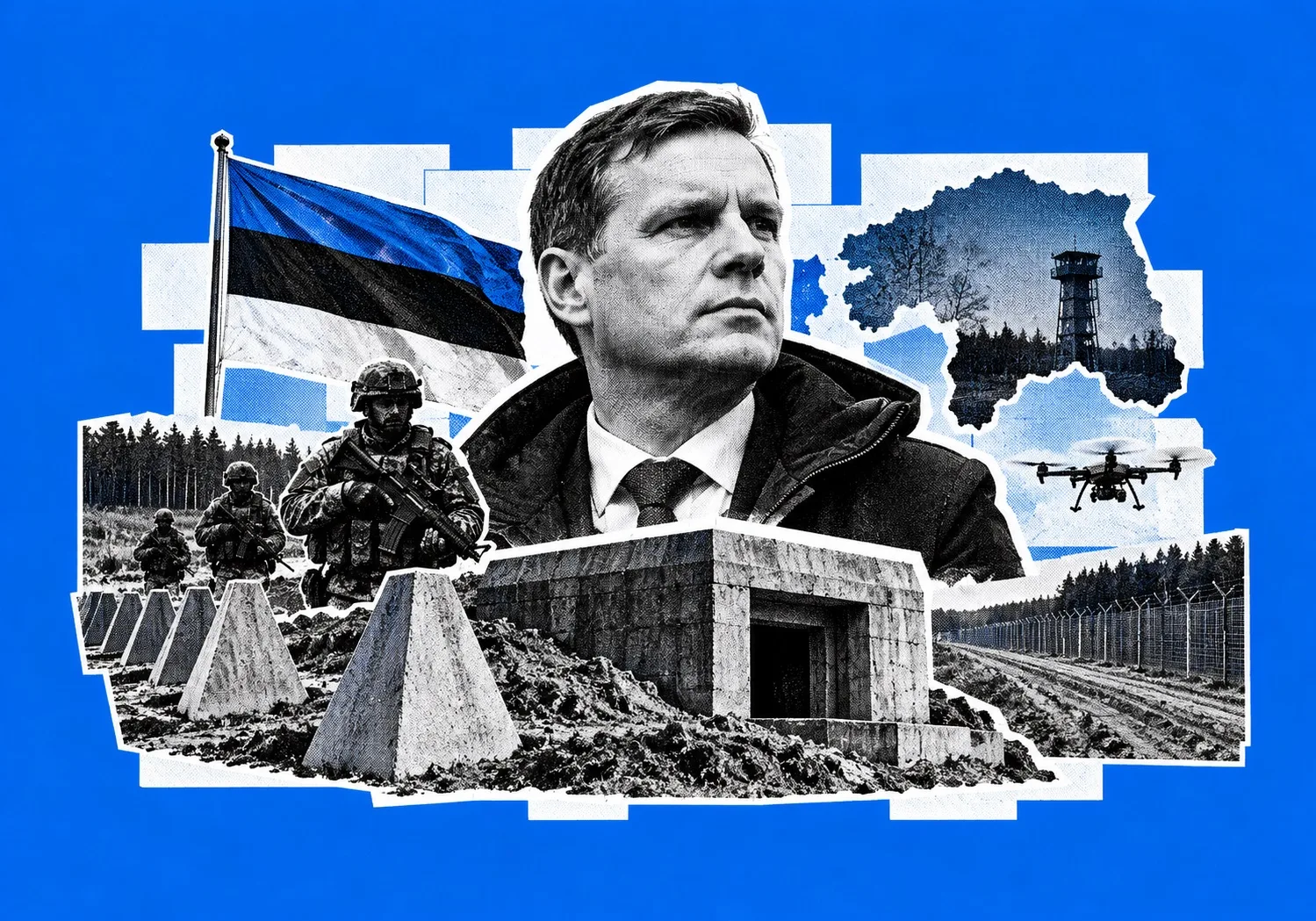
Estonia is set to begin constructing 150 concrete military bunkers along its northeastern border with Russia, marking a key phase in the ambitious Baltic Defence Belt project. Announced by Defence Minister Martin Härem, the initiative aims to transform NATO’s eastern frontier into a heavily fortified line, balancing urgent national security needs against local land ownership challenges.
This coordinated initiative involves Estonia, Latvia, and Lithuania. Its primary purpose is to make any potential military advance across NATO’s eastern frontier slower, more costly, and easier to detect.
The significance lies less in the number of concrete structures than in the change of military thinking behind them. Baltic defence planning is increasingly concerned with what can be done to the terrain before a crisis begins, rather than relying exclusively on reinforcements arriving after one has started.
Concrete as a Military Strategy
Estonia intends to construct as many as 600 bunkers along its eastern border by the end of 2027. The 150 planned for Ida-Virumaa represent an important stage in that programme, bringing the wider strategy closer to physical implementation.
These are not simply shelters intended to protect troops from bad weather or incidental shellfire.
The planned platoon-level structures will cover approximately 35 square metres, accommodate ten personnel and be designed to withstand artillery fire of up to 152mm calibre. Their military value depends on how they are positioned and supported.

A bunker can protect soldiers, but it cannot independently prevent an armoured formation from advancing. That requires obstacles capable of disrupting movement, surveillance systems to identify approaching forces, and mobile units able to exploit the resulting delays.
Estonia's approach combines concrete fortifications with anti-tank ditches, dragon's teeth and pre-positioned military supplies. Reconnaissance assets and sensor networks are intended to provide information about movements across the border, while troops retain the ability to reposition rather than remain confined to fixed defensive positions.
This is the distinction between constructing a fortified line and creating a functioning area-denial system.
A static obstacle becomes considerably more useful when opposing forces cannot easily bypass it without exposing themselves to observation or defensive fire. Equally, mobile troops become more effective when the surrounding terrain has already been prepared to restrict an adversary's choices.
The Baltic Defence Belt is designed around that relationship.
It does not eliminate the requirement for NATO reinforcements. Instead, it seeks to change the conditions under which those reinforcements might be needed, giving defending forces additional time and limiting the advantages of rapid mechanised movement.
Three Baltic States, Different Defensive Methods
The wider programme extends across approximately 950 kilometres of border with Russia and Belarus. Although Estonia, Latvia and Lithuania share the same strategic objective, their national approaches differ considerably.
Estonia has placed particular emphasis on permanent concrete positions supported by engineering obstacles and logistical storage sites.
Latvia has pursued a broader combination of border infrastructure and military fortification. It began its fortification work in May 2024, completed a 280-kilometre border fence by late 2025 and has a €303mn programme announced in March 2024.
Lithuania, meanwhile, has concentrated heavily on the capacity to deploy obstacles quickly.
Its network of 27 engineering equipment parks stores materials including Czech hedgehogs and concertina wire. The number of parks is expected to increase to 50 by 2028 under a €1.1bn programme spanning ten years.
These differences are operationally significant.
Permanent bunkers provide prepared fighting positions but require careful decisions about location, construction and future maintenance. Equipment parks offer greater flexibility, allowing military engineers to move obstacles according to changing requirements, although deployment itself takes time.
Neither method is sufficient in isolation.
Estonia's fixed positions could be undermined if surrounding routes remained accessible. Lithuania's stored obstacles would offer limited immediate protection without the personnel and logistical capacity to position them when required.
The regional strategy therefore depends on combining permanent infrastructure with rapidly deployable barriers and military mobility.
Poland's parallel East Shield initiative belongs to the same broader movement towards strengthening the region's defensive geography. The briefing does not establish specific operational coordination arrangements between East Shield and the Baltic Defence Belt, but their shared emphasis on prepared terrain points to a wider change in how Europe's eastern border is being secured.
The Procurement Problem Behind the Fortifications
For Estonia, the immediate challenge is not primarily conceptual. It is administrative and logistical.
The Estonian Centre for Defence Investment, known as RKIK, is responsible for procuring the bunker infrastructure and aims to award contracts by March 2027.

That timetable follows the Estonian Supreme Court's dismissal of an appeal by Swedish company Nordic Shield Group AB concerning tender conditions.
The decision removes a legal obstacle to procurement, but it does not resolve the practical difficulties of delivering a large construction programme across a sensitive border region.
Contractors will need to produce structures meeting military specifications, while authorities must identify suitable sites and secure access to the necessary land.
Of the 150 bunkers planned for Ida-Virumaa, approximately 100 will stand on state-owned property. The remaining 50 will require arrangements involving municipal or privately owned plots.
Härem has ruled out plans for large-scale state purchases of border land at this stage.
Instead, authorities intend to negotiate with individual property owners, using compensation for inconvenience, leases or direct purchases where appropriate.
That approach avoids treating the entire frontier as land to be acquired by the state. It also introduces a degree of uncertainty into the construction schedule.
Negotiations over individual sites can involve different financial expectations, competing land uses and concerns about future restrictions. A location considered militarily advantageous may not be straightforward to obtain.
For RKIK, completing procurement and securing land access are separate requirements that must converge within a relatively narrow timeframe.
The March 2027 contracting target leaves the remainder of that year for substantial progress towards Estonia's wider 600-bunker objective.
The briefing provides no confirmed construction costs for the Ida-Virumaa phase or detailed delivery schedule for individual sites. Nor does it establish whether all 600 bunkers will be completed on time.
Those uncertainties matter because the effectiveness of a defensive network depends on continuity. Isolated completed positions may offer local protection without delivering the intended regional system.
The Border Communities Caught in the Middle
Ida-Virumaa's role in the programme also raises questions that extend beyond military planning.
For residents and municipal authorities, the construction of permanent fortifications may affect how land can be used and developed. Areas previously assessed primarily for residential, agricultural or commercial purposes could acquire additional strategic importance.
The consequences will vary depending on the location of individual installations and the agreements negotiated with landowners.
Some owners may accept compensation or leasing arrangements. Others could be reluctant to surrender control over property or accept restrictions associated with military infrastructure.
There is insufficient information in the briefing to establish how residents or local authorities currently view the proposals. No documented local consultation outcomes or public opinion findings are provided.
Nevertheless, the political tension is evident.
The state wants to establish a defensive network whose effectiveness depends on military geography. Property owners have their own interests, which do not necessarily correspond to the locations preferred by defence planners.
The government's decision to negotiate rather than pursue extensive compulsory acquisitions appears intended to manage that tension, although individual agreements may still prove difficult.
Longer-term economic considerations are equally relevant. Permanent military infrastructure can introduce restrictions on land use and influence private investment decisions in border-adjacent areas.
The extent of those effects remains uncertain, but they form part of the cost of converting civilian territory into a prepared defensive environment.
A Defensive System That Extends Beyond the Battlefield
Estonia's fortification programme is accompanied by another change in national defence policy.
Härem also announced the approval of a four-year youth policy that will introduce drone-flying lessons and expand national defence topics in basic schools across the country.
The educational initiative is separate from the bunker procurement programme, but both belong to a broader effort to adapt national preparedness to contemporary security requirements.
Drones and distributed reconnaissance have become important elements of the defensive model underpinning the Baltic Defence Belt. Physical obstacles can delay movement, while surveillance technologies help defending forces understand where and when those obstacles are being approached.
Seismic sensors and other monitoring technologies could contribute to such networks, although the briefing does not specify confirmed deployment arrangements for these systems at the Ida-Virumaa sites.
The operational challenge is to connect information gathering, protected positions, mobile forces and pre-positioned supplies into a coherent defensive structure.
Concrete alone cannot achieve that.
Estonia's concept of active defence depends on retaining the freedom to move forces while using prepared terrain to restrict an adversary's mobility. That creates a more complicated military system than a conventional border barrier, with greater demands on communications, logistics and coordination.
It also changes the meaning of readiness.
A country pursuing this approach cannot wait until a military emergency to identify suitable terrain, negotiate access to land or establish construction contracts. Those decisions must be made years in advance, with the resulting infrastructure remaining in place during peacetime.
For Estonia, the strategic question is therefore becoming inseparable from a domestic one: how much of the country's border territory should be permanently organised around the possibility of war, and how much flexibility can be preserved for the people who live and work there?
Sources: Euobserver, Estonia, EC DI, Pulaski, MASOC, Baltic Monitor, Tarcza Wschod