
The Russian Business Behind a Viral AI Meme

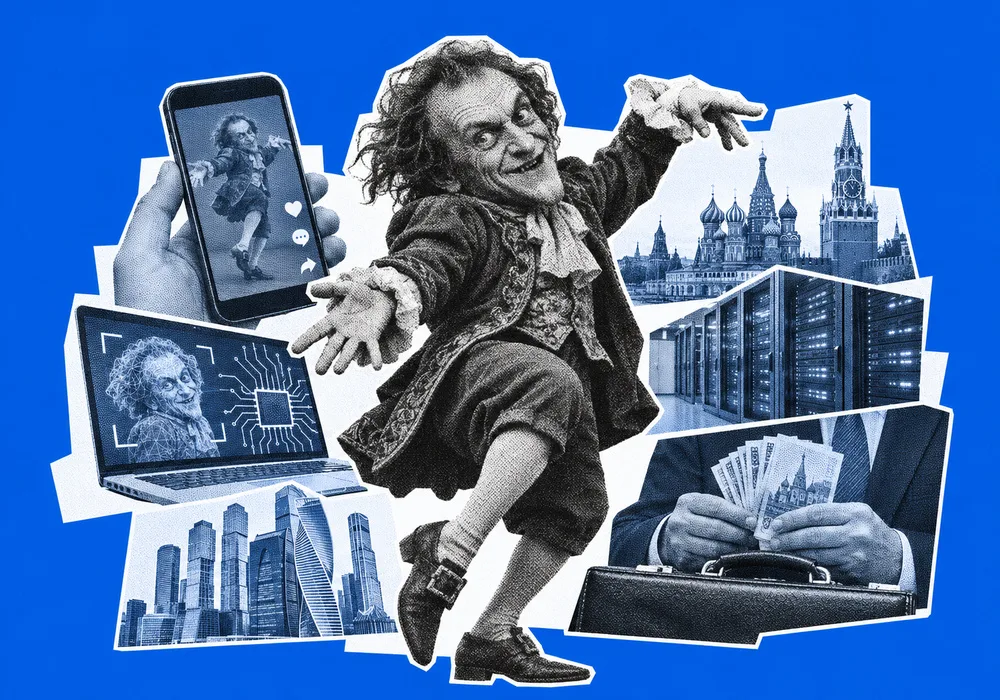
A viral video featuring the fairy-tale character Rumpelstiltskin reached millions of viewers worldwide, but its origins lead to NeuroFerma, an AI-content business linked to a company registered in Russia. The case illustrates how Russian commercial digital content can enter international online culture without audiences knowing who created it or where the business operates.
A strange little man with long, curly hair, dressed in an old-fashioned costume, approaches a frightened young woman before breaking into an unusual dance. He then turns straw into gold and eventually transforms into a prince after receiving a kiss. The character is Rumpelstiltskin, drawn from the Brothers Grimm fairy tale, and his bizarre movements became one of the most widely circulated internet memes of October 2026. The video was deliberately styled to resemble a fantasy film from the 1980s, convincing some viewers that they were watching a scene from an old movie and prompting searches for a supposed 1987 film adaptation.
In reality, the sequence was entirely generated using artificial intelligence. The original video was published on Instagram on 27 August 2026 through a collaboration between the accounts Stroinaya, NeuroFerma and Anna Glinskaya. Its principal creator was Tatyana Tereshchenko, who describes herself as an AI artist and director. The production was initially presented as a demonstration of generative AI capabilities, showing how a cinematic sequence could be created without actors, a film crew or physical sets.

The transformation into a global meme happened later, when other social media users began adapting the footage. On 29 September, a TikTok user operating under the name @6aimbot9 posted an edited version, adding American rapper Riff Raff's track Tip Toe Wing In My Jawwdinz and a humorous caption about the strange dreams associated with taking melatonin. The combination of unsettling animation and music quickly attracted attention, generating more than 850,000 views within a week. On 1 October, another version was shared by the X account @itsjusttimbro, accumulating approximately 9.8 million views over the following five days.
The meme subsequently spread across platforms, with users replacing Rumpelstiltskin with television characters, celebrities and online personalities. NBC News reported on the phenomenon on 7 October, highlighting how many viewers had initially failed to recognise that the footage was AI-generated. Yet its viral success also brought attention to a less visible aspect of the story: the commercial origins of the original production.
NeuroFerma and the business of generative AI
The original Instagram publication identifies NeuroFerma as one of the project's creators. The initiative is associated with Tatyana Tereshchenko and Anna Glinskaya and operates in the generative AI sector, producing advertising videos, animations, virtual characters, music videos, digital models and short AI-generated films. Its activities extend beyond creative production, as the NeuroFerma website also offers educational courses teaching customers how to use generative AI tools to produce commercial content.
The programmes cover multiple AI platforms and are marketed as a way to develop professional skills and generate income from digital production. In October 2026, advertised course prices ranged from 14,450 to 24,490 Russian roubles, depending on the format. The project's promotional materials claim that it has trained more than 1,000 students, worked with artificial intelligence for over two years and collaborated with more than 40 major clients. These figures are claims made by the business itself and have not been independently verified.
The Rumpelstiltskin video therefore has potential commercial value beyond its popularity as entertainment. A production that reaches millions of viewers can serve as an international portfolio piece, demonstrating the studio's capabilities to prospective customers and helping it attract new clients. Its visibility can also strengthen the project's reputation and support the marketing of its educational products. This is a familiar business model within the digital creative economy, where viral content generates attention that can subsequently be converted into commercial opportunities.
Russian registration and the project's ownership links
The most significant finding concerns the legal registration of the business associated with NeuroFerma. Its website lists the details of Anna Yuryevna Glinskaya as an individual entrepreneur, while information from Russian business registries indicates that her business was registered on 27 February 2026 in the Orenburg region of the Russian Federation. The registration identifies online retail as the principal business activity, alongside educational and other services. The company's legal details are also provided on the NeuroFerma website, establishing a documented connection between the project and a business registered in Russia.
The website additionally contains a disclaimer referring to the prohibition of Meta in Russia, another indication of the legal environment in which the business operates. However, the registration does not establish that both creators reside in Russia, nor does it independently establish Tatyana Tereshchenko's citizenship or place of residence. The available evidence confirms the Russian registration of Glinskaya's business, but it should not be used to make unsupported assumptions about the personal circumstances of everyone involved in the project.
There is also an important distinction between the original production and the meme that made it internationally famous. The initial animation was created by the NeuroFerma-associated team, while the musical edit that helped propel it across social media was produced by a separate TikTok user. The subsequent spread involved numerous accounts and independent adaptations, meaning that the original creators should not automatically be attributed responsibility for every version or use of the footage.
Commercial links do not establish propaganda activity
The Russian registration raises legitimate questions about the project's wider business relationships, particularly given Russia's full-scale war against Ukraine and the growing role of AI-generated material in international information environments. However, the available investigation does not establish that NeuroFerma works for Russian state institutions, the Ministry of Defence, the military or state-controlled propaganda media. No documented evidence of such cooperation or confirmed government contracts involving Glinskaya's registered business has been identified in the available material.
This does not provide a complete picture of the project's commercial relationships. Public business registries do not necessarily disclose private clients, subcontracting arrangements or agreements concluded through individuals rather than registered companies. NeuroFerma's claim to have worked with more than 40 major clients also remains difficult to assess because the project does not publish a complete list. The available information likewise does not provide sufficient grounds to establish the creators' political positions regarding Russia's invasion of Ukraine.
Consequently, describing NeuroFerma or its creators as Russian propagandists would go beyond what the evidence supports. Equally, the absence of documented state cooperation does not eliminate the relevance of the project's Russian commercial registration. Russian-linked digital businesses do not necessarily produce political messaging; they can operate in advertising, entertainment, education and creative services while targeting international markets without using overt political themes.
The less visible side of Russia's digital presence
The Rumpelstiltskin meme demonstrates how easily digital content can become detached from its original creators as it moves across platforms and audiences. Most people encountering the video saw an amusing animation, an unusual dance and a recognisable soundtrack, with very few having any reason to investigate the Instagram accounts behind the original publication or the business associated with its production. This is increasingly characteristic of the global digital environment, where AI tools have lowered the cost of producing sophisticated audiovisual material and enabled small teams to create content that previously required substantial production resources.
Once published, such material can be repackaged, edited and distributed by thousands of other users, often without any reference to its original source. The process makes the commercial origins of viral content difficult to trace: a video can become internationally recognisable while the identity, location and business interests of its creators remain largely invisible to the audience. The same dynamic allows commercial projects operating in Russia to reach international audiences without their country of registration becoming part of the conversation surrounding their content.
For Ukraine, this is relevant because discussions about Russian information influence often focus on identifiable political messaging, disinformation campaigns, state media and openly pro-Kremlin influencers. Yet Russia's digital economy also includes commercial content producers seeking international visibility and customers. Their activities should be assessed on the basis of verifiable ownership, business relationships and documented conduct rather than assumptions about political intent. There is no evidence that sharing the Rumpelstiltskin meme automatically generates revenue for NeuroFerma, since views accumulated by unrelated reposts do not necessarily translate into payments to the original creators. Nevertheless, international recognition can provide a commercial advantage by increasing a studio's visibility and demonstrating its production capabilities.
The episode also highlights the difficulty of distinguishing between the origin of a piece of content and the intentions of those who subsequently distribute it. The people who turned the animation into a meme were not necessarily aware of its creators' business connections, and its popularity was driven primarily by humour and the mechanics of social media rather than any demonstrated political campaign. The Rumpelstiltskin story is therefore not evidence of a coordinated Russian influence operation. Its significance lies in showing how a creative product associated with a Russia-registered commercial business can enter global internet culture without most viewers knowing anything about its origins.
Sources: Detector Media, Know Your Meme