
Behind the FSB’s Staged Arrest Reels: How Russia Turned Security Videos into Propaganda

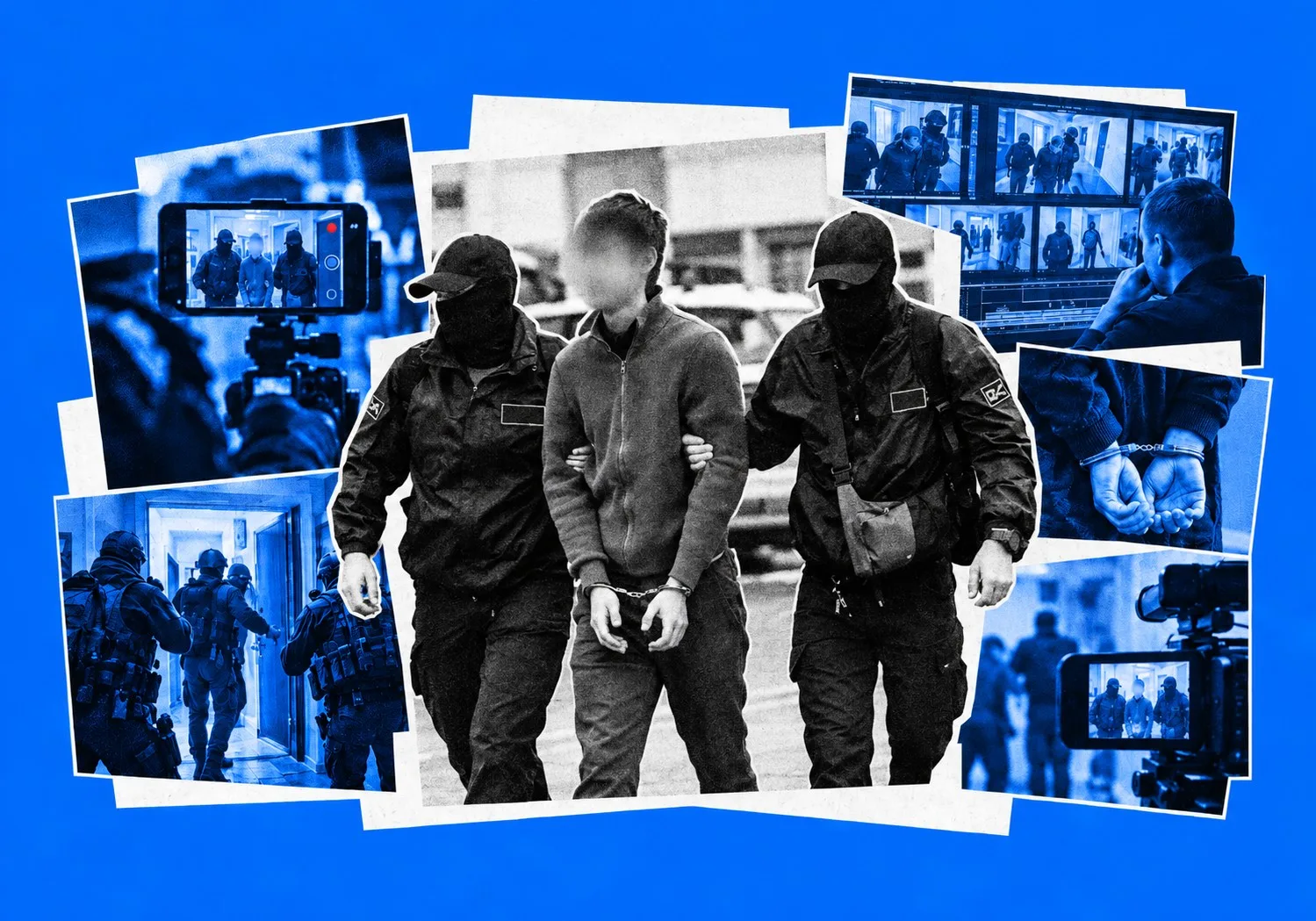
An analytical review by the human rights organization Memorial, based on an in-depth examination of seventy politically motivated criminal cases, provides a comprehensive investigation into the systematic production and distribution of staged video footage by the Russian Federal Security Service (FSB). Analyzing these seventy prosecutions documented alongside independent newsroom Meduza, researchers concluded that Russia's primary security agency routinely relies on multi-take filming, scripted confessions, and engineered operational footage across political prosecutions in the Russian Federation.
The Wartime Media Surge
Following Russia's full-scale invasion of Ukraine in 2022, the domestic intelligence agency expanded its presence across official public communication channels.
State messaging required a steady flow of public reports demonstrating law enforcement operations against domestic targets and political suspects. Rather than remaining behind closed doors, security agencies moved directly into active digital distribution.
Data tracked by Memorial across Telegram feeds operated by state news agencies TASS and RIA Novosti shows official mentions of the FSB increasing two- to threefold compared to pre-2022 baselines.

Video content expanded faster still. Agency dispatches regarding the security service now feature video footage roughly twice as often as standard coverage of economic or regional affairs.
Human rights researchers trace this shift directly to wartime communication priorities. Within the operational framework of the Russian domestic regime, the public visibility of the security apparatus expanded alongside the absolute number of political prosecutions.
Prior to 2022, video releases from the security services covered a noticeably broader operational spectrum.
Regional media clips regularly depicted migrant inspections, enforcement actions against illegal crab fishing or timber smuggling, interventions in reported school threats, raids on illegal casinos, and corruption proceedings against local officials.
Post-2022 priorities sharply narrowed this focus.
Official channels shifted almost exclusively toward cases involving state treason, anti-war statements, espionage, and alleged connections to Ukrainian state institutions or banned political organizations.
General law enforcement reporting yielded to specialized state-security messaging.
Five Components of Security Releases
Memorial’s examination of seventy post-invasion cases identifies a repeating five-part production template across video materials released by the FSB. The published clips move predictably through operational surveillance footage, tactical arrest scenes, physical searches, detainee transport, and recorded confessions.
Technical analysis of these releases highlights persistent structural gaps between recorded footage and operational reality.
Authentic operational surveillance capturing a suspect in the act appeared in just six of the seventy analyzed cases. In every one of those six instances, court records indicate that the events relied on FSB-initiated operational provocations.
Given the technical difficulty of capturing spontaneous surveillance footage, security personnel routinely generate the required conditions in advance. Undercover operatives, paid informants, and online actors operate within Telegram groups and digital networks to engage targeted individuals, ensuring operatives and recording personnel arrive prior to the filmed action.
Arrest sequences show clear signs of intentional staging and visual exaggeration.
Roughly one-fourth of the reviewed cases featured explicitly re-enacted or scripted arrest scenes. Suspects were recorded being forced onto pavement, placed in physical restraints, and held down by masked personnel in full tactical gear.
Chronological inconsistencies frequently appear on tape, such as camera operators standing at the scene before tactical entry teams arrive.
Suspects recorded on tape occasionally exhibit unnatural responses, remaining motionless while armed officers approach or delivering structured verbal statements immediately upon hitting the ground.
Achieving clear audio and visual framing requires multiple takes. Security personnel routinely select isolated locations, such as unpopulated garage complexes, open fields, or restricted industrial zones, where filming can be repeated without public interference until the recording satisfies supervising officers.
Documented Case Examples
Inside pre-trial detention facilities where procedural oversight is restricted, human rights researchers documented specific methods used to obtain recorded statements for public distribution, ranging from physical coercion to false procedural promises.
Forced Scripts: Bogdan Ziza
The prosecution of Crimean artist Bogdan Ziza provides a documented record of how security personnel enforce script compliance during video recordings. Following his arrest for a protest involving paint thrown onto a municipal building, Ziza underwent multi-take video sessions directed by FSB operatives.
Ziza later stated that officers filmed at least five separate versions of his public statement and apology. Operatives subjected him to physical beatings during filming whenever his verbal delivery or facial expression was deemed insufficiently compliant.
Staff modified his statement repeatedly, submitting written drafts up the administrative hierarchy for approval prior to releasing a final version to media outlets. The resulting broadcast represented a structured text rehearsed and enforced under physical force.
False Guarantees: Georgy Tabuev
The case of Donetsk resident Georgy Tabuev illustrates the use of procedural deception during video production.
Operatives informed Tabuev that if he agreed to unpack a parcel containing explosive materials on camera for an FSB crew, his cooperation would be documented to ensure a sentence not exceeding two years in prison.
Tabuev agreed to the arrangement and completed the requested actions on camera. Following trial proceedings, he received a fourteen-year sentence in a strict-regime penal colony.
The video recorded during his interrogation was never publicly broadcast. The production process operated in this case as an operational mechanism to secure a signed confession and guarantee a conviction in court.
Foreign Nationals: Yuki Imai
The production of recorded arrests extends beyond Russian citizens to include foreign nationals detained within Russian jurisdiction. On October 13, 2026, the FSB released operational video showing the detention of Japanese journalist Yuki Imai in Yuzhno-Sakhalinsk.
 Imai, a 34-year-old correspondent for the Hokkaido Shimbun newspaper accused of collecting information regarding military personnel in the Kuril Islands, was filmed inside a hotel room as officers instructed him to unlock his personal electronic devices.
The distributed footage contained the structural characteristics of FSB media releases, displaying his personal possessions on camera while officers read the formal espionage charges aloud.
The publication of detention footage involving foreign journalists provides state media with visual material for public distribution while establishing official documentation for diplomatic proceedings.
Institutional Objectives of Video Production
The Memorial review outlines three primary functional objectives underlying the FSB's systematic use of staged video footage in criminal prosecutions.
First, the videos function as a mechanism of public deterrence and domestic intimidation.
By broadcasting arrest sequences across state media and Telegram channels, the security apparatus projects an image of continuous oversight and mandatory prosecution.
The primary target audience includes the broader public, with the intention of discouraging anti-war expressions and establishing the standard presence of law enforcement intervention.
Second, the published footage serves to establish public pre-judgment regarding ongoing legal cases.
Staged arrests and broadcast confessions create an official public record of guilt prior to formal judicial proceedings. Once a confession video is transmitted by TASS or state television, the suspect's responsibility is presented as an established fact, affecting public defense efforts and formal court evaluations.
Third, video productions fulfill an internal institutional function related to administrative reporting and resource allocation.
Within the state security hierarchy, agencies compete for federal budgetary allocations, operational authorities, and official recognition. By supplying state channels with visual records of operations against suspected espionage or political offenses, FSB leadership documents its operational activity and aligns with official state directives.
Impact on Legal Procedures
The systematic deployment of manufactured video evidence corresponds with changes in the operational application of Russian procedural law.
Under standard constitutional and statutory provisions, specific evidentiary rules govern the collection, verification, and admissibility of materials in court proceedings. Accused persons retain procedural rights, including the right against self-incrimination and the right to legal representation during questioning.
In politically motivated prosecutions, pre-trial detention centers function partly as sites for media production where standard procedural protections are frequently disregarded.
The primary purpose of recorded confession footage is to establish an initial presumption of guilt rather than to fulfill formal judicial standards of evidence.
Court proceedings frequently operate to confirm conclusions previously presented through official media dispatches. Defense attorneys who challenge the authenticity of staged recordings or state that confessions were extracted under physical duress face administrative pressure, professional sanctions, or independent legal prosecution.
Institutional Role of the Security Services
The observed media practices reflect an institutional shift in the functional role of the Russian Federal Security Service.
The agency has expanded its core operations from traditional intelligence and counterintelligence functions to encompass broader domestic political monitoring and official information management.
By combining short-form digital media distribution with established custodial detention practices, the security apparatus maintains systematic oversight over public discourse.
The short-form arrest video functions within this framework as an operational instrument designed to communicate official boundaries, document agency activity, and maintain state control over domestic political activity.
Sources: Memorial, The Barents Observer, Meduza