
Storms Boelo and Austen Disrupt UK, France and Germany: Power Cuts and Transport Chaos Highlight Infrastructure Vulnerability

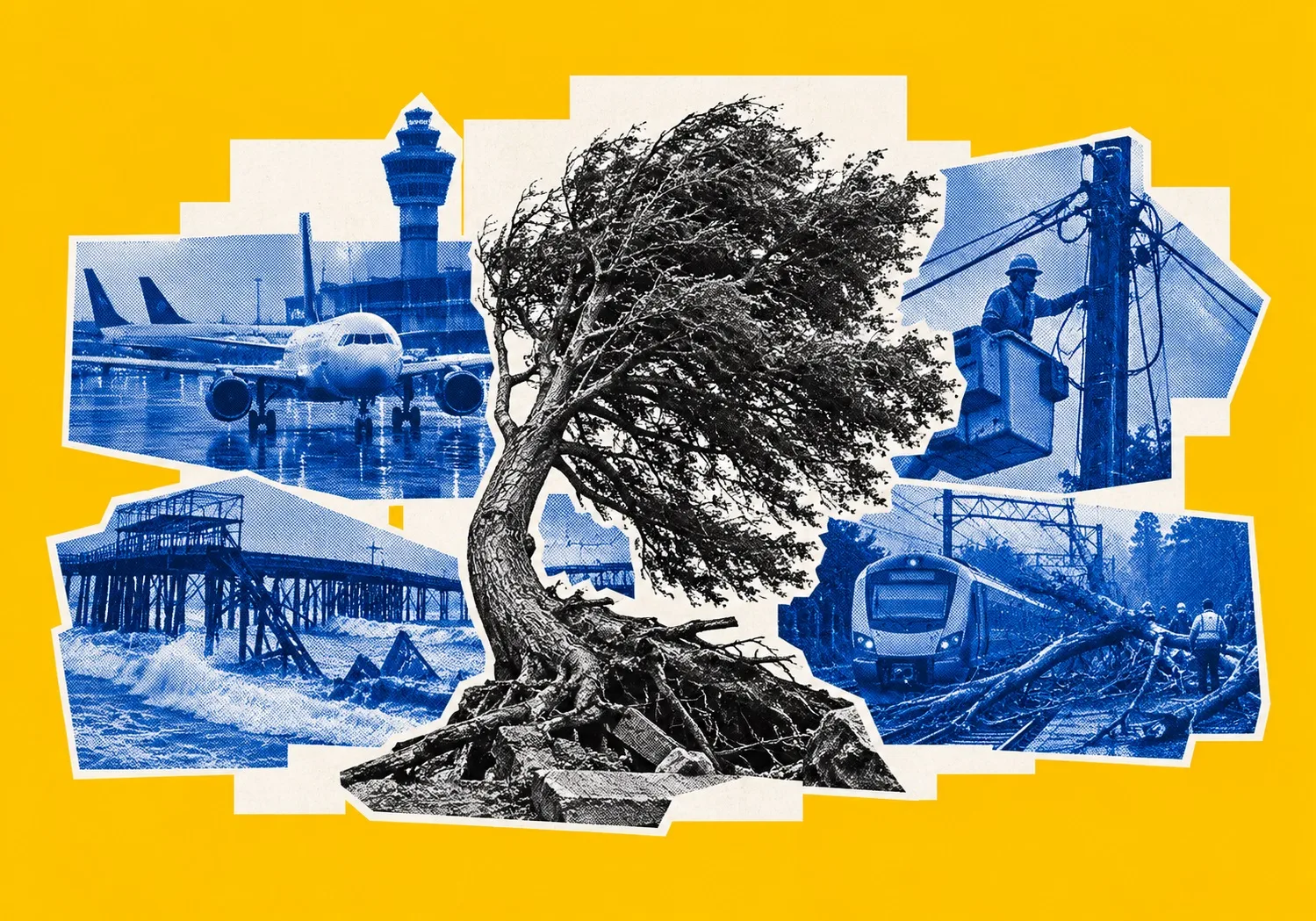
Storms Boelo and Austen left over 150,000 homes without power across Britain, France, and Germany, causing severe travel disruptions, flight cancellations, and hospital restrictions. As northern Europe recovers from the weekend’s damage, the simultaneous blackouts and transport failures raise urgent questions about the resilience of the continent’s ageing energy and transit infrastructure.
None of these failures was particularly unusual in isolation. Fallen trees damage electricity cables every winter. Airports suspend operations when winds make flying or ground handling unsafe. Railway services stop when tracks are obstructed.
What made the weekend particularly disruptive was the number of failures occurring across several countries at almost the same time. And that is becoming an expensive problem for a continent whose transport, energy and communications systems depend heavily on one another.
A Power Cut That Reached the Hospital
In Freiburg-Breisgau, Germany, the electricity failure had consequences beyond households losing their lights and heating. The local mobile phone network went down, while the main hospital restricted its services to emergency cases.
The incident offered a practical illustration of how dependent essential services have become on reliable electricity supplies.
A power cut is rarely confined to the electricity network itself. Telecommunications equipment needs power. Hospitals rely on a continuous supply for their facilities and equipment. Transport systems depend on functioning communications and control networks.
When several of these services are affected together, restoring electricity is only part of the recovery.
Elsewhere, the damage was more immediately visible. A falling tree killed a 60-year-old man in southwestern Scotland and injured two women in central Scotland. In Brussels, four people were hurt by falling trees. Two people suffered serious injuries when scaffolding was blown away in Nastatten, Germany.
The winds also destroyed an unused pier in Brighton and obstructed roads and railway lines across Scotland and northern England.
For electricity operators, much of the physical damage came from familiar hazards. Overhead cables remain exposed to falling branches and trees, particularly in rural areas where power lines cover long distances. Repairs can require crews to reach damaged sections while roads remain blocked and weather conditions are still hazardous.

Britain's National Grid has been working on measures intended to reduce these risks, including reinforcing exposed equipment and placing some power lines underground.
Such work is expensive, however, and operators must decide which sections of their networks justify the investment.
The weekend's simultaneous blackouts in three countries illustrate the difficulty of that calculation. Even where national grids are well developed, local distribution infrastructure can remain vulnerable to relatively concentrated weather damage.
Why Airports Struggle to Recover
The storms also disrupted some of Europe's busiest aviation routes. Amsterdam's Schiphol airport experienced substantial cancellations and delays, as did airports serving London, Dublin, Glasgow and Edinburgh.
Hundreds of flights were cancelled or diverted across northern Europe.
High winds impose clear operational restrictions on aviation. Aircraft have limits on the crosswinds they can safely handle, while strong gusts can make loading, unloading and other ground operations dangerous. European aviation safety requirements, overseen by EASA, leave airlines and airports little discretion when conditions become unsafe.
The more complicated problem begins after the weather improves.
Airlines operate aircraft and crews on schedules that depend on each flight arriving in time for the next. When a major airport stops or reduces operations, aircraft may be stranded in the wrong location, passengers miss connections and later departures become difficult to operate.
Disruption at one airport can often be managed by diverting aircraft elsewhere. That becomes considerably harder when several major hubs are affected by the same weather system.
For airlines, the costs accumulate quickly. Cancelled services mean lost revenue and potentially additional passenger compensation obligations. Aircraft and crews must be repositioned, while passengers need alternative arrangements.
Airports face their own operational and financial pressures as schedules become congested.
The storms therefore exposed a weakness that is not necessarily caused by inadequate airport infrastructure. Modern aviation relies on highly coordinated operations across national borders. That efficiency leaves relatively little room for simultaneous disruption at multiple locations.
It also means a weather event lasting several hours can affect travel schedules well beyond the period of dangerous winds.
Insurers Face a More Expensive Storm Season
The financial effects of severe weather extend considerably further than the immediate cost of repairing damaged property.
European windstorms generate average annual insured losses of approximately €2.6 billion and account for about 46% of the cumulative climate risk faced by the continent's insurers. Average annual insured catastrophe losses in Europe have increased by roughly 5% since 1980.

For major insurance and reinsurance companies, the problem is not simply the size of any individual storm. It is the accumulated cost of repeated events.
Groups such as Munich Re, Swiss Re and Hannover Re provide financial protection to insurers against large catastrophe losses. As exposure increases, they have greater reason to demand higher prices for that protection.
Higher reinsurance costs can eventually feed through to premiums paid by businesses and homeowners.
Insurers may benefit from stronger pricing, but that advantage comes with the risk of larger claims when destructive storms strike several heavily populated areas.
There is another problem for European governments: much of the economic damage caused by natural disasters is not insured at all.
Only around 25% of natural catastrophe losses in the European Union are covered by insurance. The remaining costs are borne by households, businesses and public authorities.
The figure does not provide a specific measure of uninsured storm losses in Britain, France and Germany. It does, however, indicate the scale of the wider European insurance gap.
Property policies in those countries generally provide cover for windstorm damage. Flooding and business interruption may be treated differently, with separate conditions or additional cover required.
A company might therefore have insurance for a damaged building without necessarily recovering all the income lost while its operations are suspended.
Municipal authorities face similar financial pressures. Clearing fallen trees, repairing roads and restoring public facilities require money that must come from existing budgets or additional spending.
Repeated storms can turn what appears to be an occasional emergency expense into a regular financial burden.
The Problem With Repairing the Same Infrastructure
Britain's Network Rail already treats severe weather as an operational risk requiring work before storms arrive.
Its preventive measures include improving drainage in vulnerable locations and reinforcing railway equipment exposed to damaging conditions. National Grid has adopted similar thinking in its efforts to protect electricity infrastructure.
The economics of prevention are less straightforward than the engineering.
Repairing a damaged cable or clearing a blocked railway line provides an immediate, measurable result. Spending money to prevent a failure that might occur several years later is harder to justify, particularly when infrastructure budgets are under pressure.
Yet repeated repairs also carry costs. They require emergency crews, replacement equipment and service interruptions that can affect far more people than those living near the damaged infrastructure.
This creates opportunities for engineering companies involved in electricity network upgrades, drainage improvements, flood protection and slope stabilisation.
For governments and operators, however, spending more is only part of the challenge. They must also decide what level of future weather exposure new infrastructure should be designed to withstand.
Storms Kristin on the Iberian Peninsula and Eowyn in Ireland had already illustrated the damage severe European windstorms can cause. Boelo and Austen have now brought similar problems to northern Europe.
These events alone cannot establish how quickly windstorm frequency or intensity is changing. They do show why infrastructure owners cannot rely entirely on historical conditions when planning assets expected to remain operational for decades.
Engineering standards, investment decisions and insurance assumptions all depend on estimates of future exposure. If those estimates prove too conservative, newly upgraded infrastructure may still require expensive improvements later.

The immediate repairs after Boelo and Austen will fall to electricity companies, transport operators and local authorities. Decisions about strengthening those networks are more complicated, involving regulators, insurers, governments and the companies responsible for maintaining them.
Each faces different financial incentives and investment timetables.
An electricity operator may be able to justify strengthening a vulnerable section of its network. The wider economic benefit of preventing another hospital outage, telecommunications failure or transport interruption is much harder to capture in its own accounts.
That leaves European governments with a growing infrastructure funding problem: the organisations expected to pay for resilience are not necessarily the ones that would benefit most from it.
Sources: Al Jazeera, Kuwait Times, The Guardian