
Serbia’s Students Challenge Vučić’s Grip on Power

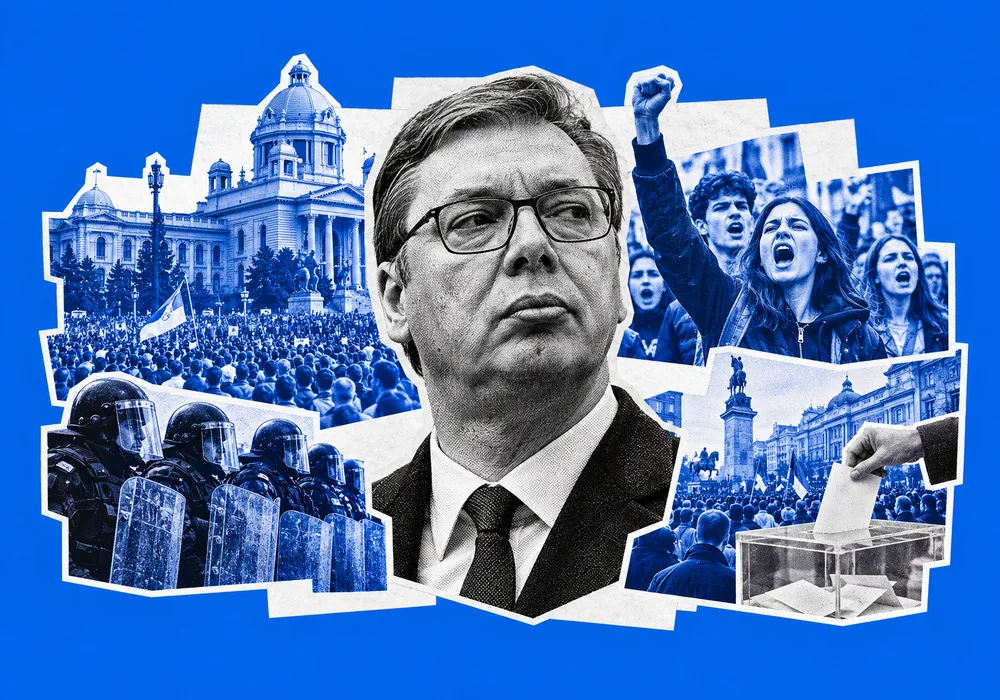
Serbia’s snap parliamentary election has become a major test of Aleksandar Vučić’s political dominance, with a student-led movement seeking to turn nearly two years of anti-government protests into electoral change. The result could reshape the country’s domestic politics and influence its already delicate relationship with the European Union, Russia and China.
Serbia is voting in a snap parliamentary election on 25 October, with a student-led movement mounting the most significant challenge to Aleksandar Vučić’s political dominance in more than a decade. The vote follows nearly two years of demonstrations against alleged corruption, declining institutional accountability and the concentration of political power around the ruling Serbian Progressive Party (SNS). Although the movement emerged from demands for justice following a fatal infrastructure disaster, it has developed into a nationwide campaign seeking a broader change in how the country is governed. The result will determine whether the ruling party can retain its parliamentary dominance or whether a movement formed outside the traditional party system can translate public mobilisation into political power.
A Tragedy That Became a Political Movement
The protests began after the collapse of a concrete canopy at the railway station in Novi Sad on 1 November 2024, which killed 16 people. The disaster triggered widespread anger and demands for transparency over the station’s reconstruction, public procurement and the responsibilities of officials involved in the project. For many protesters, the tragedy became a symbol of what they saw as a wider failure of accountability, in which political connections and weak oversight could undermine public safety without meaningful consequences for those responsible.
University students became the driving force behind the demonstrations, organising campus blockades and rallies that gradually expanded beyond academic institutions. Teachers, farmers, professionals and other groups joined the protests, helping transform a demand for justice into a wider challenge to the government. In January 2025, then-prime minister Miloš Vučević resigned amid mounting pressure, but the demonstrations continued. In March, hundreds of thousands of people gathered in Belgrade for one of the largest anti-government demonstrations in Serbia in decades.
The movement’s endurance has been central to its political significance. Rather than relying solely on large demonstrations, students developed local networks, organised door-to-door campaigning and established working groups focused on communications and election monitoring. Their approach has helped sustain public attention despite political pressure and attempts by the authorities to discredit the protests. The movement has also sought to avoid dependence on a single leader, reducing the risks associated with targeting individual organisers.
For younger Serbians, the protests have become a way to express broader concerns about education, employment prospects and the ability to influence public affairs. The movement’s support, however, extends beyond the student population. Its emphasis on accountability has attracted citizens who are dissatisfied with established political parties and believe that conventional opposition groups have struggled to challenge the ruling party effectively. By presenting itself as an alternative to the existing political establishment, the student-backed list has attempted to unite voters around institutional reform rather than a single ideological programme.
A Close Contest with an Uncertain Outcome
The election pits the ruling SNS and its allies against the student-backed electoral list, known as Students Win. The student list includes 250 candidates from varied professional backgrounds, including academics, farmers and cultural figures. It is headed by cardiologist Ilija Srdanović, although the movement has indicated that his position at the top of the list does not necessarily mean he would become prime minister if it wins.
Opinion polls point to a competitive race, but estimates differ. An Ipsos poll published shortly before the election put the SNS at 47% and the student-backed list at 40%, while a survey published by New Serbian Political Thought on 20 October placed the students ahead at 44.5%, compared with 42.7% for the ruling party. The contrasting results illustrate the uncertainty surrounding the contest, with turnout and the mobilisation of undecided voters likely to play an important role.
Vučić retains considerable advantages. His political network has been in power since 2012, and many voters associate his leadership with infrastructure investment, economic modernisation and the construction of highways, railways, schools and hospitals. During the campaign, he also promised higher pensions and public-sector salaries, investment in healthcare and subsidies for young couples. These commitments appeal to voters who prioritise economic stability and may be reluctant to support an opposition movement whose governing experience remains limited.
The student movement, by contrast, is campaigning on the promise of tackling corruption, strengthening the rule of law, improving media freedom and reforming education. Its appeal rests partly on its distance from established political parties, which supporters see as an advantage in a system they regard as entrenched. However, the same distance creates uncertainty about how the movement would govern, build parliamentary support and translate broad demands for reform into detailed policies.
The result will therefore be significant even if the student list does not secure a parliamentary majority. A strong performance could weaken the ruling party’s political dominance, alter the balance between established opposition groups and new political forces, and create pressure for further reforms. A decisive SNS victory, on the other hand, would strengthen Vučić’s claim to a continued mandate while leaving the grievances behind the protests unresolved.
Electoral Credibility and Institutional Trust
The credibility of the electoral process is another central issue. Opposition groups and civil society organisations have raised concerns about media pluralism, the use of state resources during campaigns, pressure on political opponents and the fairness of previous elections. Rights groups and activists have also reported intimidation and violence during the protest period. Vučić and his allies deny allegations of corruption, repression and efforts to undermine their opponents, while the government has accused the student movement of serving foreign interests. The students reject claims that their campaign is directed from abroad.
The dispute reflects a deeper problem of public trust. When political competition takes place amid persistent allegations of institutional bias, the conduct of the election can become almost as important as the final result. The student movement has prepared supporters to monitor polling stations and has made electoral transparency a central part of its campaign. Independent observation, transparent vote counting and the ability of candidates to challenge irregularities through established procedures will be important in determining whether the outcome is broadly accepted.
A clear result accepted by the competing sides could help reduce tensions and provide a basis for political stability. A narrow or disputed outcome could instead intensify confrontation, particularly if either side questions the legitimacy of the process. The risk is not limited to the immediate aftermath of the vote: prolonged disputes could further weaken confidence in public institutions and make the implementation of reforms more difficult, regardless of which political force emerges strongest.
The election is also taking place in a polarised political environment in which the government and its critics offer sharply different accounts of the country’s recent development. Vučić presents himself as a defender of national stability and economic progress, while the student movement argues that meaningful development requires stronger institutions and accountability. The vote will test which of these arguments resonates most strongly with the electorate.
Serbia Between the EU, Russia and China
The consequences of the election extend beyond domestic politics. Serbia has maintained a complex foreign policy, pursuing membership of the European Union while preserving close economic and political ties with China and Russia. This balancing strategy has given Belgrade room to manoeuvre internationally, but it has also contributed to tensions with European partners, particularly over democratic standards, judicial independence, corruption, relations with Kosovo and Serbia’s limited alignment with EU sanctions against Russia.
The EU remains Serbia’s most important economic partner, and accession is still a formal strategic objective. However, progress has been constrained by concerns about the rule of law, the independence of institutions and the normalisation of relations with Kosovo. Brussels has repeatedly stressed that membership requires more than diplomatic declarations: it depends on sustained reforms and alignment with the bloc’s political and legal standards. The deterioration of relations between the EU and the Serbian government has therefore become an important part of the country’s wider political debate.
A change in government would not automatically produce a decisive shift towards Brussels. The student movement has deliberately kept some foreign policy questions in the background in order to maintain a broad coalition of supporters with differing views. Its candidates have signalled that they would not introduce sanctions against Russia, while their positions on EU accession and Kosovo have not been articulated as a comprehensive alternative to the existing policy. Some of the movement’s proposals concerning Kosovo and a possible referendum on EU membership have also raised questions about its long-term direction.
These ambiguities matter because Serbia’s domestic and foreign policy challenges are closely connected. Strengthening judicial independence, improving media freedom and tackling corruption could improve relations with the EU, but disagreements over Russia and Kosovo would remain. A new government would also face the practical constraints of Serbia’s economic relationships, energy needs and regional security environment. Any rapid foreign policy realignment could prove difficult even if the student movement secured a strong electoral mandate.
If the SNS retains power, Serbia is likely to continue balancing relations with Brussels, Moscow and Beijing, although persistent disputes over democratic standards could further complicate its accession process. China has substantial commercial interests in the country, while Russia remains a traditional partner and a major supplier of natural gas. Vučić has used these relationships alongside cooperation with Western partners to preserve strategic flexibility. A shift in the domestic political balance could alter the terms of this approach, but it would not necessarily eliminate the incentives that sustain it.
The Limits of a Student-Led Challenge
The student movement’s most immediate challenge would begin after the election if it secured enough seats to influence or form a government. Its campaign has brought together people from different professional backgrounds and political traditions, united primarily by opposition to corruption and demands for institutional accountability. This breadth has helped it attract support, but it could complicate the process of agreeing on economic policy, foreign relations and the pace of reform.
Rebuilding public institutions would require more than replacing political leaders. A new administration would have to address the independence of the judiciary, the transparency of public procurement, the operation of state-owned companies and the conditions under which independent media and civil society function. It would also need to manage a bureaucracy and political environment shaped by more than a decade of SNS rule. Resistance from established networks could slow reforms and create instability, especially if the movement lacked a stable parliamentary majority.
The movement would also face pressure to deliver visible results quickly. Its supporters have invested significant expectations in the prospect of political change, while its opponents would have incentives to highlight any disagreements or failures. If a student-backed government struggled to translate its promises into concrete improvements, public confidence could weaken. Conversely, demonstrable progress on transparency and accountability could establish a new model of political participation in Serbia and strengthen the role of civil society in public life.
The wider significance of the election lies in the transformation of a protest movement into a serious electoral force. Across Europe, younger generations have mobilised around the cost of living, education, limited opportunities and dissatisfaction with established political institutions. Serbia offers a particularly important case because the student movement has sustained its campaign over an extended period and attempted to move beyond street demonstrations towards formal political participation.
The election will not, by itself, resolve Serbia’s institutional weaknesses or determine its long-term international orientation. It will, however, provide a clearer indication of whether the political system can accommodate a challenge built around public accountability, or whether the existing leadership can retain its dominance despite prolonged unrest. For the EU, the outcome will matter not simply because of the identity of Serbia’s next government, but because the country’s democratic development remains closely linked to the credibility of its European integration process.
Sources: Government of Serbia, OSCE Office for Democratic Institutions and Human Rights (ODIHR)