
Vučić Leaves Presidency as Serbia Heads for Two Elections

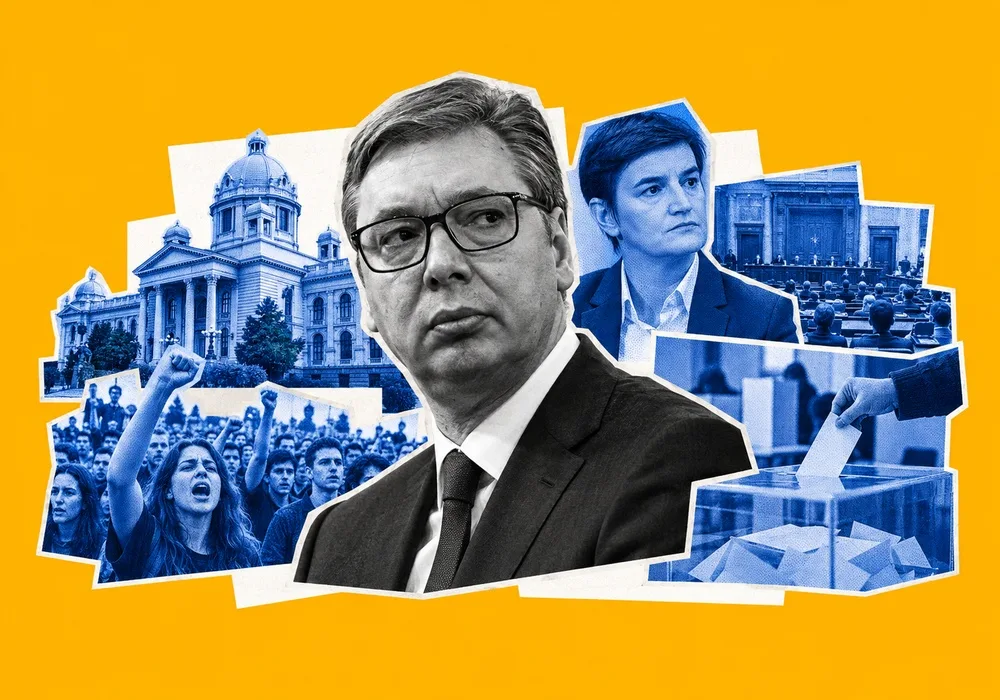
Aleksandar Vučić has resigned as Serbia’s president ahead of the 25 October parliamentary election, where he is expected to seek the prime minister’s post. His resignation comes after nearly two years of student-led protests and will be followed by a presidential election before the end of the year.
Serbian President Aleksandar Vučić has resigned from office ahead of a snap parliamentary election scheduled for 25 October, opening a new phase in the country’s political crisis. Rather than leaving politics, however, Vučić is seeking a new role at the centre of government: he is expected to lead the ruling Serbian Progressive Party’s electoral list and could become prime minister if the party secures enough support to form the next government.
Vučić announced his resignation on 27 September, saying he would participate in the parliamentary election as an ordinary citizen. The move comes after parliament was dissolved earlier this month and amid nearly two years of sustained student-led protests that have become the most serious challenge to his political dominance in years. His departure from the presidency does not therefore necessarily represent a change in the governing political structure, but could instead allow him to move from one powerful executive position to another.
From president to potential prime minister
Vučić is constitutionally barred from seeking a third presidential term after serving two terms in the office. By stepping down before the end of his current mandate, he can now participate directly in the parliamentary campaign and potentially seek the premiership. He has remained the dominant figure in Serbian politics since becoming prime minister in 2014 and later president, while the Serbian Progressive Party has controlled the government for more than a decade.
The resignation means that Parliament Speaker Ana Brnabić will take over as acting president. A presidential election must be organised within 90 days, creating an unusual electoral sequence in which Serbia will first vote for a new parliament on 25 October and then elect a new president before the end of the year. Vučić has said the presidential vote should be held by the end of December.
The arrangement could allow Vučić to remain the central political figure even after leaving the presidency. If the Serbian Progressive Party wins enough parliamentary seats to form a government, his return to the executive as prime minister would preserve his influence over domestic and foreign policy while formally respecting the constitutional limit on presidential terms.
Protests have reshaped Serbian politics
The political transition comes after months of demonstrations that began following the collapse of a concrete canopy at the railway station in Novi Sad in November 2024, which killed 16 people. What started as demands for accountability over the disaster gradually developed into a wider movement involving students, opposition groups and civil society organisations. Protesters have accused the authorities of corruption, political pressure and a lack of institutional accountability, while the government has rejected accusations that it bears responsibility for the broader problems raised by the movement.
The protests have continued to put pressure on the government despite repeated attempts to contain the political fallout. The student movement has increasingly moved beyond street demonstrations and towards direct political participation, including plans to contest the parliamentary election. This has changed the character of the confrontation: the October vote will now provide a formal electoral test for a movement that has previously operated largely outside the established party system.
Vučić also granted pardons to 49 people shortly before leaving office, including people connected with the protests. The decision included members of the so-called Novi Sad Group and people convicted over incidents involving demonstrators. The move comes as the authorities face continuing scrutiny over their handling of the protests and the wider political dispute surrounding the Novi Sad station disaster.
October election will set the next political configuration
The 25 October parliamentary election will determine whether Vučić can move directly into the next government and whether the ruling SNS can maintain its position as Serbia’s dominant political force. The party is campaigning under a list bearing Vučić’s name, despite his resignation from the presidency. At the same time, the student movement is preparing its own electoral list, turning the election into a contest between Serbia’s established political structure and a movement that emerged from the protest wave.
The campaign is also expected to focus heavily on access to the media and the conditions under which the election will be conducted. The student movement has raised concerns about the role of Serbia’s public broadcaster, RTS, and has called for more balanced treatment of competing political forces. Vučić has accepted an invitation to participate in an RTS debate, while representatives of the student movement have sought further clarification about the format.
The outcome will have consequences beyond the composition of the next government. A strong performance by the ruling party would allow Vučić to attempt a relatively direct transition from the presidency to the premiership, while a more fragmented parliament could complicate the formation of the next government and create additional uncertainty over Serbia’s political direction.
EU path and regional policy remain at stake
The elections will also take place against the backdrop of Serbia’s unresolved European integration process. Belgrade remains an EU candidate while maintaining close relations with Russia and China and pursuing a foreign policy that seeks to preserve room for manoeuvre between Brussels and other major powers. Relations with Kosovo and Serbia’s broader position in the Western Balkans will remain central issues for the next government.
The political changes also come as the EU continues to press Serbia over democratic standards, rule-of-law reforms and the alignment of its foreign policy with the bloc. At the same time, Brussels has an interest in maintaining engagement with Belgrade because of Serbia’s importance to regional stability, migration, security and the wider Western Balkans.
For Serbia, the immediate question is therefore not simply who will occupy the presidency after Vučić. The October parliamentary election will determine whether the existing governing structure can continue with Vučić in a different executive role, or whether the sustained protest movement has created enough political pressure to produce a broader change in the country’s political system.
Sources: Government of Serbia, Balkan Insight