
Serbia’s New Parliament Opens With a Student List Majority

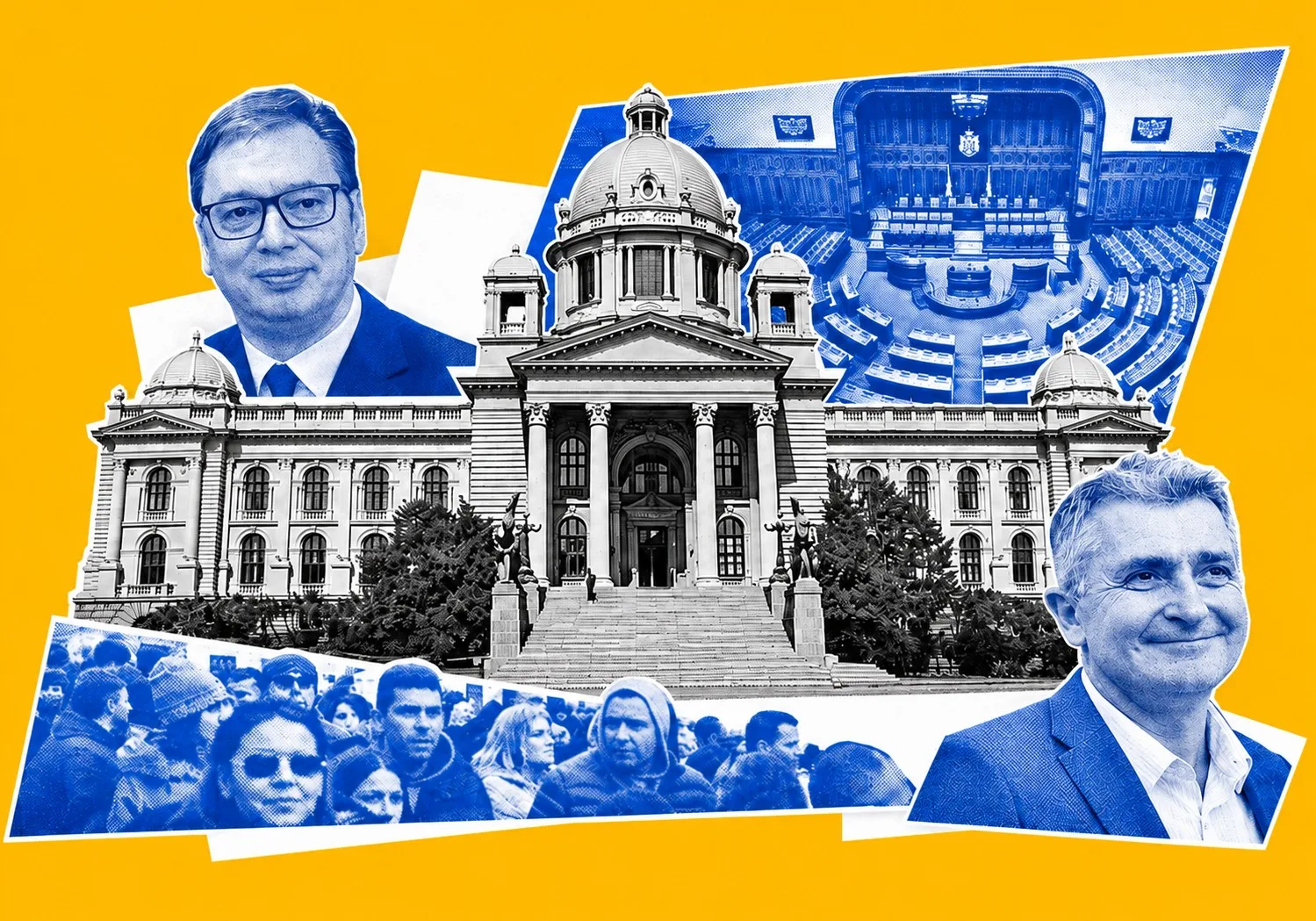
Serbia’s new parliament convened on Tuesday, just over three weeks after a student-led anti-corruption movement defeated Aleksandar Vučić’s bloc in a snap parliamentary election. The Student List won 140 of 250 seats and can form a government on its own. It has yet to name a candidate for prime minister.
Outside the National Assembly in Belgrade, cardiologist Ilija Srdanović and transport engineering professor Aleksandar Čupić led the Student List’s MPs towards the building. Before going in, they joined supporters in singing a song that had become familiar during the election campaign.
Inside, MPs took the oath after their mandates were confirmed.

The man chairing the sitting was Stojan Radenović, a mathematician elected on Vučić’s list. Parliament’s rules put its oldest member in the chair at the start of the sitting. His own bloc put him forward for the post.
Srdanović headed the electoral slate, which the students assembled through campus meetings. The movement has no formal leader. During the campaign, when asked on TV Vojvodina whether he could become prime minister, he said there was “more than one candidate for every position”. Sarah El Sarag, a human rights lawyer elected on the list, told the Guardian that student organisers were still working with MPs on the choice of ministers. “We are there because of them,” she said. “All the time, we are doing it together.”
From Campus Assemblies to Parliament
On 1 November 2024, a concrete canopy collapsed at the recently renovated Novi Sad railway station.
Sixteen people died.
Students blamed the disaster on corruption and demanded answers about the renovations. They occupied university buildings and organised marches that drew support far beyond the campuses. By May 2025, they were calling for an early election. To contest it, they chose 250 candidates from professions that included engineering, farming, law and the arts.
Decisions were taken at faculty assemblies, known as plenums, where hours of debate could end in a show of hands. Working groups organised marches and dealt with the media. Students rotated public-facing roles to make it harder for government supporters to single out individual organisers, participants told Reuters. They also knocked on doors across the country. The campaign had a way to take decisions and carry them out without a party leader. Its MPs now have to decide how often to consult the plenums when a parliamentary vote is imminent or colleagues disagree.
The list includes people who know parts of the state from the inside. Dejan Šoškić ran Serbia’s central bank from 2010 to 2012 and has called for inquiries into the assets of public officials. Estela Radonjić Živkov, who worked at the national heritage institute, challenged the government’s handling of a proposed Trump-branded hotel on the site of Belgrade’s former military headquarters. Zoran Đajić, an engineer who had worked as a stonework consultant at Novi Sad station, documented what he considered poor construction before the canopy fell.
Science reported that more than half of the Student List’s MPs held PhDs or medical degrees. They include an astrophysicist who studies how galaxies evolve and an electrical engineer who helped design robots. Some may continue teaching or doing research alongside their parliamentary duties, as MPs can hold other jobs provided there is no conflict of interest. Few of the Student List’s MPs have held elected office before. In the run-up to Tuesday’s sitting, people with political experience helped them rehearse parliamentary proceedings. “We are lawyers, doctors, professors,” El Sarag said. That professional mix will matter when MPs start assigning people to committees that will examine legislation on education, health and public spending.
Who Chooses the Prime Minister?
Vučić resigned the presidency on 27 September in the hope of returning as prime minister if his bloc won.
His Serbian Progressive Party and its allies took 103 seats, and five minority lists won the remaining seven. He now leads the largest opposition bloc. It has already clashed with the Student List over the allocation of deputy speaker posts and committee chairs. The Student List has called for public votes on those posts and for committee membership to reflect the size of each parliamentary group. The dispute matters because committees scrutinise bills and question ministers. In its November report on Serbia, the European Commission said infrequent sittings and limited debate had hampered parliament’s oversight of government. It also found that the presidency had steered political decisions in ways the constitution did not envisage. Vučić has also threatened to organise protests of his own, giving his party another way to challenge the new majority outside the assembly.
The choice of speaker also determines who will act as head of state. Ana Brnabić, the outgoing speaker, has been acting president since Vučić stepped down. The new speaker will take over those duties until a president is elected. The election monitor CRTA says the presidential vote must take place by 27 December. During a break in Tuesday’s sitting, Srdanović said it was possible that a government could be formed by the end of the year.
Under the constitution, the president consults representatives of the elected lists and proposes a candidate for prime minister.
The nominee sets out a programme and names the proposed ministers. MPs vote on both together. The Student List has 14 more seats than the 126 needed to approve the government. Tuesday’s confirmation of MPs’ mandates started a 90-day countdown. If parliament fails to elect a government by 15 February 2027, it must be dissolved. Đuro Macut remains caretaker prime minister until a new cabinet takes office.
What the Student List Wants to Change
University researchers who backed the protests have their own priorities. Marija Lesjak, a chemist at the University of Novi Sad and a newly elected MP, told Science that universities should be able to “offer criticism, without fear of political repercussions”. As an example, she pointed to a system that routes faculty transactions through the state treasury, making it harder for faculties to manage their money and plan ahead.
The movement has pledged greater academic autonomy, an independent Science Fund and more predictable research funding. It also wants to help Serbian researchers working abroad to return. Researchers who spoke to Science described pressure on universities under Vučić, including the appointment of political allies to governing bodies. Miodrag Krmar, a physicist who stood for the Student List, said political and personal ties had too often determined who received research funding. The list’s plan calls for grant assessments to be made free of political interference.
The students drew up the movement’s 11-point election programme with specialists and put it to their plenums. The proposals on public contracts go back to Novi Sad. The list wants to publish contracts and tenders, give the state audit institution more clout and review infrastructure projects with opaque terms or unexpectedly high costs. It also proposes competitive hiring in the public sector and filling senior posts in state-owned companies on merit. Managers at those companies oversee some of the contracts and public services the movement wants to bring under closer scrutiny.
To investigate corruption, the list proposes a special police unit, alongside stronger protections for judges and prosecutors against political pressure. It would give tax authorities more resources to examine the wealth of public officials. The question of who directs investigations has already become contentious. After a series of arrests involving people linked to the former ruling party, Vučić accused the incoming majority of directing police and prosecutors. Those cases, which include investigations involving senior police officers and the owner of Alta Bank, became public while the caretaker government was still in office.
Plans to change how Serbia’s broadcasting regulator and public broadcaster RTS are run belong to the same programme. The list wants to curb party influence at both and review how national television frequencies are allocated. International observers cited pro-government media bias and misuse of state resources during the October campaign. The way the new majority handles appointments and broadcast licences will affect the conditions in which its opponents campaign in future elections.
Some spending decisions may have to be made before the new ministers take office. The movement has promised free school textbooks, better-staffed rural clinics and grants for domestic businesses and farmers. It hopes to recover illegally acquired assets and use the proceeds for public investment. Investigators would first have to identify those assets and demonstrate how they were obtained. The cost of books, clinic staff and business grants will need to be met through the budget. But the budget for 2027 is more pressing. Caretaker finance minister Siniša Mali said Serbia could move to temporary financing if parliament failed to pass a budget by 20 December, nearly two months before the deadline for forming a government.
The EU, Kosovo and Russia
The day before parliament met, Aleksandar Baucal, a psychology professor and Student List MP, addressed the EU Enlargement Forum in Brussels. He said the movement wanted to speed up work on the EU’s benchmarks for judicial reform and the rule of law.
The European Commission’s November report found that Serbia had made no substantive progress in accession negotiations over the period it reviewed. The Commission says the pace of talks will depend on domestic reforms and on normalising relations with Kosovo. EU enlargement commissioner Marta Kos has already met a Student List delegation to discuss the transition.
The movement’s public statements offer more detail on judicial reform than on the foreign policy choices that accompany closer ties with the EU.
Both Srdanović and Šoškić have said citizens should have the final say on joining the EU. Šoškić has called for faster accession reforms and criticised Western sanctions on Russia. Srdanović has backed Serbia’s claim to Kosovo.
The next cabinet will have to set out Serbia’s position in the EU-mediated talks with Kosovo.
Sources: The Guardian, The New York Times , Science, Student List, European Commission, Serbian electoral commission