
Serbia After Vučić: What a Diverted Moscow Flight Reveals About Belgrade's Ties to Russia

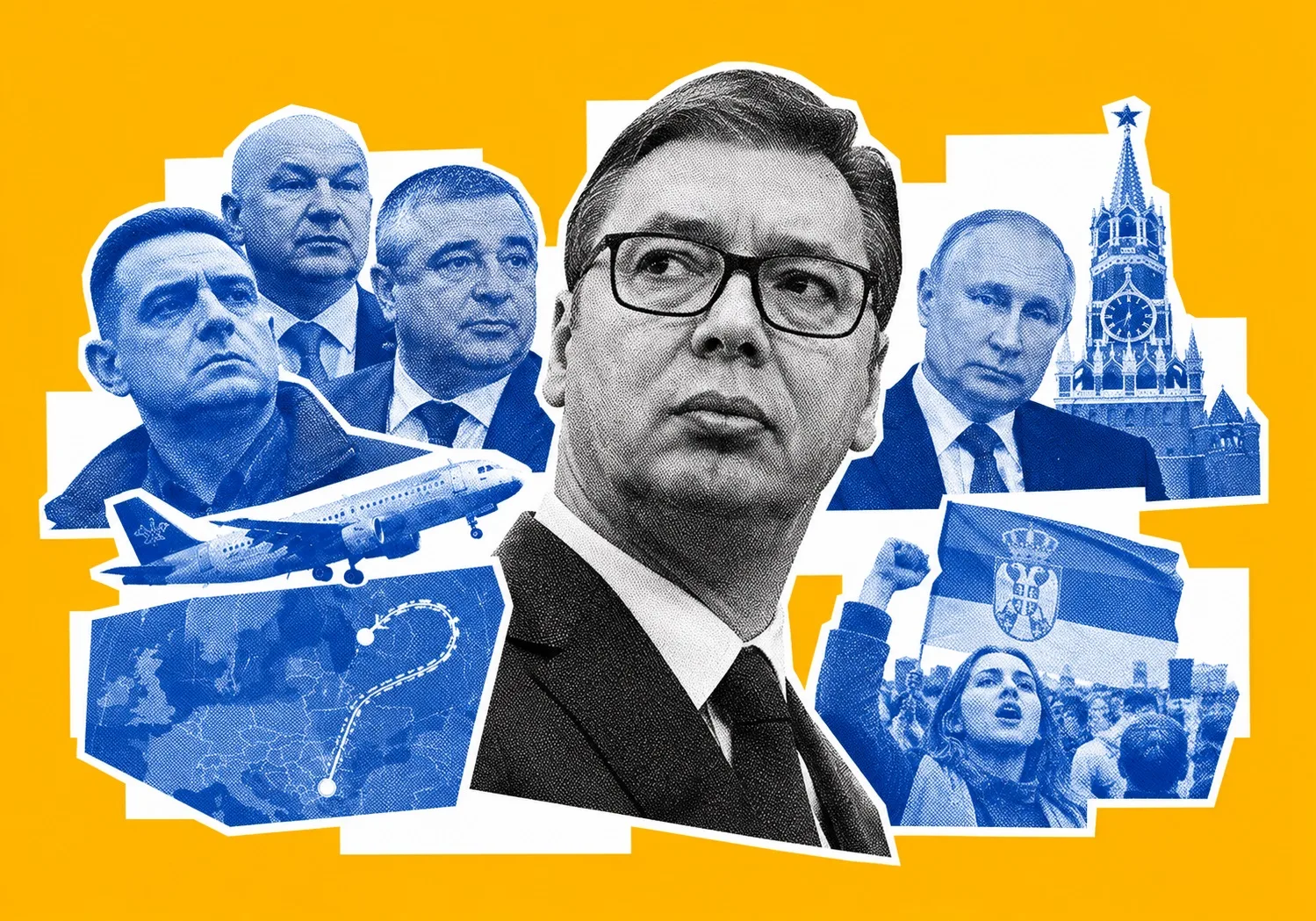
Following Aleksandar Vučić’s historic election defeat, a diverted Moscow-bound flight carrying senior pro-Russian Serbian figures—including former intelligence chief Aleksandar Vulin—has highlighted the uncertain future of Moscow’s influence in the Balkans.
Travelling alongside Vulin were Nenad Popović, a businessman and former government minister, and Dušan Bajatović, head of the state-owned gas supplier Srbijagas. Their aircraft departed Belgrade at 18:48 local time on 3 November, but by the time it reached southern Lithuania, it was unexpectedly ordered to turn around.
According to Reuters, Air Serbia confirmed that the flight was diverted following instructions from airport authorities requiring additional security checks involving one passenger.
The aircraft returned to Belgrade, where passengers and their luggage underwent further inspections. It subsequently resumed its journey, arriving in Moscow early on 4 November, as Blic reported.
The journey was delayed, not cancelled. Yet its timing was striking. Just eight days earlier, Serbia’s long-dominant political establishment had suffered an electoral defeat that could fundamentally alter Belgrade’s relationship with Moscow.
The security incident that brought Vulin back to Belgrade
The initial explanation for the diversion was procedural. Air Serbia said it had received information requiring additional security screening and had acted according to the instructions of the relevant authorities.
Serbian media subsequently reported a more specific allegation.
According to Nova.rs, Vulin had allegedly boarded without completing mandatory security checks. The outlet reported that Milan Kuč, the airport’s corporate security director, identified the irregularity through surveillance footage and ordered the aircraft to return.

The allegations have not been officially established. Vulin rejected the suggestion that he had violated security procedures, describing the affair as politically motivated.
The Serbian publication Vreme also reported, citing an unnamed source, that a prosecutor was waiting at the airport. That claim remains unconfirmed, and Vulin has denied it.
In an account published by N1, Vulin said he had been asleep during the flight and learned about the diversion only after the aircraft landed.
The circumstances are unusual enough on their own. A flight carrying influential political figures was recalled because of a reported security irregularity involving one of them, and the passengers were subjected to renewed checks before continuing their journey.
There is no verified evidence that the diversion was ordered for political reasons. Nevertheless, the incident unfolded against a backdrop of profound political uncertainty.
Serbia after Vučić: an establishment losing its grip
On 25 October, Serbia's student-led opposition movement achieved a historic electoral victory, ending more than a decade of political dominance by Aleksandar Vučić.
As Reuters reported, Vučić conceded defeat after an election shaped by nearly two years of demonstrations against his government.
The movement that eventually challenged him at the ballot box emerged from protests beginning in 2024. What started as public anger over government accountability developed into a broader confrontation with Serbia's political establishment.
Vučić had dominated national politics since 2014, first as prime minister and subsequently as president. His resignation from the presidency to contest the parliamentary election as a candidate for prime minister failed to preserve that dominance.
The opposition Student List's victory marks a significant break with the country's recent political history. But electoral defeat does not automatically dismantle the political, economic and security networks built during a prolonged period in power.
That distinction matters when examining the three passengers on the Moscow-bound aircraft.
All have longstanding connections to Russia, although those relationships operate through different channels: intelligence cooperation, commercial interests and energy supplies.
Their presence on the same flight does not establish a coordinated political mission. Indeed, Bajatović has said that they were travelling for different reasons.
But the episode draws attention to the depth of Moscow's relationships with figures associated with Serbia's outgoing political order.
Aleksandar Vulin and the intelligence relationship with Moscow
Of the three passengers, Vulin has the most direct history of cooperation with Russian security officials.
He served as Serbia's defence minister from 2018 to 2020, subsequently headed the interior ministry and led the Security Intelligence Agency until November 2023. He later served as deputy prime minister.
His political career has been marked by unusually close ties to Moscow.
Vulin developed a working relationship with Nikolai Patrushev, the former director of Russia's Federal Security Service and former secretary of its Security Council.
In 2021, the two discussed cooperation against what they described as colour revolutions. Serbian publication Danas reported on their agreement to cooperate against protest movements viewed as threats to political stability.
Their relationship also became associated with allegations concerning Russian opposition activists.
Vulin was accused of passing information about Russian opposition figures to Moscow following a gathering in Belgrade involving activists including Andrei Pivovarov and Vladimir Kara-Murza. Pivovarov was subsequently arrested in Russia.
The allegations raised questions about whether Serbian security institutions had assisted Moscow in monitoring political opponents beyond Russian territory.
Vulin's position attracted attention in Washington as well.
In 2023, the United States imposed sanctions on him, citing alleged involvement in corruption and activities facilitating organised crime, including illicit narcotics trafficking. The American authorities also highlighted his role in advancing Russian influence in the Balkans.
His relationship with Moscow was therefore not simply a matter of political sympathy. It involved cooperation between security establishments at a time when Russia was increasingly isolated from Western institutions.
That history gives his journey to Moscow particular significance, even if the precise agenda of his latest visit remains unclear.
Russian money, Serbian politics and the gas connection
Vulin represents one dimension of the relationship. Nenad Popović and Dušan Bajatović illustrate two others.
Popović founded the right-wing Serbian People's Party and developed substantial business interests in Russia. His commercial activities include the ABS Electro group, with interests across electrical engineering and industrial sectors.
An investigation connected to the Paradise Papers examined his wealth and business holdings, which have been estimated at approximately $100 million.
He has also been subjected to US sanctions.
For Moscow, relationships with politically influential business figures have long provided channels of engagement extending beyond formal diplomacy.
Bajatović's position is different. As the head of Srbijagas since 2008, he occupies a central role in Serbia's energy relationship with Russia.
Unlike the uncertain political purpose of Vulin's trip, Bajatović has publicly explained why he was travelling.
Speaking to N1, he said the visit concerned Russian gas supplies and difficulties with financial transactions following problems involving Alta Bank.
He also said he did not know the reasons for Vulin's and Popović's journeys.
This distinction is important. The gas discussions indicate that Serbia's practical dependence on its Russian relationships continues regardless of the electoral result.
Political leadership can change through an election. Energy contracts, supply arrangements and payment systems cannot necessarily be replaced on the same timetable.
That creates a difficult question for the incoming Serbian authorities: how far can the country alter its geopolitical orientation without disrupting essential economic relationships?
What Moscow stands to lose
Serbia has occupied an unusual position in Europe's relationship with Russia.
Although Belgrade condemned Russia's invasion of Ukraine, it declined to join Western sanctions. Air Serbia continued operating flights to Russian destinations even after most European carriers suspended services.
For Moscow, Serbia consequently remained an important European partner at a time of growing diplomatic isolation.
Vučić's government maintained relations with the European Union while preserving political and economic cooperation with Russia.
The arrangement allowed Belgrade to pursue European integration without fully aligning itself with the EU's foreign policy towards Moscow.
The election result now challenges the political foundation of that approach.
Russia has lost a familiar governing partner in a country where it retained considerable influence. That does not mean the incoming administration will immediately abandon existing agreements or adopt a confrontational position towards Moscow.
The student-led opposition achieved its victory through a domestic movement focused heavily on accountability and political change. Its future foreign policy remains less clearly defined.
As the Council on Foreign Relations observed in its assessment of the election, the new government faces substantial challenges despite the scale of the opposition's achievement.
Moscow therefore faces uncertainty rather than an established geopolitical defeat.
Its relationships with Serbian political figures, energy institutions and commercial interests have not disappeared. But the political environment in which those relationships operated is changing.
A European opening, but not an automatic realignment
For the European Union, Serbia's political transition presents both an opportunity and a test.
A government emerging from the student-led movement could seek a different relationship with European institutions, particularly if it prioritises institutional reform, democratic accountability and stronger safeguards against corruption.
Yet expectations of an immediate geopolitical transformation would be premature.
Serbia's relationship with Russia extends into energy infrastructure, business networks and longstanding political connections. Reorienting those relationships would require more than replacing the governing coalition.
The incoming authorities will also face domestic pressures. The movement that defeated Vučić brought together voters seeking political change, but that does not necessarily mean they share a single position on Russia, the EU or Serbia's strategic future.
European policymakers will need to distinguish between the country's democratic transition and its eventual foreign policy choices.
There is also the question of how Moscow responds.
Russia may seek to preserve established economic and political contacts while assessing whether the new leadership is willing to maintain elements of Serbia's previous balancing strategy.
That possibility is consistent with Moscow's existing interests, but there is no evidence that the November flight represented a coordinated effort to formulate such a response.
A flight that exposed a larger uncertainty
By the morning of 4 November, the aircraft had reached Moscow. The passengers who had unexpectedly returned to Belgrade were able to continue their journeys after additional security procedures.
In practical terms, the interruption lasted several hours.
Politically, however, the episode brought together several unresolved questions about Serbia's future.
Vulin's presence recalled years of cooperation between Serbian and Russian security officials. Popović represented the commercial relationships linking influential Serbian figures to Russian industry. Bajatović's journey demonstrated that negotiations over Russian energy supplies remain a practical necessity.
All three were travelling to Moscow just over a week after the political establishment with which they had been associated suffered a historic electoral defeat.
The timing invites scrutiny, but it does not establish a common political purpose.
What is certain is that Serbia's election has changed the context in which such journeys take place.
For years, Moscow could rely on familiar political relationships in Belgrade, even as Serbia formally pursued European integration. Those relationships may survive, but the assumptions underpinning them are no longer secure.
The flight ultimately reached its destination. Whether Serbia's longstanding political alignment with Moscow can continue along its previous course is a considerably larger question.
Sources: Reuters, Nova.rs, N1, Vreme, Blic, Council on Foreign Relations, Danas, ABC News, Balkan Insight