
Poland Seeks to Turn India Ties into Defence and Energy Partnerships

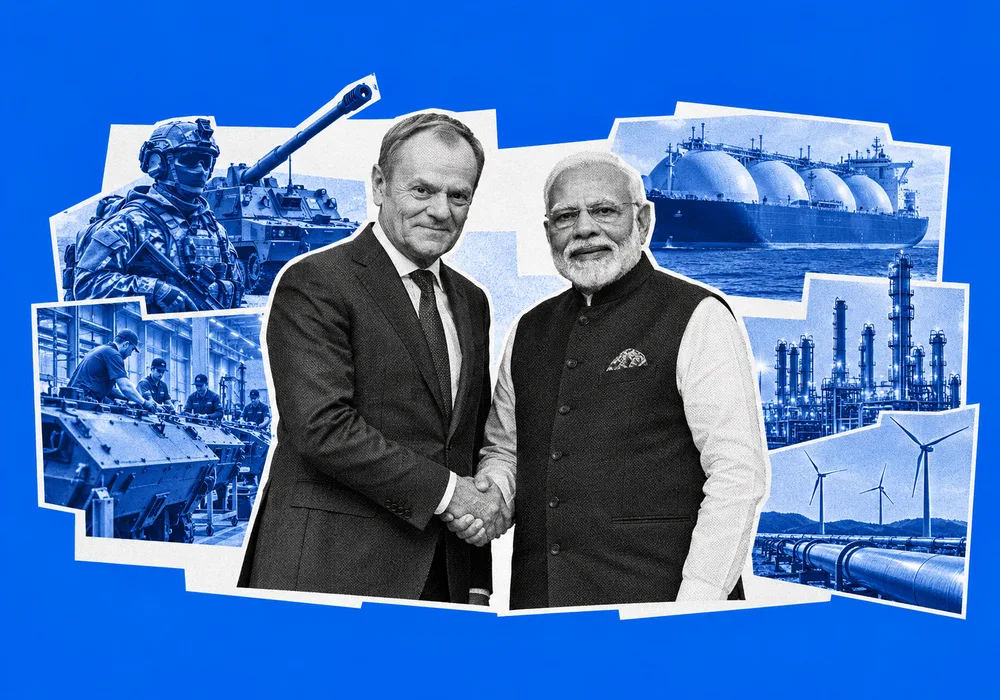
Donald Tusk’s visit to New Delhi reflects Warsaw’s efforts to expand defence exports, attract Indian investment and develop industrial cooperation beyond Europe. The talks also highlight the growing role of India in Poland’s efforts to diversify economic partnerships and strengthen its technological and energy sectors.
Poland is seeking to deepen its strategic partnership with India by expanding cooperation in defence manufacturing, clean energy, advanced technologies and investment. Prime Minister Donald Tusk’s visit to New Delhi on 21–23 October comes as Warsaw looks to convert closer political relations into commercial agreements that can strengthen domestic industry and open new markets for Polish companies.
During talks with Indian Prime Minister Narendra Modi on 22 October, the two governments are expected to review bilateral relations across security, trade and investment, emerging technologies and renewable energy. Tusk is accompanied by Finance and Economy Minister Andrzej Domański and a business delegation, reflecting the emphasis Warsaw places on securing practical economic outcomes. Business forums in New Delhi and Bengaluru are intended to connect Polish companies with Indian partners in manufacturing, technology and other sectors.
The visit builds on the strategic partnership established during Modi’s visit to Warsaw in August 2024, when the two countries sought to broaden cooperation after years in which their relationship had not fully reflected their economic and security interests. Poland is now looking to expand annual bilateral trade, estimated at around $6–6.5 billion, towards a reported target of $10 billion. Achieving that ambition will require more than increased trade in existing goods: joint production, research partnerships and long-term investment could give the relationship a more durable industrial foundation.
Defence Manufacturing and Technology Transfer
Defence cooperation is central to Warsaw’s approach. Russia’s full-scale invasion of Ukraine has accelerated Poland’s military modernisation and increased demand for equipment, technologies and industrial capacity. Warsaw wants defence spending to support domestic manufacturing, research and development, skilled employment and export growth rather than relying predominantly on imported systems. Partnerships with Indian companies could help Polish manufacturers expand production and reach a major defence market.
India has its own reasons to consider closer cooperation. New Delhi is seeking to strengthen domestic defence manufacturing, diversify suppliers and develop technologies that can be produced locally. Polish companies offer potential expertise in unmanned systems and specialised military equipment, creating opportunities for cooperation that could extend beyond direct sales to technology transfer, joint development and manufacturing in India. Existing activity involving Polish drone manufacturer WB Group provides a possible starting point for broader industrial collaboration.
However, the two sides will need to resolve practical questions around production, technology sharing, procurement requirements and the protection of sensitive capabilities. India maintains a diverse network of defence relationships, while Poland must balance export opportunities with the requirements of its own armed forces and European security commitments. Political declarations alone will not guarantee sustained cooperation; commercial agreements and clearly defined industrial projects will determine whether the partnership gains momentum.
Clean Energy and Investment Opportunities
Energy offers another avenue for cooperation. Poland is pursuing a substantial transformation of its energy system, including plans for nuclear power, small modular reactors, renewable generation and improvements to electricity infrastructure. These projects require capital, technical expertise and supply-chain capacity, creating potential opportunities for Indian investors and companies. Warsaw is also interested in attracting investment that can support its industrial base while helping foreign businesses establish a presence within the European Union.
For Indian companies, Poland could provide a manufacturing and investment base within the EU, offering access to European supply chains and markets. For Poland, Indian capital and industrial partnerships could support infrastructure development, technological innovation and economic growth. Cooperation in clean energy and research could also broaden the relationship beyond defence, reducing its dependence on any single sector.
The Wider European Context
The wider European context is significant. As European governments strengthen defence capabilities and reconsider the resilience of their industrial supply chains, partnerships with countries outside the continent are becoming an increasingly important part of economic and security planning. India, meanwhile, is seeking a greater role in global manufacturing and technology networks while maintaining strategic autonomy in its international relations. The two countries therefore have complementary interests, even if their wider geopolitical priorities do not always align.
The relationship also connects with the broader EU–India agenda. Stronger bilateral ties could help Polish businesses benefit from expanding European–Indian trade and investment, while giving Indian companies a more direct route into the EU market. Progress will nevertheless depend on regulatory compatibility, investment conditions and the ability to turn political commitments into commercially viable projects.
Tusk’s visit is therefore best understood as an attempt to establish a more substantial economic and industrial dimension to Poland’s partnership with India. Defence manufacturing may provide the immediate impetus, but energy, technology and investment could determine its longer-term value. Whether the two governments can translate this renewed engagement into sustained cooperation will depend on the projects, financing and production arrangements that follow the diplomatic meetings.
Sources: Polish Prime Minister’s Office, Polskie Radio