
Poland Turns Energy Security Into a New Economic Strategy

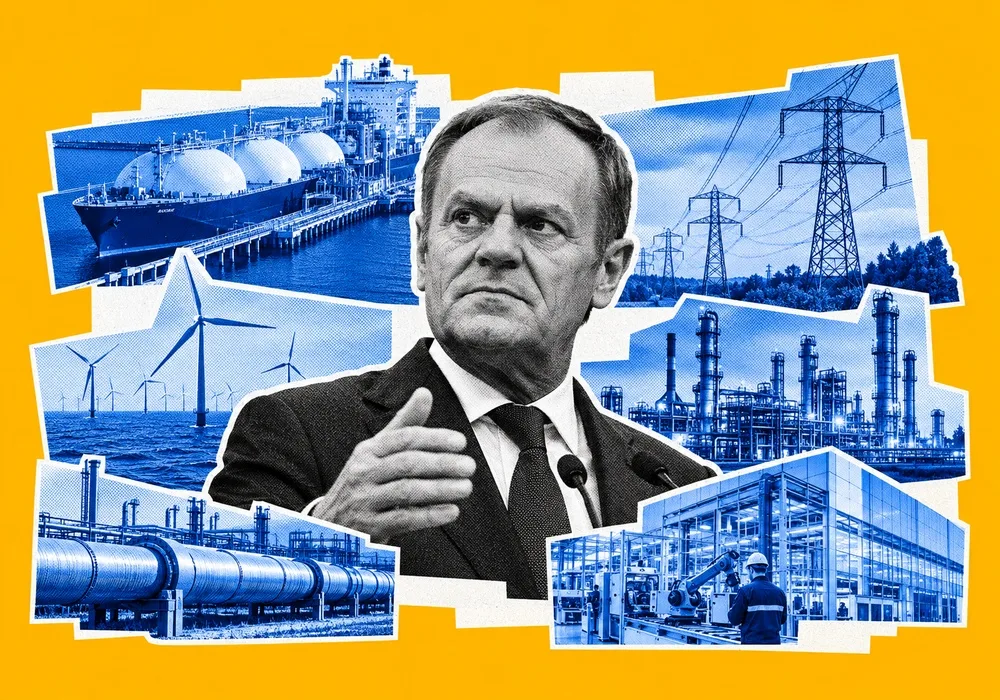
Poland is transforming energy security into an economic and geopolitical strategy, using LNG, nuclear power, renewables and EU funding to reduce dependence on Russia while positioning itself as an energy hub for eastern Europe.
Poland is turning energy security into a central part of its economic and geopolitical strategy, with a new offshore gas terminal in the Baltic becoming one of the clearest symbols of that shift. The facility near Gdańsk is designed to add 6.1 billion cubic metres of annual LNG regasification capacity when it becomes operational in 2028. A second floating unit planned for 2030 could push Poland’s total regasification capacity above 20 billion cubic metres a year.
The scale of the project goes beyond Poland’s domestic energy needs. Warsaw is positioning itself to become an important gas entry point for the Baltic states and other parts of eastern Europe, strengthening regional resilience while reducing the strategic leverage once provided by Russian pipeline supplies. Poland already operates an LNG terminal at Świnoujście and is connected to Norway through the Baltic Pipe, giving it several alternative sources of supply.
This is a significant reversal of the energy relationship Poland had with Russia. Before Moscow's full-scale invasion of Ukraine, Russia supplied more than half of Poland's gas imports. Warsaw refused to comply with the Kremlin's demand to pay for gas in roubles in 2022 and accelerated a diversification strategy that had already been developing since Russia's annexation of Crimea in 2014.
Energy independence is becoming economic policy
The strategic calculation is no longer limited to avoiding another Russian supply shock. Poland increasingly sees the cost and structure of its energy system as a determinant of its future economic competitiveness.
Poland has emerged as the EU's sixth-largest economy, with GDP surpassing $1tn last year. Its rapid growth was supported for years by relatively low labour costs, substantial foreign investment and large flows of EU funding. But wages are converging with western European levels, weakening one of the country's traditional competitive advantages. Energy costs are therefore becoming more important for Polish manufacturing and other energy-intensive sectors.
Wholesale electricity prices remain among the highest in the EU, while coal continues to dominate Poland's power system. More than 80,000 people still work in the country's coal industry, particularly in the Silesian region. The transition away from that model therefore has economic and political consequences well beyond the energy sector.
The challenge for Warsaw is that replacing Russian gas with LNG does not by itself create a cheap or sustainable energy system. LNG provides diversification, but it remains exposed to global commodity prices and geopolitical disruption. Poland therefore needs to develop several sources of electricity simultaneously: renewables, nuclear generation, gas infrastructure and eventually a reduced role for coal.
That makes energy transition part of industrial policy. If Poland cannot bring down electricity costs while maintaining reliable supply, its economic convergence with western Europe could become more difficult precisely as the advantages that fuelled its earlier growth begin to disappear.
The EU has become part of Poland's energy strategy
Poland's experience also illustrates how European integration has changed the country's economic resilience.
Warsaw has secured €54.7bn through the EU's post-Covid recovery and resilience programme, with around 40% directed primarily towards energy-related objectives. Since joining the EU in 2004, Poland has also received more than €300bn in European funding, supporting transport infrastructure and broader economic development.
This creates an important political contradiction. Poland's energy transition requires substantial European financing at the same time as parts of the domestic political establishment continue to challenge EU climate policy. The country's rightwing opposition has increasingly used the costs of the green transition as an argument against Brussels, particularly ahead of next year's parliamentary election.
Yet the economic logic of EU integration is becoming increasingly difficult to separate from energy security. Brussels has spent the years since Russia's invasion trying to turn the bloc's energy system from a vulnerability into a strategic asset. The EU says Russian gas accounted for 12% of its gas imports in 2025, down from 45% in 2021, while the bloc is moving towards a complete phase-out of Russian gas imports.
Poland is therefore not simply adapting to an EU-wide energy transformation. It is becoming one of its eastern pillars.
Security infrastructure is becoming economic infrastructure
The shift is particularly important because Europe's energy infrastructure is increasingly treated as part of national security.
Gas terminals, electricity interconnectors, pipelines and power plants are no longer viewed solely through the lens of energy policy. They are strategic infrastructure exposed to military, cyber and hybrid risks. The European Commission has explicitly identified physical, cyber and climate threats to energy infrastructure as part of the next stage of Europe's energy-security planning.
Poland's geographical position makes this especially relevant. It borders Russia's Kaliningrad exclave, sits on NATO's eastern flank and has become a major logistical centre for European support to Ukraine. Sweden's decision this week to deploy Patriot systems to eastern Poland to protect a NATO logistics hub underlines the extent to which the country's infrastructure has become intertwined with European security.
The same logic increasingly applies to energy. A diversified Polish energy system reduces the ability of a hostile supplier to exert political pressure while giving neighbouring countries additional options during a disruption.
This is why the Gdańsk terminal matters beyond its capacity figures. It represents an emerging European model in which resilience means having multiple suppliers, multiple routes and sufficient infrastructure to absorb shocks without allowing one external actor to dictate economic policy.
The harder transition is still ahead
Poland's biggest challenge is no longer simply replacing Russian gas. It is building an energy system that is simultaneously secure, affordable and compatible with Europe's decarbonisation targets.
The government plans to expand offshore wind and other renewable generation while developing nuclear power. Its first nuclear plant on the Baltic coast, however, is expected to cost more than €42bn and will not begin operating until the late 2030s. That leaves Poland dependent on fossil fuels for much of the transition period.
Public finances add another constraint. The country needs enormous capital investment in electricity generation, grids, storage, nuclear power and renewables at a time when government debt and borrowing costs are rising. The political difficulty is equally significant: households and industries are sensitive to energy prices, while the benefits of large infrastructure projects may take years to materialise.
The result is a difficult balancing act. Poland needs to decarbonise faster without undermining industrial competitiveness, maintain enough gas capacity to guarantee flexibility without creating a new long-term fossil-fuel dependency, and invest in nuclear and renewables before existing coal capacity becomes economically unsustainable.
A wider European test
Poland's trajectory reflects a broader problem facing the EU. The bloc has made considerable progress in reducing its exposure to Russian energy, but diversification alone does not guarantee competitiveness. Europe now has to convert energy security into an economic advantage rather than simply a defensive response to geopolitical pressure.
For Poland, the stakes are particularly high. Its economic model is entering a new phase in which cheap labour is less decisive and energy, technology, infrastructure and access to European markets matter more. The country therefore needs an energy system capable not only of surviving geopolitical shocks but also of supporting the next stage of industrial growth.
The Gdańsk terminal, the Baltic Pipe, renewables and planned nuclear capacity are parts of the same strategic transition. Poland is moving from being a major consumer of imported energy on Europe's eastern edge towards becoming an infrastructure and energy-security hub for the region.
That transformation also illustrates a broader lesson from Europe's confrontation with Russia: energy dependence is not merely an economic vulnerability. It can become a constraint on foreign policy, industrial competitiveness and national sovereignty. Reducing it is therefore increasingly being treated as an investment in the European economy itself.
Sources: European Commission, Council of the EU