
Nobel Prize in Medicine 2026: How Optogenetics Turned Light into a Brain Control Switch

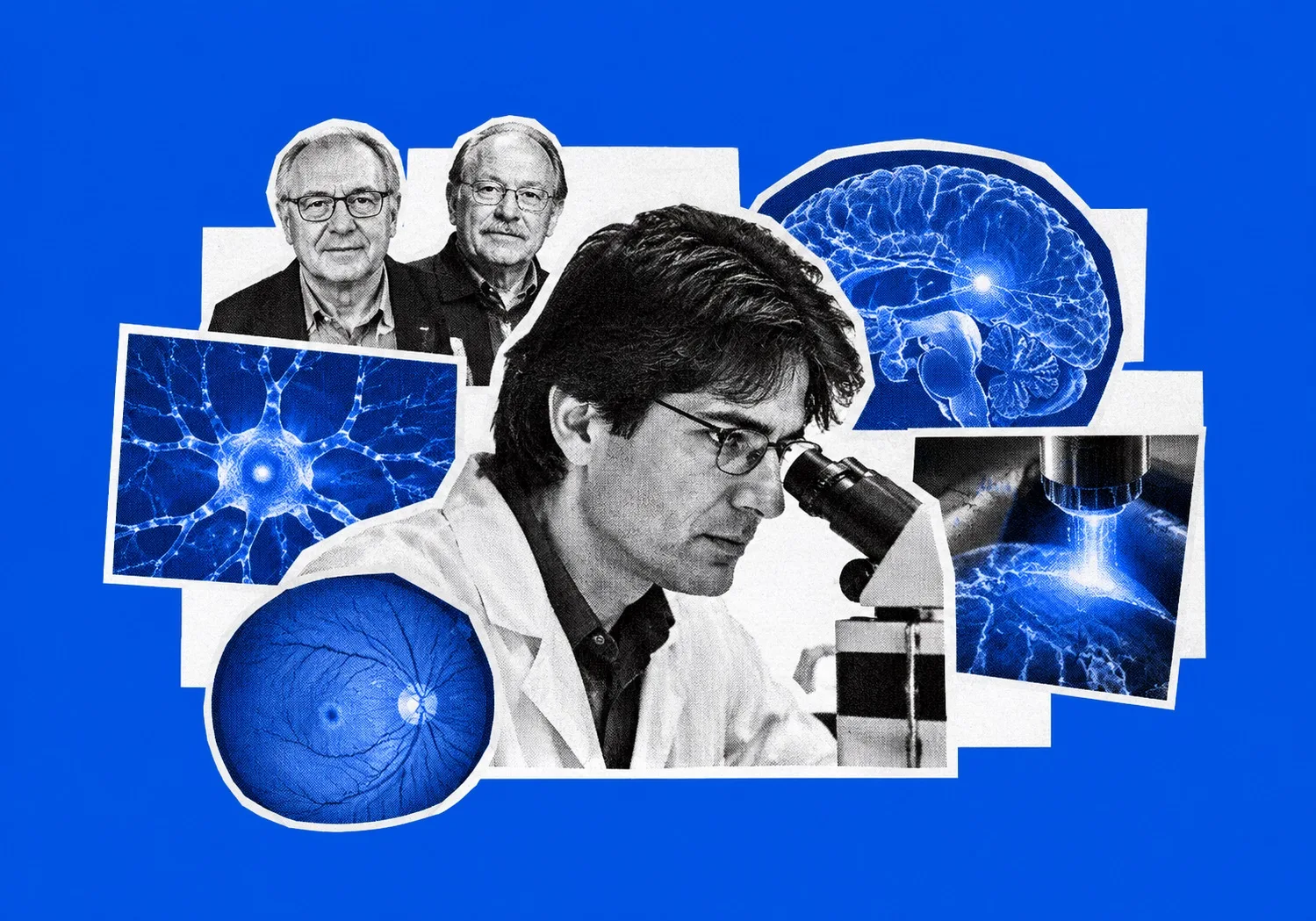
The 2026 Nobel Prize in Physiology or Medicine, awarded to Karl Deisseroth, Peter Hegemann, and Georg Nagel, recognizes a profound shift in neuroscience. By converting light-sensitive algal proteins into a precision switch for mammalian neurons, their work transformed the brain from something scientists merely observe into an engineered system they can directly control - and potentially heal.
The prize, worth 11 million Swedish kronor and divided equally among the three scientists, recognizes far more than a successful laboratory technique. It marks the precise moment neuroscience gained the causal, experimental control it had lacked for over a century.
The unlikely starting point was a single-celled green alga.
The control switch hidden in an alga
For much of its history, neuroscience had an awkward limitation. Scientists could observe electrical activity in the brain, or interfere with it using drugs and electrical stimulation, but neither approach offered reliable control over a narrowly defined population of cells.
A drug can affect many neurons at once. Electrical stimulation can activate cells in the vicinity of an electrode without necessarily distinguishing between their biological functions. Researchers could therefore establish correlations between neural activity and behaviour, but proving causation was far harder.
The crucial breakthrough came from studying organisms with no brain at all.

Work beginning in the 1970s had established that microbial organisms use light-sensitive proteins to convert light into electrochemical signals. Dieter Oesterhelt's discovery of bacteriorhodopsin in archaebacteria provided an early foundation by showing how retinal-bound proteins could respond to light.
Decades later, Hegemann and Nagel pursued related mechanisms in Chlamydomonas reinhardtii, a single-celled green alga. In 2002, they identified channelrhodopsin-1, showing that it functioned as a light-gated proton channel. A year later they described channelrhodopsin-2, or ChR2, demonstrating that it could conduct several types of ions and, crucially, that transferring its gene into other cells could make those cells responsive to light.
That observation supplied the missing piece.
The protein was not simply detecting light. It could translate light directly into a change in a cell's electrical state.
From photons to a nerve impulse
ChR2 works as a molecular switch.
In darkness, the protein contains retinal in its all-trans configuration. When it absorbs a blue-light photon, retinal changes shape to a 13-cis configuration within picoseconds. That structural change opens a pore in the protein, allowing charged particles, including sodium, calcium, protons, and potassium, to move through the cell membrane.
The result is depolarisation.
In a neuron, that electrical change can trigger an action potential. When the light is removed, retinal returns towards its original configuration and the channel closes.
The elegance of the system is its directness. There is no need for a conventional drug to diffuse through tissue and interact with multiple receptors. A genetically modified cell carries its own light-sensitive switch.
That became particularly powerful once the switch could be installed selectively.
In 2005, Deisseroth and collaborators inserted the ChR2 gene into mammalian neurons using viral vectors. Blue light delivered to those neurons could then trigger neural action potentials. The approach was subsequently adapted for living mice, establishing what became known as optogenetics.
The division of labour behind this year's Nobel Prize is therefore unusually clear. Hegemann and Nagel uncovered and characterised the microbial machinery. Deisseroth helped turn that molecular discovery into an operational system for controlling mammalian neural circuits.
The Nobel Committee is effectively recognising both halves of the transformation: discovery of the biological component and its conversion into a technology for neuroscience.
The moment neuroscience became more interventionist
Optogenetics changed the question researchers could ask.
Instead of recording activity during fear, memory, movement or addiction and asking what the pattern might mean, scientists could target a particular population of neurons and activate or silence it. If the behaviour changed, the experiment offered much stronger evidence of causation.
That distinction matters.
Traditional brain imaging and electrical recording remain valuable for observing neural systems. But observation alone cannot establish that a particular group of cells is responsible for a particular outcome. Optogenetics introduced a controlled perturbation: change one defined component of a circuit and observe what follows.
The technology also evolved. Researchers developed inhibitory opsins, including halorhodopsins and archaerhodopsins, making it possible not only to activate neurons but to suppress them. Red-shifted systems and multi-colour approaches expanded the range of cells and circuits that could be manipulated.
The result was a broader experimental toolkit for dissecting the brain into functional circuits rather than treating regions as undifferentiated blocks of tissue.
That is why the significance of optogenetics extends beyond a single technique. It helped push neuroscience towards an engineering model of the brain, in which circuits can be identified, perturbed, and tested rather than simply observed.
The laboratory is no longer the whole story
The more consequential test is now taking place in medicine.
The clearest clinical path is the eye. In retinal degeneration such as retinitis pigmentosa, photoreceptor cells can be lost while some retinal ganglion cells survive. If opsin genes are delivered to those remaining cells, they can potentially be converted into light-sensitive cells.
This is a radically different proposition from replacing the lost photoreceptors themselves.
The approach combines gene therapy with an optical interface. In the emerging model, specially designed goggles can detect visual information and project appropriate light signals towards the treated retina. The biological component supplies light sensitivity; the external device supplies the visual information.
That convergence is important because it shows what optogenetics looks like when it leaves the laboratory. It is no longer simply a method for probing neurons in mice. It becomes a platform combining viral gene delivery, molecular biology, and optical hardware.
Vision restoration is therefore ahead of applications involving the human brain itself. The retina is a much more accessible target than deep brain structures, and the therapeutic objective is comparatively well defined: provide surviving cells with a new means of detecting light.
The prospects for psychiatric and neurological disorders are more complicated.
Optogenetics has been used experimentally to investigate circuits associated with depression, anxiety and addiction, and it offers an attractive conceptual alternative to interventions that affect large populations of cells. But moving from an experimental circuit-manipulation tool to a routine human therapy presents formidable problems.
The brain remains the hard problem
Delivering viral vectors safely to the appropriate cells is one obstacle. The blood-brain barrier makes access to deep neural tissue difficult, while the introduction of foreign microbial proteins raises questions about immune responses. Researchers would also need stable, predictable expression of the engineered proteins over long periods.
Then there is the hardware.
Precisely illuminating deep structures in the human brain can require invasive optical implants. That creates an entirely different risk profile from treating the retina. A technique that is exceptionally precise at the cellular level is not automatically simple or safe at the level of a human patient.
These limitations place some distance between the real clinical programme and the more speculative claims that optogenetics could soon provide a form of broad, non-invasive control over human behaviour.
The technology does not amount to a consumer mind-control system. Nor does it offer an immediate replacement for drugs, electrical stimulation or other established treatments.
Its importance lies elsewhere: it provides a framework in which future therapies could be much more selective about which cells they affect and why.
That could eventually alter the economics of neurological medicine as well. Conventional neuropharmacology often depends on compounds whose effects spread across multiple receptors and cell populations. Optogenetic approaches instead require a chain linking genetic identity, cellular targeting and an external stimulus.
The complexity is greater. So is the potential precision.
A Nobel for curiosity-driven science
There is also a less obvious lesson in the prize.
The technology now being explored for human medicine emerged from research into microbial photobiology. The organisms involved were not chosen because researchers already knew they would provide a treatment for blindness, epilepsy or depression. The useful property was discovered because scientists were interested in how simple organisms sense light.
That path is difficult to fit into short-term calculations of scientific return.
The Nobel recognition puts the long arc of such research into view: a discovery about light-sensitive proteins in microorganisms became a molecular tool, the molecular tool became a method for manipulating mammalian neurons, and that method has now entered the clinical development of gene-based therapies.
The distance between the original question and the eventual medical application is precisely what makes the story significant.
For neuroscience, the prize marks a shift from asking which cells are active to testing what happens when selected cells are deliberately controlled. For medicine, it points towards therapies in which genetic identity determines the target and light provides the command.
The difficult question is no longer whether biology can convert light into electricity. A green alga answered that one decades ago.
The harder question is how far that molecular switch can be carried into the human brain without losing the precision that made it revolutionary in the first place.
Sources: The Nobel Prize, NIH, DW, SNL, Nature