
Nobel Chemistry 2026: How Henri Kagan and Kenso Soai Solved the Mystery of Life’s Mirror Molecules

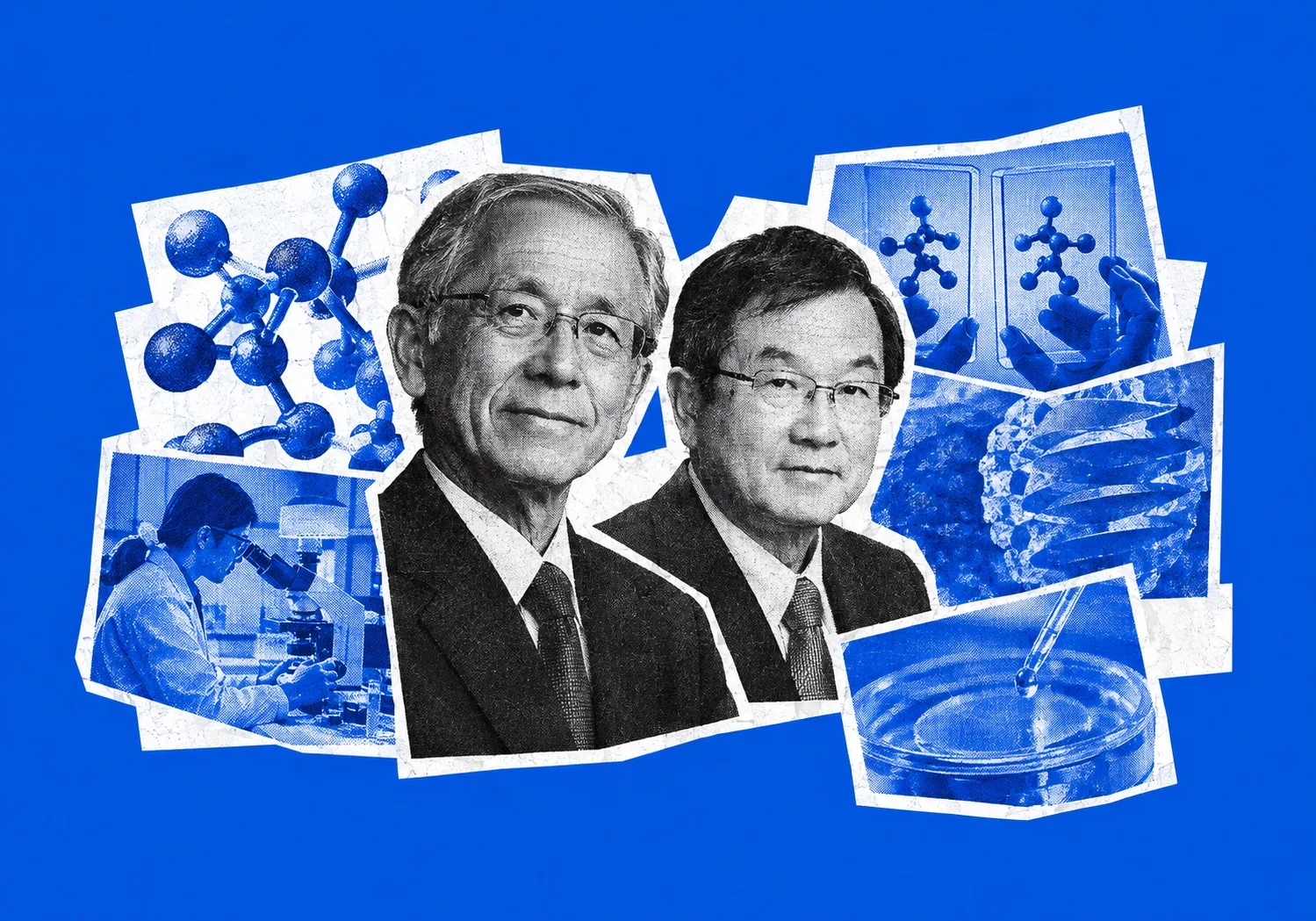
The 2026 Nobel Prize in Chemistry was awarded to French chemist Henri B. Kagan and Japanese chemist Kenso Soai for discovering how chemical homochirality - nature’s preference for single-handed mirror molecules - can emerge spontaneously. Beyond solving a century-old origin-of-life mystery, their work on non-linear effects and asymmetric autocatalysis provides the foundation for modern pharmaceutical manufacturing and stereospecific drug design.
Chirality is easy to describe and surprisingly difficult to explain.
Some molecules exist in two forms that have the same chemical formula and connectivity but are mirror images of one another. They are called enantiomers. The simplest analogy is a pair of hands: identical in broad structure, but impossible to superimpose perfectly.
Chemically, the distinction can be decisive. Biological systems are themselves chiral, so the two versions of a molecule can interact with proteins and other biological structures differently. One may have the desired effect while its mirror image behaves differently, with consequences ranging from ineffectiveness to toxicity.
Life is strikingly consistent on this point. Proteins are built almost exclusively from left-handed amino acids, while DNA and RNA use right-handed sugars. This state is known as homochirality: a chemical system dominated almost entirely by one of two possible mirror-image forms.

The mystery is not that chirality exists. Louis Pasteur demonstrated molecular chirality in the 19th century, when he separated right- and left-handed tartaric acid crystals manually.
The harder question was why a system that begins without a preference should end up overwhelmingly preferring one side.
If the starting chemistry is symmetrical, where does the asymmetry come from?
For more than a century, that question sat somewhere between chemistry, mathematics and theories of the origin of life.
From a small bias to a chemical landslide
One of Kagan’s crucial contributions was to show that the relationship between the chirality of a catalyst and the chirality of the resulting product does not have to be proportional.
Before his work, chemists could reasonably expect that a catalyst mixture containing, for example, 75 per cent of one enantiomer and 25 per cent of the other would produce a broadly comparable distribution in the product.
Kagan demonstrated that this intuition could be wrong.
His work on DIOP, one of the first effective C2-symmetric chiral ligands, established that metal catalysts could be deliberately designed to favour one molecular configuration. In 1986, he went further, demonstrating what became known as the non-linear effect.
The chemistry of the catalyst mixture itself could amplify its initial imbalance. Heterochiral pairings - a “left” catalyst with a “right” catalyst - could be substantially less reactive than homochiral pairings. The less effective combinations therefore acted as a kind of reservoir, while the more reactive same-handed catalysts drove the reaction.

A modest initial preference could consequently become a much larger one in the final product.
The significance was conceptual as much as technical. Asymmetry no longer had to be treated as a fixed property imported into a reaction. Under the right conditions, the reaction could magnify it.
That provided an important bridge to an older theoretical idea.
In 1953, physicist Charles Frank proposed a mathematical model in which homochirality could emerge if a system combined an initial chiral bias with asymmetric amplification and autocatalytic behaviour. The model offered a way to think about how a tiny departure from symmetry might become chemically dominant.
Kagan supplied experimental chemistry showing that non-linear amplification was not merely an abstract possibility.
Soai supplied the next piece.
When the product starts making itself
Kenso Soai’s work transformed amplification into something closer to chemical self-replication.
In 1995, he reported a reaction in which a very small initial enantiomeric excess could be dramatically amplified. An initial imbalance of about 2 per cent could grow to roughly 87 per cent through reaction feedback.
The crucial development came later, when Soai demonstrated a fully autocatalytic reaction. In this system, the reaction product acts as its own catalyst. In simplified form, the process can be represented as P + A + B → 2P: the product helps generate more of itself.
That changes the logic of the reaction.
A conventional catalyst accelerates a process. An autocatalytic product feeds the outcome back into the process that created it. If one enantiomer gains even an almost imperceptible advantage, the chemistry can reinforce that advantage.
Soai demonstrated that a non-chiral starting mixture could develop an overwhelmingly one-sided outcome following a tiny random fluctuation. With repeated additions of reagents, enantiomeric purity could exceed 99.5 per cent and, in particular experimental setups, reach 99.99 per cent.
This is the part of the Nobel story that carries the greatest significance for the origin-of-life debate.
The experiment does not establish that this was exactly how life became chemically organised on early Earth. The Nobel Committee has been explicit about that distinction.
It establishes something more limited, but fundamental: a symmetrical chemical starting point does not necessarily remain symmetrical. Under suitable conditions, a microscopic statistical fluctuation can be amplified until one molecular form overwhelmingly dominates.
Why medicine cares about molecular handedness
The same principle that helps illuminate a question about primitive chemistry has a direct industrial counterpart.
Modern pharmaceutical chemistry operates in a world where three-dimensional molecular structure matters. A drug is not defined only by its atoms and chemical formula. Its spatial arrangement can determine how it interacts with a biological target.
The history of medicine has supplied a particularly painful lesson in the consequences of inadequate stereochemical control. The thalidomide disaster helped establish the importance of understanding and controlling the behaviour of different enantiomers in drug development.
That makes the Kagan-Soai framework more than an elegant explanation of chemical symmetry.

Industrial synthesis has traditionally relied in many cases on creating mixtures and then separating the desired molecular form. Techniques such as chiral chromatography and fractional crystallisation can distinguish between enantiomers after synthesis, but physical resolution adds processing steps and can generate additional waste.
The alternative represented by asymmetric catalysis is to make the desired form preferentially in the first place.
The work recognised by this year’s Nobel pushes that principle further. If a chemical system can amplify a very small initial asymmetry through its own dynamics, manufacturers can potentially rely on less highly purified chiral inputs while still obtaining extremely high enantiomeric purity.
That points towards a broader shift: from separating unwanted molecular forms after the reaction to designing reactions that sort themselves while they happen.
The distinction is important because it changes where complexity sits in the manufacturing process.
A Nobel that also rewrites a scientific history
For France, the award carries another layer.
Kagan’s recognition comes decades after his work helped establish modern asymmetric catalysis. In 1971 he developed DIOP, and his 1986 work on non-linear effects became a foundation for understanding how small differences in catalyst composition can be magnified.
French scientific institutions and media have therefore treated the Nobel as overdue recognition, particularly because Kagan was absent from the 2001 Nobel Prize in Chemistry, which went to William Knowles, Barry Sharpless and Ryoji Noyori for their work on asymmetric catalysis.
At 95, Kagan now receives the prize alongside Soai, whose own research provided the experimental demonstration of asymmetric autocatalysis.
Japan's scientific community has emphasised a different aspect of the achievement: Soai succeeded in reproducing in a controlled chemical system the extreme one-sidedness characteristic of biological chemistry.
The two strands of the work fit together unusually well. Kagan showed how asymmetry can be amplified. Soai showed how the product itself can participate in that amplification.
Their Nobel is therefore less about discovering one more way to make a molecule than about changing the presumed direction of causality.
Chemists once had to ask how an external source of chirality could impose order on a symmetrical chemical system. Kagan and Soai demonstrated that, under the right conditions, the system can generate the mechanism for amplifying its own tiny departure from symmetry.
That leaves the origin-of-life question open, but in a more interesting form. The problem is no longer whether chemistry can turn randomness into molecular one-sidedness. It can.
The harder question is what conditions allowed that chemical feedback to persist, spread and become part of the organised molecular machinery that eventually made biology possible.
Read also:
- The awarding of the 2026 Nobel Prize in Physics to Francis Halzen recognises a fundamental shift in how humanity observes the universe. By turning a cubic kilometre of Antarctic ice into the IceCube Neutrino Observatory, the UW–Madison physicist helped establish neutrino astronomy - a breakthrough that coincides with the completion of IceCube's first major upgrade.
- The 2026 Nobel Prize in Physiology or Medicine, awarded to Karl Deisseroth, Peter Hegemann, and Georg Nagel, recognizes a profound shift in neuroscience. By converting light-sensitive algal proteins into a precision switch for mammalian neurons, their work transformed the brain from something scientists merely observe into an engineered system they can directly control - and potentially heal.
Sources: The Nobel Prize, Le Monde, AFP