
Montenegro arrests head of Russian intelligence-linked media network

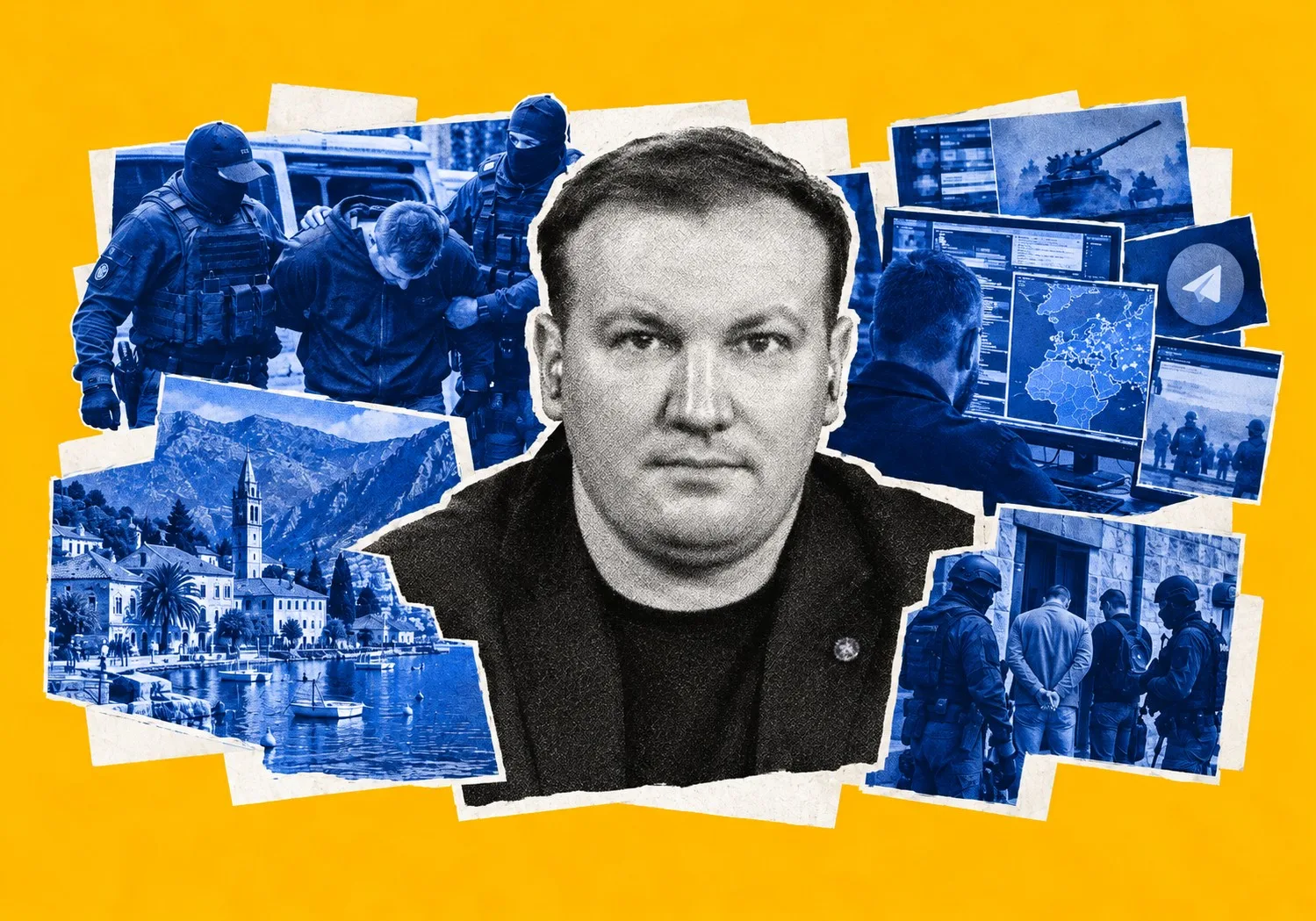
Mikhail Zvinchuk, founder of the Rybar Telegram channel, detained in joint security operation alongside key operatives in Risan as European authorities step up enforcement against Kremlin-backed hybrid cells.
Montenegrin security officers moved in on a house in the coastal town of Risan early on Friday morning, arresting Mikhail Zvinchuk, the head of the pro-war Russian media enterprise Rybar.
His wife, Valerija Zvinchuk, was detained in the same raid alongside several other persons working for the network, according to Montenegrin media .
 The joint operation by Montenegro’s Police Directorate and the National Security Agency (ANB) marks the end of a long period during which Zvinchuk operated with near-total impunity across the Western Balkans. Prosecutors in Podgorica have opened a formal national security investigation, with specific charges expected in the coming days.
Friday’s arrests in Risan show how quickly the ground is shifting beneath Russia’s hybrid networks in Europe. For years, European governments treated entities like Rybar as mere propaganda platforms—irritants to be monitored or put under diplomatic sanctions. Now, police and counter-intelligence services are treating them as physical operational cells and actively making arrests on NATO territory.
From Telegram Posts to Target Scouting in Prague
The raid in Montenegro is the latest step in a wider European effort to dismantle Rybar’s physical network.
The pressure began building earlier this year in London. On 13 July 2026, the Foreign, Commonwealth & Development Office added ten individuals tied to Rybar to its sanctions list, specifically citing their role in foreign information manipulation and state interference.
Two months later, the network's activities spilled over into physical surveillance inside the European Union.
On 21 September 2026, Czech police in Prague spotted two men secretly filming sensitive infrastructure sites across the capital. When officers moved in, they detained Vitaly Chashchuhin—a Russian citizen living in Germany—and camera operator Igor Dolmatov.
Under police questioning, both men produced press passes issued by Izvestia, a sanctioned Russian newspaper, and claimed to be working on a standard news feature.
It was a cover story that fell apart almost immediately. Undercover footage recorded during the investigation captured Chashchuhin admitting that the team had been sent to Prague to film a secret video series commissioned directly by Rybar. Czech authorities served both men with deportation orders on 22 September, giving them 72 hours to clear out of the country.
By the time Montenegrin officers breached the property in Risan on 9 October, police services across the continent were already piecing together the true scale of Rybar’s transition from digital propaganda to physical target scouting.
How Prigozhin’s Cash Built a Kremlin Cut-Out
To understand how Zvinchuk ended up in a Montenegrin holding cell, you have to look at how Rybar grew from a niche blogging project into a multi-million-dollar state cutout.
Zvinchuk, a former press officer inside the Russian Ministry of Defence, launched Rybar in 2018 alongside co-founder Denis Shchukin. At first, it operated as an anonymous Telegram channel focused on military commentary and Middle Eastern proxy conflicts.
Everything changed with the full-scale invasion of Ukraine in February 2022. As demand for battlefield mapping exploded, Rybar scaled up rapidly, eventually running more than 250 regional channels in 28 languages.
That kind of expansion requires serious capital.
US State Department filings and investigative reports confirm that Rybar’s early growth was bankrolled by Yevgeny Prigozhin, the late founder of the Wagner mercenary group. Prigozhin’s money allowed Zvinchuk to build a large digital newsroom, hire specialized graphic designers, and pay field contributors.
When Prigozhin’s mutiny failed and his business network was broken up, Rybar did not disappear. Instead, it was swallowed whole by the state.
British and American intelligence assessments show that funding for the network was taken over by Rostec, Russia’s state-owned defence conglomerate headed by Sergey Chemezov. From that point on, Rybar stopped operating as an independent media outlet altogether. Its overall strategy was coordinated directly out of the Russian Presidential Administration, while its field operations were run in close cooperation with officers from the GRU military intelligence and the SVR foreign intelligence service.
Zvinchuk did not just run a digital network out of Moscow. He set up physical hubs—which he called "media schools"—in places like Serbia, Bosnia and Herzegovina, and Kyrgyzstan. He also recruited people holding legal residency in the European Union, such as Chashchuhin in Germany, turning them into field operatives who could move across borders without raising suspicion.
A Safe Haven on the Adriatic Turns Cold
Selecting Montenegro as an operational base was a deliberate choice that ultimately backfired.
Ever since Montenegro joined NATO in 2017—overcoming a fierce Russian pressure campaign and a failed coup attempt linked to GRU officers—the small Adriatic country has been a priority target for Kremlin influence campaigns.
By setting up a presence in quiet coastal towns like Risan, Russian operatives thought they could slip under the radar. They calculated that a combination of local political tensions, lax oversight, and heavy Russian tourism would give them a safe place to live, manage money, and run field operations right on NATO’s southern doorstep.
That calculation proved wrong.
The joint action by Montenegrin police and the ANB points to tight intelligence sharing with Western allies. For counter-intelligence agencies, catching Zvinchuk in person is a major break.
When you arrest a digital editor in Moscow, you get a story. When you arrest him in a NATO country, you get his encrypted phones, his laptops, his travel logs, and his local contact books.
Investigators in Podgorica now have a chance to map out the entire financial pipeline running from Rostec through the Balkans, as well as the names of local fixers who helped hide Rybar's operatives on the coast.
The Legal Net Closes In
Zvinchuk’s legal problems go far beyond Montenegro’s criminal code.
The European Union put him under personal sanctions in June 2023, citing his management of Rybar and his seat on Vladimir Putin’s official war coordination group.
In Washington, the State Department’s Rewards for Justice programme still holds an active $10m (£7.6m) bounty for information on Rybar operatives involved in foreign election interference and state-sponsored cyber operations.
Whether Zvinchuk is prosecuted inside Montenegro on espionage charges or faces extradition requests from foreign courts, his career as a mobile operative for Russian intelligence is over.
Back in Risan, police searches are wrapping up, and prosecutors in Podgorica are reviewing the seized material. The story that began with slick Telegram maps of the Ukrainian front line has ended in a quiet Balkan courtroom—and exposed the fragile reality of Russia’s shadow intelligence infrastructure in Europe.
Sources: Vijesti,Pobjeda, Radio Liberty/ Radio Free Europe, US Department of State